
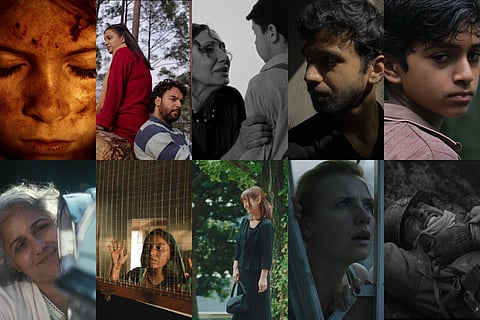
Bengaluru International Short Film Festival’s 16th edition raises the bar with global themes, a new dance-focused category

Films are the love language that millions of people around the world understand . Often for ming their own dialect of these languages, directors have always broken and reinvented the rules of storytelling. And more often than not, every big filmmaker at some point in their life has dabbled with short films during their career. These projects offer specific visions that filmmakers possess and highlight the larger possibility of their narrative’s scope. Bengaluru International Short Film Festival (BISFF) has upheld this passion for 15 editions, and now, with the Oscar-accredited short film festival's 16th edition rolled out, it has definitely become an integral part of the city’s cultural circuit. With new additions in categories this year like the Dancing Lens and international and national standout titles like La Ligne De Vie (The Lifeline), Close Your Eyes Hind, Small Clouds, Aasmani and many others promising stellar screenings; master classes and more — BISFF prepares itself to make this year all the more engaging. We rope in festival founder/artistic director Anand Varadaraj to discuss what we can expect from this year’s edition of the festival.
Bengaluru International Short Film Festival founder Anand Varadaraj discusses what’s in store for the this edition…
You’ve received a record 3,300+ submissions from over 100 countries this year; that’s a staggering amount of cinema to filter through! What was the curation process like this year and did you notice any surprising global themes or recurring patterns in what storytellers are creating right now?
What stood out to us most this year was the sheer quality of the films. BISFF has always attracted exceptional submissions but this edition felt different. The overall standard was remarkably high and it made the curation one of the most challenging we’ve experienced. We often returned to the same films, watched them again, discussed them at length and re-evaluated our choices. It wasn’t about finding good films; it was about choosing among so many deserving ones. We wanted every filmmaker to receive a fair, thoughtful evaluation and for the final selection to reflect the strongest work we received this year. In terms of themes, it’s always fascinating to see how filmmakers from completely different parts of the world respond to similar realities. Without any coordination, many were exploring the same concerns through very different stories. We noticed several films dealing with war and its lasting impact, stories seen through the eyes of children and narratives that questioned crime, justice and morality. While each film was rooted in its own culture and context — those shared themes kept emerging, reminding us how universal many of today’s concerns have become
The Dancing Lens category is among the few new section you’ve added this year and it sounds like a visual treat. What drove the decision to highlight dance/movement in the film specifically
Cinema has always found new ways to tell stories and dance is one of the most instinctive forms of expression we have. With Dancing Lens, we wanted to create a space for films where movement isn’t simply choreography or performance, but the story itself. What’s fascinating is that these films communicate across cultures without relying heavily on language. A gesture, a pause or even the way a body occupies a space can reveal emotion with incredible honesty. In a short film, where every frame matters, movement becomes an especially powerful storytelling tool. It invites audiences to feel the narrative rather than follow it. For us, this section is about recognising that storytelling isn’t confined to words. Sometimes the most profound stories are the ones that are experienced rather than spoken.
What is the single biggest pitfall you see emerging short filmmakers fall into when trying to compress a big idea into a tight runtime?
A major pitfall faced by filmmakers is when they try to over-complicate a plot, storyline, themes, etc, in a short film. When the narrative takes too much of the space, the film ends up failing to deliver what it initially meant to achieve. The most successful short films embrace clarity and restraint, focusing on a single idea, emotion or narrative rather than trying to fit everything that a feature-length movie contains.
If you could only preserve one short film from the history of global cinema for future generations to watch, which one would you pick and why?
If I had to choose one, it would be Murder at Monkey Hill (1976) by Vidhu Vinod Chopra. What makes it even more remarkable is that it was made as his student film at FTII. Every time I revisit it, I’m amazed by how ambitious and assured it is. The use of a twocamera setup, the inventive camera angles and the way it builds a compelling crime narrative in just 25 minutes demonstrate an extraordinary understanding of cinematic language. It’s a reminder that great filmmaking isn’t defined by the scale of production or the length of the film but by the strength of vision.
The online festival is on till August 14. Catch the on-ground festival from August 14 to 16.
Mail id: pranav.shriram@newindianexpress.com