
- LIFESTYLE
- FASHION
- FOOD
- ENTERTAINMENT
- EVENTS
- CULTURE
- VIDEOS
- WEB STORIES
- SPORTS
- GADGETS
- CAR & BIKE
- TRAVEL
- SOCIETY
- GALLERIES
- NORTH EAST
- INDULGE CONNECT

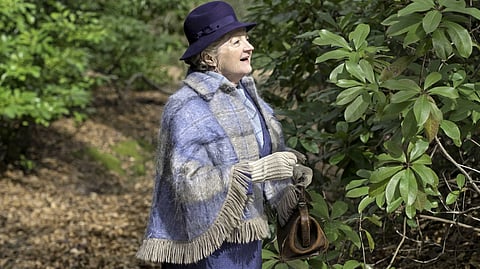
In December 1927, readers of The Sketch magazine were introduced to an unusual addition to detective fiction. She did not carry a magnifying glass, smoke a pipe, or possess a theatrically large egg-shaped head, like a certain moustachioed French sleuth. Instead, she sat in her drawing room, wrapped in a fluffy pink shawl, softly clicking her knitting needles together. Her name was Jane Marple.
Agatha Christie built her world of literary detectives around misdirection, which makes it fitting that one of her most ingenious creations would be a village spinster with a cat whose unassuming nature concealed an extraordinary understanding of human nature.
Miss Jane Marple lived alone with her cat, she knitted, gardened, socialised and took a keen interest in gossip in the sleepy English village of St Mary Mead. She approached a crime scene like a curious neighbour, asking nosy questions and observing everything around her. To the police, she hardly looked like a threat. What could an old lady like her know about crime?
But beneath her lace bonnets, Marple possessed a razor-sharp mind, just as dangerously analytical as any seasoned Scotland Yard investigator.
Behind that deceptively gentle figure was someone Christie knew intimately: her grandmother.
Christie acknowledged several times that Miss Marple was partly inspired by her maternal grandmother and her grandmother’s friends. The resemblance was not meant to be a literal portrait. Christie herself noted that Miss Marple was more fussy and spinsterish than her grandmother ever was.
But the essential idea came from the older women Christie had observed while growing up, women who, despite leading seemingly sheltered lives, possessed a surprisingly sophisticated understanding of human behaviour.
Miss Marple remarkably spans two distinct eras, embodying both Victorian sensibilities upon her 1927 debut and the realities of the post-WWII generation by the 1970s. She lived through emergence of modern society, and though she harbors nostalgia for bygone days, she never rejects progress and is not a reactionary.
Where others saw gossip, Ms Marple saw clues
Miss Marple did not solve murders because she had spent years studying criminology. However, she had spent years studying people. Her greatest weapon was precisely the thing other characters dismissed: her knowledge of village life.
Christie grew up surrounded by the rhythms of Victorian and Edwardian social life, where women were largely easily underestimated. To understand Jane Marple, one must look directly at Agatha Christie’s own upbringing, specifically her step-grandmother, Margaret Miller, affectionately known as "Auntie-Grannie".
A woman who spent her days at home, visiting neighbours, tending to her garden or exchanging gossip might appear to have little connection with the serious business of the world. Christie turned that assumption upside down.
Miss Marple's greatest weapon was precisely the thing other characters dismissed: her knowledge of village life.
The foundational psychological trait that defined Miss Marple’s genius was borrowed entirely from her grandmother’s quiet observation of human nature. As Christie recalled in her dictations and autobiography, her grandmother possessed an uncanny, almost eerie gift: she invariably expected the absolute worst of everyone and everything.
"There was no image of villainy that my grandmother could not believe," Christie once reflected. "She did not expect people to be bad—she simply knew that human nature was frail, deceptive, and prone to terrible errors."
Her first appearance came not in a novel but in the short story The Tuesday Night Club, written in 1927. The story introduced readers to a white-haired lady whose apparently harmless manner concealed a remarkably analytical mind. The character subsequently appeared in a series of stories, before making her full-length novel debut in The Murder at the Vicarage in 1930.
Up to that point, Golden Age detective fiction was dominated by quirky, brilliant men, world-weary detectives, aristocratic sleuths, or foreign geniuses like Poirot. A spinster whose primary laboratory was an English garden would naturally be laughed off. Miss Marple turned that assumption into her greatest advantage; society's ageism was her ultimate disguise.
Why Marple worked
Miss Marple's age was not an obstacle to her investigations; it was part of her advantage.
People talked around her, they confessed things; they ignored her and were often quite careless. Christie recognised a form of intelligence that society routinely undervalued. Sometimes, Miss Marple didn't need to see a crime to solve it. In 4.50 from Paddington, a fleeting glimpse from a train becomes the starting point for a murder investigation, because Marple understands that even the smallest observation can contain the answer.
In The Murder at the Vicarage, when Colonel Protheroe is murdered, Marple draws on her knowledge of the people around St Mary Mead rather than conventional detective methods.
Her crucial insight is essentially that human behaviour repeats itself. She compares people in the murder investigation to people she has encountered in village life, adulterers, liars, jealous neighbours, hypocrites and people capable of violence.
That is what makes her method so unusual: she treats a murder as an extreme version of ordinary human behaviour.
A legacy that refuses to age
While Hercule Poirot eventually grew to annoy his creator, Christie famously referred to him as an "insufferable little pompous creature" her affection for Miss Marple never waned.
Over twelve novels and twenty short stories, Jane Marple evolved from a slightly sharp-tongued village gossip into a warmer, deeper figure of quiet justice.
In Nemesis, the final Marple story to be written, she finally concedes that ‘you know, I could be ruthless . . .’ By now, Miss Marple has gained a reputation as someone who can remedy the ‘wickedness’ that she sees in everyday life.
Christie’s grandmother taught her that human nature is fundamentally flawed; in turning that lesson into fiction, Agatha Christie gave literature one of its most enduring, beloved, and deceptively lethal protectors.
In 2008, more than 13 hours of audio tapes recorded by Agatha Christie were discovered by her grandson in an old cardboard box when he was cleaning out the family home. Biographer Laura Thompson said listening to Christie's voice is like eavesdropping on an England that no longer exists.
The tapes were dictated on a reel-to-reel recorder that was abandoned in the same box with the 27 reels of tape. Among the recordings of Christie's voice are a BBC interview from 1955 and a 1974 recording in which she recalled her experience in a World War I dispensary, where she gained a working knowledge of poisons.
It was in these tapes, Christie cleared the air on the birth of Miss Marple. She said Miss Marple is not "based" on her grandmother, but admits there are similarities: ‘She had this in common with my grandmother that, although a completely cheerful person, she always expected the worst of anyone and everything and, with almost frightening accuracy, was usually proved right.’
Being in the right place means nothing if you lack the context to understand what you are seeing. Marple captures the truth of a moment because her decades of studying human frailties allow her to link a minor gesture today to a pattern she recognised forty years prior.
As she writes in 1929 in her short story ‘The Man from the Sea’, ‘You as you may not matter to anyone in the world, but you as a person in a particular place may matter unimaginably.’
For more updates, join/follow our WhatsApp, Telegram and YouTube channels.