
- LIFESTYLE
- FASHION
- FOOD
- ENTERTAINMENT
- EVENTS
- CULTURE
- VIDEOS
- WEB STORIES
- SPORTS
- GADGETS
- CAR & BIKE
- TRAVEL
- SOCIETY
- GALLERIES
- NORTH EAST
- INDULGE CONNECT

For generations, Ajrakh has been understood through repetition. The Kachchh textile tradition depends on inherited knowledge: carved wooden blocks, natural dyes, painstaking layers and patterns refined across families and centuries. In Looking Back. Looking Forward., at 47-A in Khotachi Wadi, Khalid Amin Khatri is interested in what happens when that inheritance becomes a starting point rather than a set of instructions.
Khatri, who learned Ajrakh from his father and maternal grandfather before he was twelve, spent part of his youth in Mumbai. The city altered his way of seeing. He remembers its buildings, crowds, movement and walls layered with years of paint. When he returned to Ajrakhpur, those impressions followed him home.
“I wasn't trying to make pictures of Bombay,” he says. “I was interested in what the city had done to the way I saw things.”
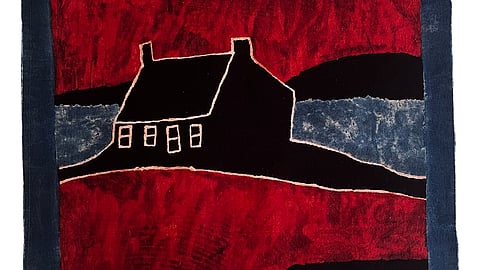
That shift eventually changed his relationship with the cloth itself. Instead of relying exclusively on blocks, Khatri began painting with brushes and his hands, using natural dyes to build, erase and overprint. Found objects enter the process alongside traditional tools. The resulting works draw from architecture, landscapes, memory and human settlements, often allowing the material to determine where a piece goes next.
“When I first started working with Ajrakh, I felt I was expected to make it in a particular way,” Khatri says. “But I wasn't enjoying the repetition.”
The exhibition is the first solo presentation of his work, bringing together sixteen years of practice. It is also the latest project from Sanchari, founded by researcher Satish Reddy in 2020 to question the familiar division between those who conceive artistic ideas and those who are expected to execute them.
“I don't think Khalid has moved from being a craftsman to becoming an artist,” Reddy says. “He was an artist all along. What has changed is that he has been given more space to work from his own ideas.”
That distinction matters. The language around craft often places artisans inside a history, while reserving authorship for the designer or artist who arrives later. Sanchari’s approach has been to introduce references and conversations, then allow the maker to decide what has meaning.
When Kirit Dave introduced Khatri to Jan Kath’s Erased works, Khatri’s response was immediate: “Yes, that's me.” He spent months working through the idea of erasure and what it might mean within his own practice.
The resulting exhibition gives Khatri room to treat Ajrakh as a living material, shaped by memory, instinct and experience as much as inherited technique. In doing so, it shifts the conversation around craft towards the person behind the making, and towards what becomes possible when tradition leaves room for an individual voice.
Date: Till September 13, 2026
Time: 11 am – 7 pm (except Mondays)
Venue: 47 A, Khotachiwadi, Mumbai
For more updates, join/follow our WhatsApp, Telegram and YouTube channels.