
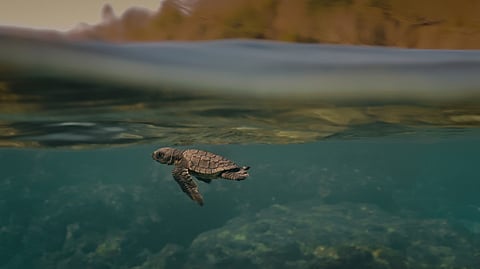
Turtle Walker on Animal Planet: Taira Malaney on documenting Satish Bhaskar’s journey

Conservationist Satish Bhaskar spent decades documenting sea turtle nesting sites along India’s coastline and the Andaman and Nicobar Islands. His work, including long stays on remote islands and his return to the Andamans after the 2004 tsunami, is at the centre of Turtle Walker — an award-winning documentary directed by Taira Malaney. The film, which took nearly nine years to make, follows Satish’s journey and his efforts to protect sea turtles. Now part of Animal Planet’s India: Epic Wild Stories anthology, it brings his story to a wider audience. Taira discusses the challenges of making the film, Satish’s dedication to conservation and what she learnt from his journey
What first drew you to Satish Bhaskar’s story?
I spent a year in the Andaman and Nicobar Islands, learning to dive and working with a marine conservation organisation. I fell in love with the islands and wanted to tell a story about their marine ecosystems. An article by herpetologist Romulus Whitaker introduced me to Satish, whose humility stood out. He cared more about the work, not recognition.
What were the biggest challenges of making the film over nine years?
Funding was difficult. We independently produced the film for the first few years before Tiger Baby and HHMI Tangled Bank Studios joined. Remote, protected nesting sites required permits and since turtles are nocturnal, we shot at night, often amid sandflies and saltwater crocodiles. With no archival footage, we used recreations featuring my friend Rohan Joglekar.
What aspects of Satish’s work and personality stayed with you?
His humility and persistence. Satish had turned down earlier opportunities to tell his story. He spent months, sometimes up to nine at a time, on remote islands, yet felt at ease in nature. His life showed me the impact of quiet commitment without seeking recognition.
How did you portray the personal sacrifices behind his work, particularly his relationship with Brenda Bhaskar?
I wanted to show the personal cost of Satish’s dedication. He would leave for five to nine months without contacting his wife — Brenda — who never knew whether he was safe or even alive. Yet, she spoke of their relationship with warmth and simplicity. Their love brings a human dimension to the film.
How did Satish’s return after the 2004 tsunami shape the film?
His return became a turning point. He wanted to revisit South Reef Island to see whether hawksbill turtles still nested there. In his mid-seventies, living with neuralgia and away from fieldwork for decades, he nevertheless dived in as soon as we arrived. The tsunami had devastated the places he studied; understanding the damage became the film’s central thread.
What did filming teach you about sea turtles and responsible wildlife filmmaking?
I learnt that sea turtles enter a trance-like state when laying eggs. Researchers from the Andaman and Nicobar Islands Environmental Team taught us to wait until a turtle began laying before moving closer, as approaching earlier could frighten her back into the sea. It showed me the importance of understanding animal behaviour and avoiding disturbance.
How did Tiger Baby and HHMI Tangled Bank Studios shape the film?
Emaho Films independently funded the first three and a half to four years. Pitching forums helped us meet partners. Tiger Baby joined when we needed post-production support, followed by HHMI Tangled Bank Studios, which supported postproduction and distribution. These partnerships taught me how to collaborate, fundraise and pitch a documentary.
The film has screened at nearly 80 festivals. How have audiences responded?
It has been heartwarming to see the film connect with people across ages and cultures. It reminded me of character-driven storytelling’s power. Though rooted in the Andaman and Nicobar Islands, Satish’s journey is universal. Audiences do not need prior knowledge of sea turtles or conservation to connect with him.
What does the Animal Planet association mean and what do you hope Indian audiences take away?
Animal Planet’s India: Epic Wild Stories anthology gives the film a wider Indian audience. I hope it sparks curiosity, particularly among young people, about our marine ecosystems. India has a long coastline and incredible island biodiversity, yet much remains unfamiliar.
How has the film changed your relationship with wildlife and conservation?
It has made me think more deeply about local communities’ role in conservation and research. Their contribution to understanding and protecting natural ecosystems must be recognised. Spending time with Satish also left me with new questions. That ongoing learning is one of documentary filmmaking’s most rewarding aspects.
Turtle Walker is streaming on Discovery+
For more updates, join/follow our WhatsApp, Telegram and YouTube channels.