
- LIFESTYLE
- FASHION
- FOOD
- ENTERTAINMENT
- EVENTS
- CULTURE
- VIDEOS
- WEB STORIES
- SPORTS
- GADGETS
- CAR & BIKE
- TRAVEL
- SOCIETY
- GALLERIES
- NORTH EAST
- INDULGE CONNECT

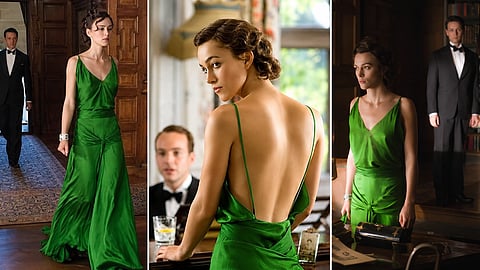
Almost two decades after it became one of cinema's most recognisable costumes, Keira Knightley's emerald-green dress from Atonement is set to find a new owner. The backless silk gown, which became synonymous with the 2007 romantic drama, will go under the hammer at Christie's in London on December 9, with an estimated price of £120,000 (approximately $161,000).
Designed by Jacqueline Durran, the dress will feature in Christie's Love & Lust: A Literary Guide auction. Knightley's green dress that carries a particularly enduring place in popular culture. In Joe Wright's adaptation of Ian McEwan's novel, Knightley plays Cecilia Tallis, who wears the gown during an emotionally charged library encounter with Robbie Turner (James McAvoy).
As the two characters finally give in to their feelings for each other, the dress becomes part of one of the film's most memorable sequences.
Costume designer Jacqueline Durran engineered Keira Knightley’s backless gown to do heavy emotional lifting. Director Joe Wright specifically requested an intense emerald shade to visually channel dangerous temptation, sexual tension, and destructive passion during the library scene.
That vibrant green also acts as a visual trigger for young Briony’s (Saoirse Ronan) blinding jealousy and fatal misunderstanding.
The brief called for a dress with movement at the hem and a low back, drawing inspiration from the fashion of the 1930s.
The making of an iconic dress
Durran and her team spent considerable time developing the look, eventually settling on a flowing silk slip with thin straps, a daring open back and a thigh-high slit. The exact shade of green was equally important. Rather than choosing a single fabric, Durran layered three different materials to arrive at the desired colour before commissioning an expert dyer to reproduce its intensity in silk.
The result was a striking emerald-green gown that stood out against the film's otherwise muted period palette. Yet, Durran has previously admitted that neither she nor Wright expected the outfit to resonate so strongly with audiences. In an interview, she recalled being surprised by how much the dress was singled out as the film's defining look. Interestingly, it was not even Wright's favourite costume from Atonement. That distinction went to the cream organza dress worn by a young Saoirse Ronan as Briony Tallis.
Why the Atonement dress remains significant
Few film costumes manage to transcend the stories they belong to. The green dress, however, has spent nearly 20 years doing precisely that.
For one, it is closely tied to the film's emotional turning point. The colour, too, has often been associated with passion, desire and forbidden love, making it a perfect choice for a romance shaped by secrecy and tragedy.
Its appeal also lies in the way it balances period dressing with contemporary fashion. Although rooted in the film's 1930s setting, Durran introduced elements that gave the silhouette a modern sensibility. The result was a costume that felt appropriate to the period without looking dated to contemporary audiences.
More importantly, the dress has continued to influence fashion long after the film's release. In 2024, London-based designer Nensi Dojaka reimagined the iconic silhouette for model and television host Alexa Chung, who wore the creation to the Serpentine Summer Party in London. Other red-carpet looks have also drawn comparisons with Knightley's memorable gown.
Part of the dress's lasting appeal is that it is more than an attractive piece of period costume. It is a visual shorthand for an entire film, a defining moment in a love story and an example of how clothing can become inseparable from cinematic storytelling.
Following the film's release, the dress was taken from the production archive and sold at a charity auction in 2008. It has since remained in a private collection in the US.
While it is “difficult to predict” who might bid for the gown, the spokesperson expects it to attract individual collectors with a particular interest in Atonement, as well as enthusiasts of film and costume history. Museums and cultural institutions may also be interested in acquiring the dress, given its significance in popular culture.
For more updates, join/follow our WhatsApp, Telegram and YouTube channels.