
- LIFESTYLE
- FASHION
- FOOD
- ENTERTAINMENT
- EVENTS
- CULTURE
- VIDEOS
- WEB STORIES
- SPORTS
- GADGETS
- CAR & BIKE
- TRAVEL
- SOCIETY
- GALLERIES
- NORTH EAST
- INDULGE CONNECT

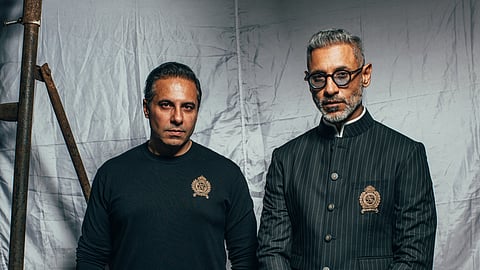
An invitation once came with a postmark, not as a notification that briefly lit up your phone, but as something that lit up your mood and your whole week, and the party began the moment it landed on your doorstep. There was handwriting to recognise, an envelope to open and a guest list to wonder over, and between all that wondering sat the real question of what to wear. That anticipation is where Aamantran, the Festive ‘26 line from S&N by Shantnu & Nikhil, begins. Twenty-five years into dressing people for life’s grand celebrations, the Delhi-based brothers Shantnu and Nikhil Mehra have turned the card itself into a design archive. Ornamental borders, seals and crest motifs surface as prints and zari embroidery across bandhgalas, waistcoats, kurtas, kaftans and sari gowns in navy, black, rust and emerald.
Their belief runs deeper than any one occasion, though. Belonging, they say, “has never meant conforming,” and a good outfit needs no grand reason. Here, the two talk about the ritual of being invited.
Your starting point for Aamantran is the ritual of receiving an invitation. What interested you about that ritual beyond its nostalgia?
Nikhil: It was the anticipation that fascinated us. An invitation once had a certain ceremony to it. You recognised the handwriting, opened the envelope, read the names and immediately began imagining what lay ahead. Who would be there? What would the evening look like? And, inevitably, what would you wear?
Aamantran began with that feeling of looking forward to something. We took inspiration from the physical invitation, its typography, detailing and decorative elements, but the larger idea was to celebrate the excitement of having somewhere to go. After all, we’ve always believed in having a reason to dress up.
An invitation is also a kind of social permission. It tells you that you belong in a particular room, at a particular table, among particular people. Did that idea of belonging inform the way you approached this collection?
Shantnu: An invitation brings people together, but it doesn’t mean everyone has to arrive looking the same.
That’s something we’ve always found interesting about celebrations. You have different generations, personalities and approaches to dressing in one room. Some gravitate towards classic tailoring, others towards colour, print or something more experimental.
We wanted the collection to accommodate that variety. The idea of belonging, for us, has never meant conforming.
There is an interesting contradiction in the collection: the invitation is a private, intimate object, but what follows is often a very public performance of dressing up. How did you translate the invitation into the clothes?
Nikhil: We approached the invitation almost as a visual archive. Its ornamental borders, decorative typography, seals and graphic details offered an interesting starting point.
You see those references translated into prints, embroidery and embellishments, alongside a palette that moves from understated neutrals to richer celebratory colours.
The silhouettes, however, remain very much our own: sharply tailored jackets, expressive waistcoats, asymmetric drapes and sari gowns. We wanted the inspiration to be recognisable in the details without becoming literal in the clothes.
In your sari gowns, the sari’s visual language stays but its construction changes. What does that reimagining bring to the silhouette?
Nikhil: For us, it’s about bringing a contemporary sense of fluidity and glamour to the silhouette. We explore asymmetric drapes, sculpted waists and defined forms that celebrate femininity with a certain boldness.
The idea is to create something sensual, expressive and glamorous, where the movement of the drape meets the sharpness of contemporary construction.
A waistcoat is usually treated as a supporting layer, something that completes a suit. In Aamantran, printed and embellished waistcoats can carry the entire look. What happens to menswear when the layer that was supposed to be secondary becomes the most expressive part of the outfit?
Shantnu: We enjoy challenging the hierarchy of menswear. Why should the jacket always be the most important piece?
A waistcoat offers an interesting canvas because it sits close to the body and can completely change the proportion of an outfit. With Aamantran, prints and embellishments give it enough character to stand independently.
It also makes dressing more versatile. You can wear it with a kurta, a shirt or as part of a layered ensemble. The same piece can take on an entirely different personality depending on how it’s worn.
A jacket is built around control: the shoulder, the lapel, the line of the torso. How do you bring expression to classic tailoring without losing that discipline?
Nikhil: For us, a sharply tailored jacket is one of the most versatile pieces in a wardrobe. It’s about creating a strong, well-defined silhouette that can transition effortlessly between different occasions.
With Aamantran, we’ve explored that versatility through contemporary cuts and embellished accents, bringing a more expressive character to classic tailoring without compromising its sharpness.
The collection moves between sharply structured bandhgalas and jackets, fluid sari gowns, kaftans and asymmetric drapes. Are these different expressions of the same design philosophy, and where did the experimentation lie?
Shantnu: Structure and fluidity have always been central to our aesthetic. It’s what gives our silhouettes their distinct character, whether it’s the sharp tailoring of a Bandhgala or the glamour of a draped gown.
With Aamantran, we’ve brought these elements together through a mix of structured jackets, expressive kaftans and contemporary sari gowns. The experimentation has been in giving familiar silhouettes a fresh perspective through proportion, detailing and styling, while keeping them versatile and relevant to how people dress today.
What do you want a woman to feel in these silhouettes, and how has that changed over the years?
Shantnu: For us, it’s always about how a woman feels in what she’s wearing. The fit, the movement and the silhouette all contribute to that.
Over the years, we’ve seen women become far more experimental with their choices. They want glamour, they enjoy sensuality, and they’re not afraid of making a statement. Our approach has evolved with that, creating silhouettes that celebrate femininity with confidence and a modern attitude.
When a garment is photographed, the eye often goes straight to its most dramatic feature: the embroidery, the drape, the shine. What is the detail a photograph cannot adequately communicate, but that you would want someone to notice when they encounter the piece in person?
Nikhil: The fit, without question. A photograph can make an embellished jacket look spectacular, but it cannot tell you how comfortably it sits on the shoulders or how naturally it moves.
We pay a great deal of attention to those details because people don’t experience clothes standing perfectly still. They sit, walk, dance and spend entire evenings in them. That’s when you really discover whether a garment works.
What is something you used to believe about occasionwear, or about what makes a garment beautiful, that you no longer believe?
Shantnu: That the scale of an occasion should determine how much effort you put into dressing for it. We’ve spent twenty-five years dressing people for extraordinary celebrations, but we’ve also come to appreciate the pleasure of dressing up without a grand reason.
A beautifully tailored Bandhgala can be worn to dinner. An embellished jacket can transform an otherwise simple look. A statement shirt can be enough. We’re interested in making these pieces part of people’s lives rather than having them spend most of their time waiting in a wardrobe.
There is a lot of design intelligence in making something look effortless. A drape must fall in a particular way; a structured shoulder has to sit just right; a heavily embellished garment still has to move with the wearer. Which piece in Aamantran best illustrates the work hidden behind that apparent ease?
Nikhil: It’s difficult to choose one because the challenges are so different. With a kurta, the cut has to feel relaxed without losing its shape. A Bandhgala demands greater precision, particularly through the shoulders and torso. And with a sari gown, the drape has to appear natural even though its placement is carefully considered. What connects them is the attention to proportion. You can have beautiful embroidery or an interesting print, but if the garment doesn’t sit correctly on the body, none of it has the same impact.
Is there a piece in this collection that you consider a particularly accurate expression of where Shantnu & Nikhil are creatively right now?
Shantnu: The Bandhgala is a particularly interesting example because our relationship with it has changed over the years.
Earlier, the focus was largely on establishing its identity through strong tailoring and distinctive detailing. Today, we’re exploring how much further it can go through proportion, surface treatment and styling. We see it as an alternative to the conventional suit, rather than a garment defined by a particular celebration. That change in perspective opens up far more possibilities for how we design it.
If someone wore a piece from Aamantran ten years from now, what would you want them to recognise in it: a particular moment in fashion, a technical achievement, or an idea about dressing that still holds up?
Nikhil: We’d want them to recognise the strength of the design rather than the season it came from.A well-cut jacket, an interesting waistcoat or a beautifully proportioned draped gown shouldn’t lose its appeal because fashion has moved on.In fact, we’d be delighted if someone wore an Aamantran piece ten years later in a way we hadn’t originally imagined. Clothes become much more interesting when people make them part of their own stories.
Rapid fire
A fashion rule you would happily break for the rest of your life?
Shantnu: That the occasion should dictate the outfit.
One occasion that deserves a spectacular outfit but rarely gets one?
Nikhil: A long lunch with your favourite people. Especially one that turns into an evening out.
A garment that looks better with age?
Shantnu: A beautifully tailored bandhgala. The more you wear it, the more it becomes yours.
The difference between being well-dressed and being stylish, in one sentence?
Nikhil: Being well-dressed is about putting together a good outfit; style is what makes it memorable.
Rs 16,500 onwards. Available online.
For more updates, join/follow our WhatsApp, Telegram and YouTube channels.