
Anavila Misra brings childhood memories into contemporary living

For Anavila Misra, the designer behind the artisanal label Anavila, home has always been an intrinsic part of her world, finding expression over the years through its textiles, objects and the everyday details that have shaped the brand’s creative language. Her idea of home is rooted in the memories of Hashupur, her village.
Anavila Misra on the meaning of home and a sense of belonging
With Anavila Home, the designer brings these memories into a collection of textiles and objects for contemporary living. In this conversation, she reflects on childhood influences, and the journey from dressing the body to creating spaces that feel personal, familiar and lived in.
What does home mean to you today, and how has that idea evolved over the years?
Home, for me, is a space of belonging and comfort, a place that also makes you dream and imagine. It is that feeling of being at ease, like water that is pure, clear, and undisturbed. As a child, home was very much rooted in Hashupur and the aangan of my village. Today, I see home as something more expansive. It is the comfort of returning to what is familiar, but also the freedom to dream, imagine and be entirely yourself. It can travel with you, from a village to a city, from one country to another and still somehow bring you back to yourself.
Why was Hashupur the starting point for the first Anavila Home collection?
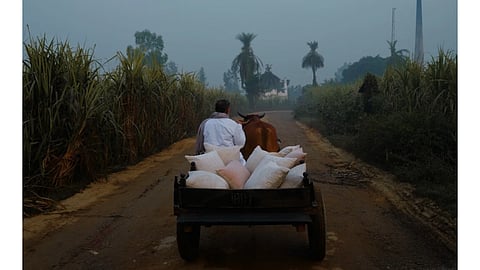
Hashupur is where my first idea of home comes from. It is the landscape that shaped my childhood, the potato and sugarcane fields, the neem tree, the morning mist, dew on leaves, the sound of the tube well they’ve all seen my becoming. So when I began thinking about Anavila Home, Hashupur felt like the most natural place to begin. The collection is a homage to that landscape and to the memories that have stayed with me and shaped me.
You describe the aangan as your first idea of home. What memories of that space continue to influence your work?
The aangan was a space where the boundaries between family and nature simply did not exist. A tree could become a room and a khaat could become a world. There was a deep sense of safety and belonging, but it was never a closed or inward-looking space. I think that sense of being deeply rooted is what gives you the freedom to look outward, to follow the horizon, absorb what you encounter and bring those experiences back with you. That combination of rootedness and curiosity continues to influence the way I think about home and the things I create for it.
How did the landscape of your village translate into the colours and textures of this collection?
The colours come directly from the landscape I remember—off-white, sand and bark brown as the prominent colours scattered around us. The textures derived from the ploughed fields, interlaces khaat, tree barks comes through in the details like running stitches, quilting, raw edges and motifs inspired by the wilderness around me as a child. I wanted the collection to carry something of the earthiness and simplicity of that landscape.
What was it like bringing memories of your childhood into objects and textiles for the home?
It feels like coming full circle. These memories have actually been present in my work for a long time, in little glimpses and fragments, from the busa dolls I created to our Jardin throw and appliqué wall art. With Anavila Home, I was able to let those fragments come together more consciously. There is something very joyful about returning to the places that shaped you and seeing how those memories can become objects that live in someone else’s home.
The collection uses linen, kala cotton, khadi, cotton and velvet. How did you choose these materials?
All the materials that we have chosen for this collection are natural, be it cotton, linen or khadi. The comfort and ease of these materials coupled with their benefits, is what makes this collection not only close to nature but also extends itself into the wellbeing of the user. You sleep on a bed that’s made-up using linen or cotton your sleep is more restful and restorative. These are daily habits and choices that make for a healthy living and are key drivers of our home collection.
How do embroidery, appliqué, quilting and block printing help tell the story of Hashupur?
They allow the story to come through in fragments rather than as a literal representation of the village. The running stitches, quilting, raw edges, embroidery, appliqué and block prints bring depth and texture to the fabrics and echo the details of the landscape and wilderness I grew up around. In an extended family there is always someone busy doing some mending, hemming, quilting and embroidery around you and as a child it becomes a part of your way of life and a tactile memory. This is what I have tried to capture through the first farmland collection.
How did you approach designing for a home rather than for the body?
When I design for the body, the person wearing the sari is at the centre of it. My aesthetic is never about imposing a particular design or style on the person. It is about creating something that allows them to feel like themselves in it. I approach home in much the same way. I don’t want to stamp a particular aesthetic onto someone’s space. The person living there is at the centre, and my intention is to create pieces that allow them to make the space truly their own.
What did moving from fashion into home reveal to you about your own design language?
The idea of home has always been an important part of my design language, even when I was designing fashion, so moving into home feels less like a departure and more like a return to where I started. Even in fashion, my intention has always been for the woman wearing my clothes to feel at home in them, to feel comfortable, like herself, and connected to what she is wearing. Designing for the home has simply allowed me to explore that idea more directly. It has made me realise that so much of my work has really been about creating a sense of belonging more than to anything else, to onself.
Rs 2,000 onwards. Available online.
—manuvipin@newindianexpress.com
@ManuVipin
For more updates, join/follow our WhatsApp, Telegram and YouTube channels.