
- LIFESTYLE
- FASHION
- FOOD
- ENTERTAINMENT
- EVENTS
- CULTURE
- VIDEOS
- WEB STORIES
- SPORTS
- GADGETS
- CAR & BIKE
- TRAVEL
- SOCIETY
- GALLERIES
- NORTH EAST
- INDULGE CONNECT

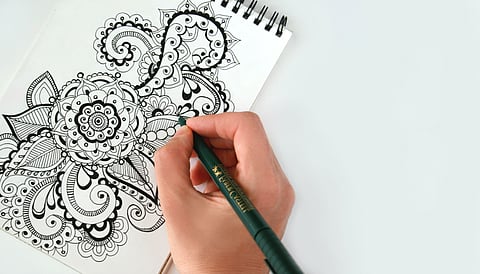
Remember school? The teacher talking, the notebook open, and somewhere in the margin — a spiral, a face, a flower that turned into a pattern, a pattern that turned into something else entirely.
It turns out those aimless marks were never really aimless. When your hand moves in a loose, repetitive rhythm, your brain finds a sweet spot — not fully switched off, not fully stressed, just lightly engaged enough to stay present.
That is why a person doodling through a long meeting often remembers more than the person sitting perfectly still trying hard to concentrate. That same in-between state is where creativity lives. Doodling brings together two parts of the brain that rarely talk to each other in structured work. One part wanders, makes loose associations, and replays memories. The other part evaluates, organises, and decides. When you doodle, both stay on.
You are not trying to draw something good, so there is no fear of getting it wrong. A circle becomes a face, a face becomes a character, a squiggle becomes a layout for a problem you have been stuck on for days. The hand leads, and the mind follows, quietly making connections it would not make if you were staring at a blank screen waiting for a brilliant idea to arrive.
There is a physical calm to it too. The repetitive motion of a pen moving across paper is meditative, almost like breathing. Studies have found that doodling increased blood flow to the frontal cortex and lowered cortisol, the stress hormone, even in people who did not consider themselves artistic. It is not about producing art. It is about giving your nervous system something simple to do while your thoughts settle.
And that is perhaps the most freeing part of doodling — it asks nothing of you. You do not need talent, or expensive supplies, or a plan. A cheap notebook and any pen will do. Ten minutes is enough. Start with what feels easiest, circles, squares, triangles, lines that loop back on themselves. Let colour in if you want to, because colour changes mood, and mood changes what you notice. Try a different style when you get bored, geometric one day, cartoonish the next, abstract the day after. Draw without lifting the pen. Draw how you feel. Draw a random word you picked from a book.
Then, pause and look back. Not to judge, but to notice. The same shapes keep appearing. The same theme keeps returning. A doodle you dismissed in the morning can look like the start of an idea in the evening.We grow up believing creativity is a lightning strike — sudden, rare, reserved for the talented. Doodling suggests it is quieter than that. It is a habit. A way of staying with a thought long enough for it to become something else.
So the next time your pen starts to wander in the margin, let it. You are not wasting time. You are thinking in disguise.
For more updates, join/follow our WhatsApp, Telegram and YouTube channels.