
- LIFESTYLE
- FASHION
- FOOD
- ENTERTAINMENT
- EVENTS
- CULTURE
- VIDEOS
- WEB STORIES
- SPORTS
- GADGETS
- CAR & BIKE
- TRAVEL
- SOCIETY
- GALLERIES
- NORTH EAST
- INDULGE CONNECT

At ten years old, in a school in Izhevsk, Russia, a girl can be handed a brooch shaped like the letter D, told she is now a "noble maiden," and sent home to ask her parents for an eight-thousand-ruble dress. Trousers are not an option. It is 2026. AI is drafting legal briefs, and somewhere a committee is still asking what girls are for.
The Traditional Education of Girls course, called "Traditional Upbringing for Girls, Grades 5 to 9" in Udmurtia, is a set of special classes run inside ordinary schools for girls aged 10 to 16. Its stated aim is to prepare them to be future wives and mothers. It was started in September 2024 in four schools in Izhevsk, the capital of Udmurtia, by Olga Novgorodtseva of the Union of Orthodox Women, and presented to the regional head by the local Orthodox metropolitan. Verstka and Novaya Gazeta Europe now count 22 classes in 13 schools across Udmurtia, Krasnodar Krai and annexed Crimea, with about 400 girls, by the organisers' own tally.
The curriculum is nine extra subjects on top of normal lessons: cooking, floristry, the history of fashion, wedding traditions. Priests teach a course on the "basics of morality" and the girls are taken to church. Every girl wears the same dress and the same brooch, and trousers are banned. Parents pay for all of it, around 7,500 to 8,000 rubles per dress. Novgorodtseva's logic, as reported, is that girls in trousers pick up "masculine behaviour," so daily dresses are there to remind them of their purpose.
In May, two girls fainted while rehearsing an Orthodox song outside Izhevsk's cathedral. One family could not move their daughter back to an ordinary class because there were no places. And, in a detail I keep rereading, a similar programme for teenage boys is reportedly in development.
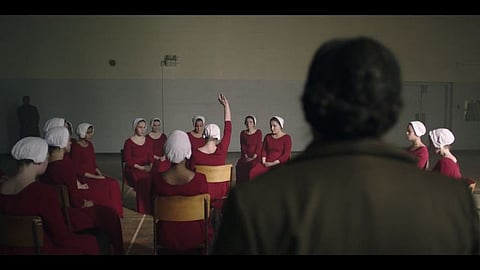
Margaret Atwood’s Gilead in her dystopic novel The Handmaid’s Tale dressed its women in red and teal so you could tell what they were for from across the street. Izhevsk uses navy blue. The principle is the same: make the role visible, then make it normal.
Russia's fertility rate is about 1.4 children per woman, a two-decade low, and the state has been tightening the screws on women's choices to raise it. In late 2024 it banned "child-free propaganda," and the first fine Olga Borisova reports in Eurozine went to a woman in occupied Sevastopol for posting memes. Abortion is still legal, but Human Rights Watch counts more than 200 clinics that have lost or given up their licences since 2023, and 25 regions now punish "incitement to abortion.” Since September 2024, Moscow has also been sending women invitations for hormone tests that indicate egg count. Officials call it reproductive health. Women who got the letters, Borisova writes, called them "a greeting from The Handmaid's Tale."
Anne Hathaway is starring in and producing the film of Caro Claire Burke's novel Yesteryear, for Amazon MGM Studios. Its heroine is a tradwife influencer who wakes up inside a grim 1855 version of her own homestead and learns what her feed leaves out; one outlet summed it up as Ballerina Farm with time travel. I could not find a release date, but the novel is already one of 2026's most talked-about books. Studios do not bid for a trend that is fading.
The real accounts are the original. Hannah Neeleman of Ballerina Farm and Nara Smith pull in millions of followers, but notice the genre never shows a tired woman.
CORRECTIV's Viera Zuborova describes two big groups: Orthodox priests' wives who post recipes and family chronicles, and North Caucasus food bloggers such as Zalina Michieva (3.6 million subscribers), some of whom never show their faces. Most do not use the word ‘tradwife’ at all, and many list business projects in their bios. Russian women were long expected to work; the housewife ideal only took hold in the 1990s. And what the West met on TikTok in 2022, she writes, Russia had already written into law in 2013.
Novaya Gazeta Europe reports a growing stream of foreign bloggers praising Russia's "traditional values," including videos telling Western women that Russian men still do the providing. Some reports say that some of these supposedly independent creators are paid by the state broadcaster RT.
It is not Gilead, and a piece like this should say so. Nobody has been assigned a Commander. The Izhevsk programme is a regional project; a source close to the Education Ministry told Verstka that a mandatory nationwide rollout has not been approved. Mothers say anyone who wanted a place got one, and some schools barely filled their classes. The organisers describe it as moral and cultural upbringing, and some families clearly want exactly that.
The demographic worry is real too: a fertility rate near 1.4 is a genuine problem for any country, and officials say lifting it is a top priority. Supporters of traditional family models argue that choosing home and children is a legitimate choice that feminism should respect, and that critics sneer at it. The Institute for Family Studies, for one, argues that Yesteryear misunderstands the lives of Christian women.
When Lara Trump and Katie Miller claimed that 47 percent of Gen Z women dream of being ‘tradwives’, Reason pointed out that the underlying survey asked about a stable future over riches and fame, and the word ‘tradwife’ never appears in it. Other data points the other way: some reports say that 53 percent of Gen Z women call themselves feminists, and King's College London researchers found that young women are drawn to the aesthetic of simplicity and escape from pressure rather than to male-breadwinner marriages. Over 60 percent of their respondents said both partners should contribute to household income.
So our honest claim is simpler. The evidence for a mass conversion of young women is thin. The evidence for a mass marketing campaign, in feeds, in classrooms and in statute, is not. One March 2026 study even reported that almost a third of Gen Z men think a wife should always listen to her husband. The girls are not the only audience being worked on.
Margaret Atwood has said she put nothing in The Handmaid's Tale that had not already happened somewhere in history. That is the thing to carry out of Izhevsk. Authoritarian projects rarely open with red cloaks. They open with a word like ‘purpose’, and a reasonable-sounding worry about the birth rate. Watch the dress code, it is usually the first thing to change.
For more updates, join/follow our WhatsApp, Telegram and YouTube channels.