
- LIFESTYLE
- FASHION
- FOOD
- ENTERTAINMENT
- EVENTS
- CULTURE
- VIDEOS
- WEB STORIES
- SPORTS
- GADGETS
- CAR & BIKE
- TRAVEL
- SOCIETY
- GALLERIES
- NORTH EAST
- INDULGE CONNECT

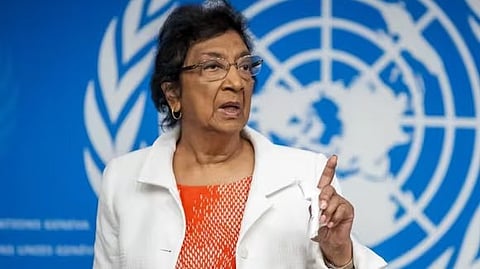
Former UN human rights chief Navanethem “Navi” Pillay, a South African jurist of Indian descent who serves as a judge at the International Court of Justice (ICJ), has been awarded this year’s Nobel Peace Prize. Norwegian Nobel Committee Chair Jorgen Watne Frydnes said the 85-year-old was honoured for her contributions to peace and international law.
Pillay’s career has encompassed the fight against apartheid, landmark legal proceedings involving genocide and sexual violence, and a six-year stint leading the United Nations’ human rights office.
Born in Durban in 1941, Pillay comes from a family of Indian origin. She grew up during South Africa’s apartheid era, when racial discrimination was entrenched in the country’s legal and political systems.
"We grew up very poor. My father was a bus driver, and then seven children, the usual seven children. I tell the story because most people assume that in my country if you are Indian you're better off than the African people. Yes, so all of us were poor and we struggled together," she said in a United Nations interview.
Pillay pursued her higher education at the University of Natal, where she earned a Bachelor of Arts degree in 1963 and a Bachelor of Laws degree in 1965. She later continued her legal studies at Harvard University, obtaining advanced law degrees, including a doctorate in juridical science in 1988.
In 1967, she became the first woman to open a law practice in Natal, now known as KwaZulu-Natal. She subsequently made history as the first Black woman appointed to South Africa’s High Court.
These early milestones laid the groundwork for a career focused on challenging abuses of power and ensuring that the voices and experiences of victims were recognised within the justice system.
A pioneering role in the Rwanda Genocide Trials
Pillay was appointed to the International Criminal Tribunal for Rwanda (ICTR) in 1995. Established by the United Nations, the tribunal was tasked with prosecuting those responsible for the 1994 Rwandan genocide and other serious violations of international humanitarian law.
She went on to serve two terms as the tribunal’s president between 1999 and 2003.
Among the most consequential cases she was involved in was the trial of Jean-Paul Akayesu, the former mayor of Taba, Rwanda. In September 1998, the tribunal found Akayesu guilty of genocide and crimes against humanity in a landmark ruling.
The judgment also marked a turning point in international law by recognising that rape and other forms of sexual violence could constitute acts of genocide when carried out with the intent to destroy a protected group, either entirely or in part.
Through her work at the ICTR, Pillay contributed to the evolution of international legal principles governing genocide, sexual violence and crimes against humanity. The tribunal’s proceedings also reinforced the principle that individuals, including those in positions of public authority, could be held accountable for serious international crimes.
From The Rwanda Tribunal To The International Criminal Court
In 2003, Pillay was elected as a judge of the International Criminal Court (ICC), a permanent judicial institution responsible for prosecuting individuals accused of genocide, crimes against humanity, war crimes and, under specific conditions, the crime of aggression.
Her appointment followed her significant contributions to the Rwanda tribunal, extending her work in international criminal justice.
Pillay’s career also illustrated how experiences gained while confronting discrimination and repression within national legal systems could help shape broader international frameworks for accountability
Leading the United Nations' human rights office
Pillay assumed office as the United Nations High Commissioner for Human Rights in September 2008 after being appointed by the UN General Assembly. She held the position until 2014, heading the Office of the High Commissioner for Human Rights (OHCHR), which is responsible for promoting and protecting human rights worldwide.
The position placed her at the forefront of global discussions on government accountability, discrimination, civil liberties, armed conflicts and the rights of vulnerable populations.
During her tenure, Pillay championed the principle that human rights apply universally. She also stressed the need to safeguard human rights defenders and ensure that serious violations are investigated and addressed.
Although her tenure as High Commissioner concluded in 2014, her contributions to international law and human rights advocacy continued to influence debates surrounding justice and accountability.
The 2026 Nobel Peace Prize recognises Pillay’s contributions to advancing peace and international law.
For more updates, join/follow our WhatsApp, Telegram and YouTube channels.