
- LIFESTYLE
- FASHION
- FOOD
- ENTERTAINMENT
- EVENTS
- CULTURE
- VIDEOS
- WEB STORIES
- SPORTS
- GADGETS
- CAR & BIKE
- TRAVEL
- SOCIETY
- GALLERIES
- NORTH EAST
- INDULGE CONNECT

After a successful inauguration and opening of the Nandan Hall and SSVAD, we spent another day at Santiniketan taking walkthroughs as more venues open for the Bengal Biennale 2026-27
Sculpture Park
A group exhibition of sculptures, the works merge unconventional thinking, revival of old works, tribute to Nature and more. Bimalananda Roy’s ‘Innerscape’ is a living installation which focuses on impermanence and the importance of co-existence. From clay, earth, bamboo, as materials, including burnt wood from cemetery, the idea boils down to how everything is made of Earth and returns to it one day. It is interesting to see how the sculpture as a whole, from a distance resembles a seal-like structure while the motifs include a bull, a dancing feet, a pregnant woman, a boat and more.
Pankaj Panwar’s ‘Monument of Love’ is a revival of his work where he uses a bullet ridden wall used for NCC firing practice and drills holes in them to affix red flowers. The artist even leaves some flowers for the visitors to place in the holes, thereby making it a community installation spotlighting love in times of violence.
Arijit Bhattacharya’s ‘ How to Detain a Forest?’ can best be defined as a performance set complete with light and creative backgrounds. Using techniques like data mapping among others, his works peel layers of a narrative which reiterates how much of the surrounding land was developed from coal mining money and how forests vanished to make way for the mines which in turn was used to develop land- irony much?
The mysterious pink pathway to Suman Chandra’s ‘The Black Well’ calls the audience to be spectators of the entertaining motorsport- The Death Well – where the bikes are replaced by mining cycles and the dangers of rat-hole mining are laid bare. The accompanying sound of live mining recorded by the artist from the depths of an actual mining site add a layer to the sculpture that makes it all the more sensorial. The idea of bringing the audience to a height and making them lower their heads to see the sculpture spotlights layers of fantasy, entertainment, tragic reality, identity, and the politics of death. And while one exits the sculpture through a path rubbed with coal powder, they are still trying to answer whether The Black Well was mocking them or their power mocks the labourers?
Maksud Ali Mondal’s The House of the Last Days makes use of fungi, termites, bacilli, insects, and other organic matter to reiterate that everything beautiful and living ultimately decays into earth. He draws inspiration from Tagore and Ramkinkar Baij’s sculptures to create his own site-specific architectural installations.
Krittika Art Space
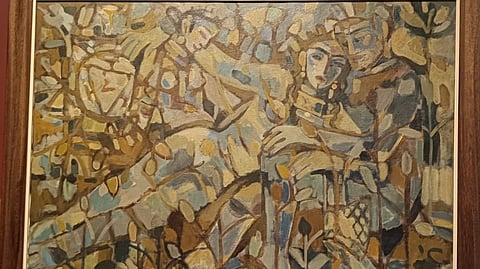
Curated with DAG, the space shows the collections of Nirode Mazumdar through the exhibition titled ‘Toil & Transcendence’. Having lived his life between India and Paris, one can find influences drawn from cubism in his works. Some of his earlier works done in between 1950’s and 60’s have Sanskrit mantras, mythological figures, symbols, and more. Each canvas is a riot of bright colours. His later works, done between 1970- 74 summed up via the Boitorini series focuses more on the arrival of capitalism through ape-like imageries which give way to satire, politics, anger, value-measures and more. Here, one finds the colour palette to have changed to more greys and muted tones of maroons, dark greens and blues.
Tokaroun
Tejal Shah’s works revolve around eco-printing with herbs on gauge. Her works clubbed under the title ‘Forests of Plural Darkness’ revisits eco-sexuality, healing, wounding, and queerness. Her works go deep into wilderness while also highlighting the intricacies of technique.
Xewali Deka’s ‘ If Seeds Could Speak of the Past’ is an unusual yet intriguing interplay of indigenous materials like bamboo, seeds from her own farm in Assam and dokra. Instead of relying on traditional canvas, her community installation looks into the subordination of women. The life-size bamboo traps refer to the traps a woman enters right from birth. While she is restricted in her own house and thinks of achieving freedom after marriage, little does she know that marriage may just change the situation, not the trap. Moreover, while farming is always seen as a male dominated field, the contribution of the women in nurturing the seeds are completely bypassed.
'And the trees sing resistance songs' by Rah Naqvi, points towards the wounds caused by ongoing genocide. Through wood sculptures, paintings, and textiles Rah tries to discover how to sustain oneself in a community that is trying to not only suppress but also erase women, minority and queer communities and yet, how should one have faith to rebuild this trust and co-exist.
‘ Revisit’ by Britto Arts Trust is an image and video installation which was built over a decade focusing on the indigenous communities across India and how socio-political power systems change indigenous ways of living and memories of co-existence.
Somnath Hore Studios
Master printmaker Somnath Hore’s address in Santiniketan is now a museum and has opened its doors to welcome visitors during the Bengal Biennale to see the works of printmaker Debnath Basu. Basu’s visual language stems from oddity and discomfort, where one can see canvases comprising texts in upside-down placement along with etchings, writings and scripts. His inter-textuality combines his works with other disciplines making them truly unique. His works deal with the surface-scape and can often be seen through a sculptural gaze comprising several elements.
Arthshila
Abir Mukherjee’s ‘the measure of home’ curated by Siddharth Sivakumar may seem repetitive in subjects but the detailed nuances that the artist captures over the past 15 years is what lends the canvases their characters. For most of the exhibition, the subjects drawn by the artist are family members, including his four dogs. One can visibly notice the absence of a self-portrait, but the artist himself describes the works as ‘ auto-biographical’ making his presence inevitable even in figurative absence. His works compel the audience to hit the pause button and truly notice their home and the people in it. Over a period of truly 'seeing' your home and the family members allows you to notice changes- minor and nuanced.
As the series progress, one can notice how the structural gives way to the abstract, but even in that abstract lies a clear messaging. One of the major highlights of the display are sculptural representations of his family members and the dogs, capturing daily expressions and activities, which almost brings them live in front of the audience.
Willem de Rooij’s 'Genda' is an interesting installation which displays the artist’s interest in flowers and the colour orange. Even before you enter his installation, the inviting fragrance of the marigold flowers piques your interest. Upon entering, the room is full of marigold flowers on the floor, lying in heaps and layers of flatness. Willem’s work stems from a geopolitical space and connects it with Nature touching upon several aspects, including ' death as a spectrum'. While on one side it speaks about Dutch political dominance, on the other, it also talks about life, decay and death- for over a period of 40 days henceforth the colour of the flowers will slowly change. Using marigolds for an event in Bengal Biennale also holds significance, as the flower is primarily used during any Indian festivities signifying hope and good luck. Thus Willem's work truly portrays both sides of the same coin.
Uncensored Lilac, a film by Bassam Issa Al- Sabah and Jennifer Mehigan follows a group of Goddesses as they emerge and lounge in the subterranean world. Their usual channel of communication and habitats, destroyed by climate change, makes them visibly disturbed. This film under the theme Banalata, draws everyone’s attention to how climate changes are a big part of changing the ecosystem.
Srirangam Homestay: Bengal Biennale Internodes
What Remains, What is Withheld curated by Soma Bhowmik is a multimedia installation by artists Paul Holmes and Stefano W. Pasquini.
Paul’s works as a video artist are out of the box and often amplifies the overlooked traces of a human being. His show titled Traces That Remain, comprises videos, muscular memory, and photographs. A video running in loop shot from a restaurant in Calcutta shows the shadows of people and lights from cars casting its imprint on the restaurant window. It makes one wonder about the stories these people have to tell. Are they in a hurry? Are they taking a leisurely walk? What are their backgrounds? The artist leaves the viewers to weave their own stories in between.
Book of Signatures is another interesting piece where the artist, tired of people stealing his identity, signs thousands of stickers and asks the audience to take one and paste them anywhere they want. While these signatures may look the same, they are made from different coloured inks, on sticker sizes that vary and with muscles that give away making these signatures different from one another, at times.
Stefano’s works on the other hand are very perceptive. Each painting, print, sculpture, photograph seems to hide a mystery that the artist wants the viewers to decipher.
After a successful opening of all the Bengal Biennale shows in Santiniketan, the event would move to its Kolkata chapter where the inauguration takes place on November 28 at Alipore Museum.
All exhibitions are on display till January 2. 2027
For more updates, join/follow our WhatsApp, Telegram and YouTube channels.