
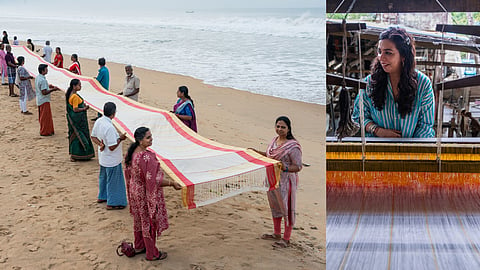
Weaving history: 2,500 artisans unite to create 6,000 ft of kasavu in Kerala

What can 2,500 weavers create when they come together? In Balaramapuram, Kerala, the answer is 6,000 ft of kasavu, woven over two years into a remarkable community-led artwork. Conceived by artist Lakshmi Madhavan, the project celebrates the people behind the textile, bringing generations of craft knowledge, individual stories and collective memory into one extraordinary work.
How the Balaramapuram Kasavu Project brought 2,500 weavers together
Lakshmi Madhavan talks about celebrating Balaramapuram’s rich handloom heritage through a landmark community-made artwork.
What was the idea behind the Balaramapuram Kasavu Project?
My relationship with kasavu began with my grandmother, my Ammamma. When I began working with the cloth as an artist, I wanted to understand it from the perspective of the people at the loom. We know kasavu through the occasions on which we wear it and the memories it holds in our families. I wanted to make a cloth that could also hold the histories of the people who weave it.
How did you go about involving 2,500 weavers in the project?
We worked through local handloom cooperatives and master weavers. They knew the weaving community and how to organise the work around the rhythms of people’s lives and livelihoods. Their role was central. The project took two years, and the relationships I had built in Balaramapuram over several years gave us a place to begin. From there, it grew through the people who took it forward within their own weaving networks.
What were the biggest challenges in coordinating such a large community effort?
One of the biggest challenges was keeping track of each contribution as the work grew. In a piece of this scale, it would be easy for the names and histories attached to individual lengths to get lost. Coordinating the weaving and keeping that record had to happen together. The record mattered as much as the finished textile because the idea was for each person to have a place in the work that we could identify.
How did you arrive at the scale of 6,000 ft of kasavu?
I thought about scale in terms of people. Each weaver needed a length of cloth in which their contribution could be seen and read. Once you bring together 2,500 such contributions, you’re looking at 6,000 ft of kasavu. When you stand before it, you can take in the sweep of the textile and then come close enough to look at what one person wove. I wanted the work to hold both of those experiences.
Could you tell us about the weaving process and how the individual contributions came together?
We began with the Balaramapuram checks, a pattern the weavers already knew well. We adapted the grid of the check into a woven graph that could record details about each maker, including their place in the community’s weaving generations. Working at shared looms, the weavers each wove a length carrying their own record. Those lengths were then joined. When you look closely, each joint marks the point where one weaver’s contribution meets another’s.
Did the weavers have a say in how the final artwork took shape?
Yes. I proposed the artwork and the idea of using the check as a way to record information. Working with the master weavers grounded that idea in what could be done at the loom. Each weaver then had a direct hand in the final form by weaving a section that carried their own record. That’s what I mean when I call them co-authors. The composition of the finished cloth comes from the contributions of all 2,500 makers.
Balaramapuram has a long history of handloom weaving. What makes its kasavu tradition distinctive?
Balaramapuram is one of Kerala’s oldest handloom centres. More than two centuries ago, during the reign of Maharaja Balarama Varma, his diwan, Ummini Thampi, brought skilled weaving families from what is now Tamil Nadu to settle in Balaramapuram and weave fine cloth for the Travancore royal household. Over generations, that tradition became part of life beyond the palace, woven for people across Kerala. As an artist working with kasavu, I found some of the most technically skilled weavers I’ve worked with in Balaramapuram.
Do you see this project opening up new possibilities for the weaving community?
I hope it creates more opportunities for weavers to speak about their work in their own words and to shape how Balaramapuram’s handloom history is documented and shared. The Sathya Foundation, named after my grandmother, is one way I’m carrying this relationship forward. Its work will focus on healthcare, education and skill development, with particular attention to the children of weaving families.
What do you hope people take away from this work?
At Kanakakunnu Palace in Thiruvananthapuram, the weavers were the first to walk through the exhibition. It mattered to me that they encountered the finished work together, here in Kerala, and that visitors could hear about the cloth in their voices and through their own histories. I hope the next time someone wears kasavu or takes a piece out of a family cupboard, they pause to wonder who wove it. Every piece of cloth begins with someone at a loom.
—manuvipin@newindianexpress.com
@ManuVipin
For more updates, join/follow our WhatsApp, Telegram and YouTube channels.