
- LIFESTYLE
- FASHION
- FOOD
- ENTERTAINMENT
- EVENTS
- CULTURE
- VIDEOS
- WEB STORIES
- SPORTS
- GADGETS
- CAR & BIKE
- TRAVEL
- SOCIETY
- GALLERIES
- NORTH EAST
- INDULGE CONNECT

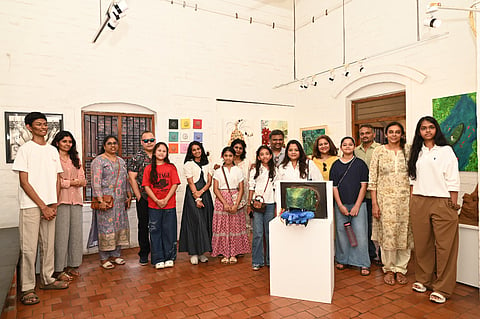
Nature has a way of turning the ordinary into the extraordinary, from the intricate patterns on a butterfly’s wings to the spirals hidden in a sunflower. At IMAGO-1, an exhibition of young artists, these everyday discoveries become the starting point for artworks that explore the shapes, rhythms, and structures found in the natural world.
Curated by Diana R and co-curated by M Vennimalai in collaboration with Diana’s Art Room Studios (DARS), the exhibition brings together around 30 young artists, aged seven to 24, who have interpreted the theme of Patterns in Nature through an eclectic mix of materials and techniques.
The idea began with a biodiversity walk organised with Nature Red, an educational initiative associated with the Crocodile Bank. The walk brought the young artists into the landscape alongside members of the Irular community, traditionally known for their knowledge of snakes. They spotted snakes, a red chameleon, striped ladybirds, birds and turtle shells, while patterns in flowers, leaves and seeds caught their attention.
Diana did not wanted this biodiversity walk to be something forgotten after. She instead thought to snowball this entire thing into an art exhibition.
Back in the studio, these observations opened up conversations about tessellations, the mathematical patterns seen in nature, and the work of artists such as MC Escher. The young participants also explored the golden spiral in sunflowers and cauliflower, as well as repeating patterns in pineapples and snake scales, before developing their own interpretations.
The results are as varied as the materials used. Paper mache, sand, bottle caps, wires, seeds, aluminium foil and recycled canvases find their way into the artworks. One young artist collected real termite wings and spent 30 hours painstakingly attaching them to a canvas with superglue, creating an installation accompanied by a terracotta anthill. Another transformed seeds gathered during the biodiversity walk into an installation, while an origami work by Ishan layers paper dragons over a lily pond, making them appear to hover above it.
Beyond the experimentation, inclusion is central to the exhibition. Neurodivergent young artists are among those participating, with the show offering them a platform to present their work confidently. Entries from Russia and Singapore have also expanded the initiative beyond its original national scope.
“It's an inclusive art show. Okay. That's very important,” Diana says. “And we've had lots of neurodivergent children who exhibited with confidence.”
For visitors, the exhibition offers a chance to look more closely at the patterns that often go unnoticed, while seeing how young artists transform curiosity into creative expression.
On till October 12. Weekdays 10 am to 6 pm, Weekends 10 am to 7 pm. Closed on Tuesdays. At Kadambari Art Gallery, DakshinaChitra Heritage Museum, Muthukadu, Chennai.
For more updates, join/follow our WhatsApp, Telegram and YouTube channels.