
- LIFESTYLE
- FASHION
- FOOD
- ENTERTAINMENT
- EVENTS
- CULTURE
- VIDEOS
- WEB STORIES
- SPORTS
- GADGETS
- CAR & BIKE
- TRAVEL
- SOCIETY
- GALLERIES
- NORTH EAST
- INDULGE CONNECT

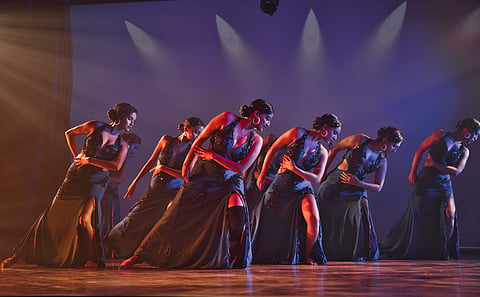
In the familiar tales of One Thousand and One Nights, some characters have long remained on the sidelines. Bengaluru-based dance company Nrityakosh, founded by Debapriya Das, brings them into the spotlight with The Arabian Nights: A Belly Dance Extravaganza. Presented by Debapriya and her ensemble, the production revisits these much-loved stories through a contemporary lens, shifting the narrative towards characters such as Sindbad and Shahryar. From Morgiana’s intelligence and courage in Ali Baba and the Forty Thieves to Peri Banou’s perspective in the tale of Prince Ahmed, the performance gives familiar narratives a fresh interpretation through dance and theatre, with evocative music, elaborate costumes, dramatic lighting and immersive visuals setting the scene.
What inspired you to conceptualise One Thousand and One Nights into a dance production?
There are so many folktales within this collection, yet most of us are familiar with only a handful of them. Even within the stories we know, some of the characters I find most interesting are not necessarily the protagonists. I have always been drawn to these lesser-explored characters and I wanted to revisit the familiar tales by shifting the perspective and allowing some of the female characters to take centre stage. This year, we are revisiting the production with around 75 students and dancers, but with a fresh interpretation and a different theatrical approach.
What drew you to the stories of Scheherazade, Shahryar, Dunyazade, Morgiana, Jasmine, Sindbad, Peri Banou and Prince Ahmed?
When selecting the material for this production, I was more interested in the characters than in retelling the stories exactly as we know them. Scheherazade is a woman who takes charge of her own future. Faced with almost certain death, she uses her intelligence, courage and storytelling to change her fate and save other women. Dunyazade, her sister, stands beside Scheherazade and helps her undertake this perilous journey, knowing the risks involved. Shahryar is a flawed, egocentric man consumed by rage and betrayal. But I was also interested in the possibility that he might be willing to listen and that the stories Scheherazade tells could gradually make him confront something beyond his own anger. With Morgiana, it was her wit, courage and extraordinary presence of mind that drew me in. She is often remembered as a supporting character in Ali Baba’s story, but in our production, she takes the lead. Jasmine, on the other hand, is someone who wants to look beyond the palace walls. We explore her desire for independence, her ambition and her long - ing to see the world beyond the life prescribed for her. Sindbad takes us into a more complex exploration of gender identity. In our interpretation, Sindbad is a woman who has to conceal her identity and live as a man to pursue her adventures. It raises an interesting question: would she have been equally successful, celebrated and remembered as a sailor and adventurer if she had been able to travel openly as a woman? Finally, Peri Banou and Prince Ahmed bring us a love story between two different worlds. What interests me about their journey is the choice they face when one might have to give up their world for the other. Instead, they find a way to remain connected to both. For me, it is a story about love that doesn’t demand that one person abandon who they are or where they come from.
How have you used belly dancing to communicate character, emotion and narrative, particularly in a production with multiple storylines?
Each story in this production explores a different dance style. We incorporate Egyptian folk styles such as baladi-shaabi and saidi, alongside muwashahat, a classical and traditional genre of Arabic vocal and instrumental music. We also feature traditional and modern raqs sharqi, the classical Egyptian stage form of Oriental dance. Alongside these, we incorporate fusion elements, including Indian influences, to suit the story and its musical setting. It is about understanding the character, the music and the situation, then finding a movement language that brings them together. Since we are telling several stories, I wanted each one to have its own musical identity. Some sections also incorporate Indian musical influences. As this is a dance-theatre production, the transitions between musical pieces are equally important. They help connect the narratives and allow the audience to move from one world to another.
How have you approached costumes, visual design and stage presentation?
I was conscious of not falling into a generic, fantasy-inspired interpretation of the Arabian Nights. The visual language takes inspiration from different cultural and historical references associated with the stories and the dance traditions we are presenting, rather than simply relying on familiar exotic imagery. As a belly dance theatre production, it also offers audiences an opportunity to experience the different costume traditions and visual elements associated with the dance form. From folk-inspired Egyptian costumes to classical Oriental stage attire, the styles, silhouettes and embellishments vary considerably. Our lighting and props help create transitions between the different stories, taking the audience from a marketplace to a palace, from an adventure at sea to a magical world, without relying on elaborate set changes.
₹450 onwards. November 28, 7 pm. At Meenakshi Rangamancha Auditorium, Konankunte.
For more updates, join/follow our WhatsApp, Telegram and YouTube channels.