
- LIFESTYLE
- FASHION
- FOOD
- ENTERTAINMENT
- EVENTS
- CULTURE
- VIDEOS
- WEB STORIES
- SPORTS
- GADGETS
- CAR & BIKE
- TRAVEL
- SOCIETY
- GALLERIES
- NORTH EAST
- INDULGE CONNECT

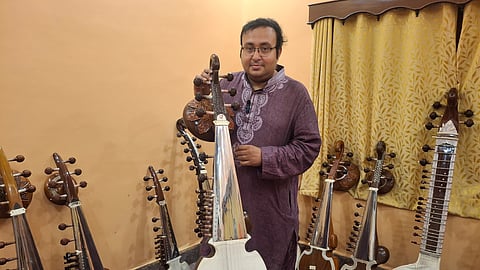
While Calcutta has several museums displaying the heritage and history of the city and the state’s culture, there are private collections as well, which are no less than great repositories of history. Popular musician Joydeep Mukherjee showed us his private collection, which dates back to the Shahjahanpur Gharana of music and art patronage of erstwhile performers. Joydeep shares the stories of finding these rare instruments and restoring them.
Inside musician Joydeep Mukherjee's private collection of rare instruments depicting the rich musical history of the Shahjahanpur Gharana
The beginning
Joydeep mentions, “My interest in collecting and restoring rare instruments developed from 2003-04 onwards, and I started collecting from 2006. Right now, this passion is 20 years old. I mostly get calls from North, West, and Central India because these are the places where the musicians of my gharana used to travel to perform in the courts of the princely states in the 18th and 19th centuries.” He further mentions, “A primary reason to open this museum is that there are three sarod gharanas today. The other two have their own museums, but my gharana – Shahjahanpur Gharana by Radhika Mohan Maitra did not have any dedicated museum so far. So, I have tried to make a small museum and archive.”
Performing on stage
One of the most interesting aspects of the collection is while visitors can see them, they are also used during stage shows. He mentions, “My objective was not to make a museum from the very beginning. This developed only in the past 1.5–2 years when I added 30 or so instruments to my collection. My main objective was to find, restore, and learn to play them on stage. This would give the audience a different sound base and exposure to rarity. Today we are sitting with new acoustics. How do these instruments sound today? Moreover, my objective was also to introduce people to these rare and lost instruments so that one stays connected to their roots and heritage.”
The collection
From a variety of sarods to mohanveena, rubab, and Joydeep’s own patented instruments, the collection has them all. While giving us a tour of the instruments, he started with the very first sarod on which he took taleem. Another sarod from the 1840s belongs to Ustad Murad Ali Khan. He says, “I call this a firstgeneration sarod because it looks like a modified rubab. It was my heirloom sarod, and its age would be more than 180 years today.” What attracted us to the Sur Bahar was the intricate detailing on its fret and head. Interestingly, Joydeep shares, ‘This ancient sur bahar is almost a century old. I acquired it from Bangladesh in 2014 and have completely restored it. It has a yeli on the head with beautiful carvings alongside. Moreover, it is actually lower in height than regular sur bahars, suggesting that it is an instrument for women.”
We almost ignored the next instrument, mistaking it for a sarod, before Joydeep pointed out that it was actually a sur rubab, often easily mistaken for a regular sarod. He explains, “A mixture of sur sringar and semi rubab, the instrument has a unique tonal quality. It has a larger soundbox, fingerboard, and pegstand than that of a sarod. First made in 1880 in Bengal by Ustad Abdullah Khan, the one in the collection is an early 20th-century masterpiece. I got it from a demolished building in Darbhanga.”
While we concluded with three curated instruments by Radhika Mohan Maitra—the mohanveena mad e i n 1948, the dil bahar made in 1956, and the nabadeepa made between 1962- 67 —there were still many which had intriguing histories of their own, waiting to be heard. Even though you can see and play these instruments, we definitely recommend a tour so that you don’t miss out on a slice of history.
How to visit?
Joydeep says, “The museum is open to all. Usually music lovers and musicians come over by appointment. When I am not available to show around, my family does. Visitors can touch and play the instruments since most of them are instrument lovers. Unless you touch them, you cannot feel the history.”
At Bally Halt. Visits by appointment only.
For more updates, join/follow our WhatsApp, Telegram and YouTube channels.