
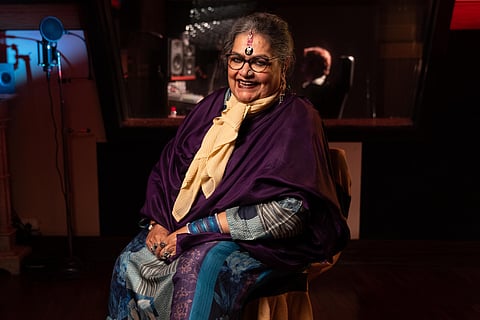
Usha Uthup on Mastery Season 2: "Being Different Was Not a Weakness; It Was My Strength"

Every artiste’s art is a reflection of the different hats that they’ve worn, varied experience that they’ve had, all the art they consume and a voice they hope to use to enthral and educate the audiences with. A painter paints, a dancer or dancer dances but singer Usha Uthup’s art feels like a living, breathing spectacle.
Ever since her days of singing live at nightclubs since late-1960s, the chanteuse knew that she was different — not just in the way she sang, but also in the way she adorned herself on stage and the personality she carried. From the trademark vibrant kanjivarams to the towering bindis and the fresh jasmine woven into her hair, Usha Uthup has always been an icon. The playfulness of One Two Cha Cha Cha, the disco-funk forward Hari Om Hari and the power-packed beats of Ramba Ho — have all reflected the diverse use of Usha’s iconic voice. And across the five-decade journey, the legend has always upheld the belief that the learning never stops. This vast journey of hers is also one of the subjects of the upcoming Season 2 of the cultural film series Mastery by StoneX Global that is now live on SonyLIV.
During our conversation ahead of World Music Day, Usha deep dives into the person she is when the stage lights go off and further chronicles what building a legacy means to her, how she realised being different was not a weakness and lots more!
From Kanjivarams to crowd-reading, Usha Uthup breaks down her musical process, her feature in Mastery Season 2 on SonyLIV, and why she never stops being a student.
Mastery shifts the spotlight away from just star status and places it entirely on your process, routine and discipline. For someone who has been a powerhouse performer for over five decades, what does the quiet routine of maintaining your artform, its quality, ingenuity and energy actually look like when the stage lights go off?
People often see the sequins, the flowers in my hair, the excitement of the stage. But what they don’t see is that music is a way of life, not just a performance. When the stage lights go off, I return to the basics. I listen… a lot. I listen to old recordings, new artistes, sounds from different cultures and generations. I read, I observe people, I stay curious. I also believe discipline is a form of respect — for the audience, for the music and for oneself. Taking care of my health, my voice, my mind and my spirit has always been important. But most importantly, I never stop being a student. Even after all these years, I wake up feeling there is still so much to learn. That sense of wonder is what keeps the energy alive.
What was that one moment or cluster of moments that made you realise that you were not just making music but building a legacy?
To be very honest, I never set out to build a legacy. I simply wanted to sing and connect with people. But over the years, there have been beautiful moments that made me pause and reflect. When I see grandparents, parents and children all singing along to the same songs at my concerts, I realise that the music has travelled across generations. Another touching experience is when young musicians tell me that they found the courage to embrace their individuality because they saw me being unapologetically myself. That means far more to me than any award. Legacy, I feel, is not what you leave behind; it is what continues to live and grow in others.
What artistes always aspire to imbibe from you alongside your vocal talent is the confidence that you have always exuded. Right from your earliest days in singing how did you find the confidence to own your unique sound?
The truth is, confidence did not arrive overnight. In my early years, I knew I sounded different. I did not have what people considered a conventional voice for a female singer at the time. But I was fortunate to realise quite early that being different was not a weakness — it was my strength. I always tell young artistes that authenticity is powerful. You can spend your whole life trying to sound like somebody else or you can spend it becoming the best version of yourself. I chose the second path. Of course there were challenges, but every time audiences responded with love, it reminded me that sincerity always finds its place.
We often talk about the craft of music in terms of vocals but there is also a distinct craft to showmanship. When you’re on the stage, how do you balance the technical side of your singing with the sychological side of reading and managing the crowd?
For me, a performance is a conversation. The technical side — the pitch, timing, phrasing, breath control — is absolutely essential because it gives you the foundation. But once you are on stage, you must also be present in the moment. I watch the audience closely. Are they reflective? Are they energetic? Do they want to sing along? Every audience has its own personality. The beauty of live performance is that it never is exactly the same twice. You have to listen to the room as carefully as you listen to the music. When you genuinely connect with people, they become part of the performance itself.
You’ve sung in many Indian and foreign languages. In such experiences of singing across languages that were new to you, what was that one universal connection you found to help bring out the emotions of the music better?
Emotion is the universal language. Before I learn the words, I try to understand the feeling behind them. Is it joy, longing, celebration, devotion, heartbreak, hope? Once I connect with that emotion, the language becomes much easier to inhabit. I have always made it a point to respect pronunciation and understand the cultural context of every language I sing in. But at the end of the day, audiences respond to honesty. If you feel the song deeply, people can sense it, whether they understand every word or not.
What is the one core piece of advice you would give to a young artiste today to ensure their career has real longevity?
Be 100 per cent honest, no artificiality at all. It’s not about how good or bad one is; it’s about how original one is. Hang in there! There are no shortcuts to success; it’s all about hard work.
Your discography is as versatile as it gets. From jazz, pop and rock to Indian film music — you have done it all! Is there a genre or style of music that you have recently discovered and want to explore yourself further?
One of the joys of music is that there is always something new waiting around the corner. Lately, I have been fascinated by how traditional folk forms from different parts of the world are being blended with contemporary sounds. I find that intersection of heritage and innovation very exciting. I have always enjoyed musical experimentation and I remain open to collaborations with younger musicians who are bringing fresh perspectives. Music evolves constantly and I believe artistes should evolve with it while staying rooted in who they are.
Mastery Season 2 is streaming on SonyLIV.