
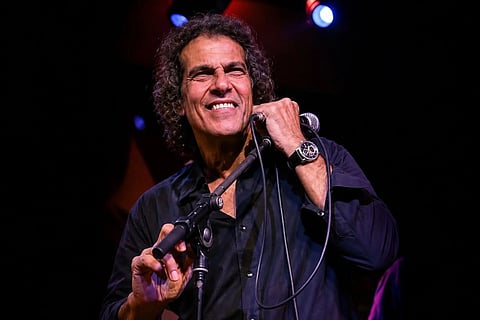
Gary Lawyer on his upcoming show, rock 'n' roll journey, musical rebellion, and winning over younger listeners

When it comes to Indian rock 'n' roll, Gary Lawyer is a name that needs no introduction. He is widely recognised as the first Indian artiste to be signed to a Western album outside India, with This Cannot Wait. In a musical scene where film music has long called the shots, Gary has managed to carve out his own space, staying fiercely loyal to his love for Western rock. With seven albums to his name, including The Other Side of Dawn and No Turning Back, he has spent decades doing what he does best – making original music and bringing the house down with his electrifying performances.
A singer, songwriter and something of a rock 'n' roll institution, Gary has never been one to follow the crowd or play by the rules. His hit Nights on Fire became an MTV favourite, while his musical journey has seen him share the spotlight with international legends. And if anyone thought rock 'n' roll was a thing of the past, Gary is proving otherwise, winning over a fresh crop of Gen Z listeners along the way. Ahead of his performance at Olly Fest in Mumbai this weekend, we caught up with the man whose rock 'n' roll spirit shows no signs of slowing down. Excerpts…
What can we expect from you this weekend in Mumbai?
Well…I have had the same band for 16 years. We pretty much are together in spirit and repertoire. We never really plan our performances. I like to test the wind, so to speak, just before we go on stage, and then we pull out the songs depending on how we feel. There are no predictions. All I know is that the crowd has to have a good time. The customer is king.
After decades in music, what is it about performing live that continues to excite you and brings you back to the stage?
It's a part of my life. It's actually part of my being, and that's the way I've lived. I've raised a family doing purely what I want to do, which is Western music, and it's worked very well in my favour. I've had seven albums, six of which feature original music. My songs have been featured alongside the likes of Deep Purple, Whitesnake, and Kenny Rogers. I've done everything that is possible to do in this country. I've had my share of frustrations, but all in all, it's been absolutely a miracle. I've set out to do this, and it's happened. Of course, there's room for more.
You were exposed to artistes like Nat King Cole and Ray Charles at a very young age. Do you think you chose music, or did music choose you?
I think you're born with it. That's really the only explanation. I was always very drawn to music. I've never been through a nursery-rhyme stage, you know. It was always about listening to great singers and great musicians. Music moved me in every way. It made me happy, sad, made me burst into tears and laugh. I'm just very attracted to music, and particularly to the sound of instruments. My first instrument was actually the trumpet, inspired by Louis Armstrong. Ironically, I eventually exchanged that trumpet for a microphone. You realise you have a sense of pitch. Even a car horn can spark off a song in your head. These are all indications that nature has blessed you with a certain talent. And then that talent can only grow. I really knew music was going to be my life, despite all the negativity I had to deal with from family and friends. I just went along with it, and it's served me so well. I've been told that I could become an international performing artiste, flying all over the world. I don't want any more, and I don't want any less.
Your older album, The Other Side of Dawn, has recently found a new audience with its vinyl release. How does it feel to see music you created years ago being rediscovered by a younger generation?
It was actually very nice. All my albums are something I really believe in. I've put so much into them, and perhaps what disappoints me is that they haven't been given their full potential because of the circumstances of our region.
India really doesn't afford an international market for Western music, at least not in the way one would hope. We have a huge Western music audience, but it is largely focused on foreign artistes. When you think of Western music, you think of the Rolling Stones, The Beatles, (Frank) Sinatra and so on. You don't necessarily think of someone from India. It's a tough call.
But coming back to your question, it was wonderful to get 225,000 views, especially when a huge percentage of the audience was Gen Z. It only goes to show that if you expose people to the right material, there's a lot of potential. A lot of great music just goes undiscovered.
Some of my albums have never really been given the light of day. They come into the market for four or five days, and then they're gone. We don't have the kind of support system that is needed. There's no press support, television, radio or anything. So, all the more reason why it feels special when something works. It has to work purely on the quality of the product.
Do you think the situation has improved over the years, or have the challenges become greater for Western music in India?
I think the challenges have become greater. Right now, it's the era of Bollywood. It's a huge wave that has drowned out everything else .There are far fewer concert venues today. When we started out, there was Rang Bhavan and there were venues all over India. Right now, you get little clubs to play in. The only thing happening at a mass level is Bollywood.
A new band has to ask itself: where does it go? Playing to 50 or 100 people isn't really exposure. There's no radio, television or support. I think it would take one Indian artist to break through internationally while living in India. Then perhaps things would change.
Do you think audiences have become more adventurous in their musical tastes, given the greater exposure to global music?
I don't know. I just see a huge resurgence of what people have coined as retro. Suddenly, everybody is discovering Pink Floyd, The Beatles, Led Zeppelin and The Doors. It's quite ironic.
But the internet has given new bands an avenue. They're free to post their own songs and get some kind of exposure. You don't have to rely on a filmmaker to make a video for you anymore. You can put your own stuff out, and it seems to work. So, in many ways, things have changed, perhaps for the better.
With streaming platforms and social media changing the way music is consumed, do you think the pressure to capture instant attention has affected the depth of music?
I think life has somehow become more temporary. Everything is instant gratification. Anything that gets attention is almost guaranteed to be forgotten in the next 48 hours.
It's no longer something people will think about or read about for long. Every second, you're getting a million things thrown at you. You get onto YouTube and see everything from politics and geography to arguments, debates and breaking news. There's so much information being flung at you that everything tends to become temporary. Nothing seems permanent anymore.
Having spent decades in an industry where trends are constantly changing, how do you protect your individuality as an artiste?
I do what comes from my soul. If there are 10 people listening to me and actually being influenced by what I'm saying or singing, that's enough for me. I've chosen the rigorous path. I've had offers to sing in Hindi. I'm a Parsi from Bombay, and I speak Gujarati, so the accent wouldn't necessarily be a problem. But somehow, my soul has always been more into Western music. We have a huge record collection, with all the greats from the beginning. That's not to say there aren't great Indian musicians. But all my heroes, at least musically, are from the West.
Your album The Other Side of Dawn and the song Nights on Fire received considerable attention, particularly after MTV began promoting Indian Western music. What do you remember about that phase?
It was a very successful album. The Other Side of Dawn was recorded in New York with some great musicians, and we got a huge hit with Nights on Fire. It became so predictable that the song would come on MTV every couple of hours.
MTV was an international phenomenon, and it really helped promote Indian Western music talent. It took someone like me to another level. Suddenly, everybody knew who Gary Lawyer was and what Nights on Fire was.
I remember we were touring the UAE and had got into the bus when I heard a radio quiz about myself. They were asking where Gary Lawyer was from, and whoever came up with the right answer would get a gift. I didn't even know my identity was being discussed. It was quite hilarious!
On the same trip, I walked into a store and saw promotional tapes of the album displayed from ceiling to floor. The owner gifted me one and said it was selling like hotcakes. I still have that tape. It was a very successful album.
Can we expect more archival releases or new material from you?
I wouldn't attempt to do another album at this point. I tend to get so involved in the process that it takes a chunk of my soul out of me. And then to know that there's no real avenue for the music can be discouraging.
I've done seven albums, six of them original. I feel I've really done enough to last me a lifetime. I have a lot of great ideas that I've shelved because I don't know what to do with them. I could make a home video and put out a new song, but I don't know how much of an audience it would reach.
Unless some miracle happens and I feel like getting back into recording, I'm not prepared to do that right now. It's too taxing and too obsessive.
Your voice remains remarkably intact. How have you managed to preserve it over the years?
That's an advantage I have. I've undergone five years of Western classical training with a very famous vocal coach. So I know how to preserve my voice and not wreck it.
There are certain rules I follow. I don't use my voice unnecessarily. Just before a show, I might vocalise a little and sing for three or four days. Otherwise, I don't sing all the time. I would never sing at the drop of a hat, as people love to do at parties. The voice will hopefully remain intact as long as my life is intact.
Of all your albums, which one would you choose to define your musical legacy?
I don't know. I love both The Other Side of Dawn and Arrow in the Dust. Both were recorded in the States with the same musicians, and I'm very proud of them.
I sometimes feel guilty that I didn't do full justice to those albums. Had I been a different kind of personality, I might have stayed there, found myself a manager, an agent and the right infrastructure, and pursued an international career more aggressively.
I had some very close calls. One of the heads of a major company heard my songs and loved Garden in the Rain. He told me that my voice was very distinct and recognisable, and suggested that I move back to the States, perform regularly, build a following and eventually sign a contract.
But it was a difficult time. I had become a father, and my responsibilities were different. I realised I didn't need anything more.
I also recorded a beautiful album with my friend Mayesh Tinaikar, called No Turning Back. I'm incredibly proud of it. My songs and arrangements were mine, but I gave them to Mahesh and asked him to expand on them. He did a stunning job. I love that album.
I'm also very fond of my debut, This Cannot Wait, I did with Ehsaan Noorani and Zubin Balaporia, as well as my jazz album, High Standards, with Louis Banks. My last album was particularly special because I played all the instruments, recorded everything myself and handled the entire process. I love the raw energy that comes through. It's an unpolished gem. There are flaws I've deliberately left in because I love hearing them. Every album has something special about it, and I'm very proud of all of them.
If you could change one thing about the Western music scene in India, what would it be?
I would like to see more support. There's so much great talent here. There are incredible guitarists, drummers and musicians in the Western music space, but I don't think there's anywhere for them to go. Eventually, they wind up playing in studios for Bollywood. That's the tragedy. I'd like Indian bands to be able to hold their own, form their own groups and put their own songs together. There's enough talent, but there isn't enough encouragement.
The bottom line is money. If you can't make a living doing Western music, you eventually move away from it. I'd like to make Western music a very viable profession. I'd like musicians to be able to pursue it without constantly worrying about whether it will sustain them.
What can audiences look forward to at Olly Fest?
I think it's a very well-organised event. I was part of it last year, and it was a lovely way for people to spend their time. It's a wonderful festival, and my hat's off to the organisers for putting it together and using their talents in such a positive way.
They're bringing three lovely days of music to the people, with good food, drinks and entertainment. It's something for everybody and would make a lovely family outing as well.
I hope it becomes a yearly event, regardless of whether I'm there or not. It's not easy to stage something like this, economically, politically or socially. I wish the organisers every success and would love to see a full house. It's a very nice attempt, and I hope people come out and support it.
For more updates, join/follow our
https://www.whatsapp.com/channel/0029Vb677uz60eBXiDYheb0n