
- LIFESTYLE
- FASHION
- FOOD
- ENTERTAINMENT
- EVENTS
- CULTURE
- VIDEOS
- WEB STORIES
- SPORTS
- GADGETS
- CAR & BIKE
- TRAVEL
- SOCIETY
- GALLERIES
- NORTH EAST
- INDULGE CONNECT

It starts with a question that has no particularly convenient answer: who am I?
It is an old question, almost impossibly old, and Rahul Sridhar isn’t pretending he has solved it. With Onna Moona, his new Tamil music video, he is doing something more interesting: turning the question into a piece of music and leaving enough space for the listener to sit with it.
The song began with Indian non-dual texts and was originally imagined as three separate songs, one each for the mind, body and consciousness. He wanted to create two independent musical arrangements that could combine to produce a third. The idea eventually changed into a single song, but Rahul retained the same concept, implementing it through the lyrics by Pa Hariharan. “The philosophy directly dictated the song structure as well,” he says.
The lyrics brought their own challenge. Given the unusual structure, they had to satisfy the mathematical concept while still functioning as lyrics, making them “the most difficult to get right given the unique complexity stemming from the math formula required to writing them,” he says.
He composed, arranged and sang Onna Moona, with Jananie SV on female vocals, and produced it along with Melvin Davis. Musically, the track moves through different textures and moods while deliberately holding on to certain familiar elements. “Even though there are some melodic and textural differences, a few elements stay the same, such as the rhythms and guitars,” he explains. “They keep the underlying movement familiar while things change on top.”
It is also a way of reflecting the relationship between the mind and body. “It’s also intended as a subtle indicator of how the mind and body appear different, but are quite similar when you peel the layers.” The melody shifts between minor and major scales across the sections too, creating different feelings that still belong to the same musical world.
The third section, which comes after the solo female verse, was the hardest part for Rahul to get right. It had to carry “disorientation, an inner quest, a realisation, a sense of resolution” before building towards the emotional release of the final section. “I’m unsure whether it did it all,” he admits. “But it felt right at the time of finishing the song.”
Knowing when to stop adding to an arrangement is another challenge, one Rahul describes as “an ongoing process”. The freedom of an independent release helped. Without strict deadlines, he could leave the song alone and return to it later with some distance. Melvin Davis became an important sounding board during the process, while friends and family provided what Rahul calls “trusted ears”. He also keeps voice and video notes from the earliest versions of his songs, when the emotions are at their rawest, and returns to them occasionally to see how far an arrangement has moved from its emotional core.
The music video had to solve a similar problem: how do you make an abstract philosophical idea feel like something a person can actually experience?
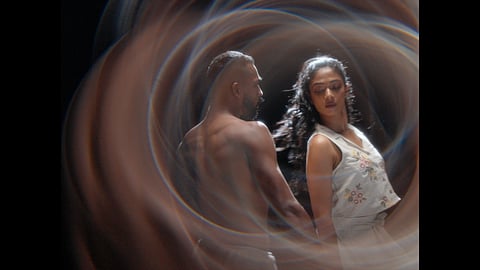
Directed by Dinesh Mathikumar and produced by Ashwanth Rajan Dayal of Celluloids Films, the video follows three strangers whose lives become connected through their art. Rather than illustrating the philosophy literally, Dinesh and his team developed a story around artistes inspiring one another to create something together. “The concept and the song, being abstract as they are; the video needed some emotionally relatable anchors,” Rahul says. The hope was that viewers could connect with the characters through their emotions, melancholy and experiences, even though they are artistes.
Fort Kochi provided the setting, with its beaches, greenery, Chinese fishing nets, boats, studios and city roads all becoming part of the visual landscape. The location also had a personal connection to the performers and choreographers, Aloshy Amal and Gopika Manjusha, who are from Kerala.
Some of the film’s most striking moments came from what the team had to leave behind. The original plan for the final section involved a huge fire, with people dancing in front of it in a devil-may-care attitude to represent emotional release. It was eventually abandoned because of the logistics and, as Rahul puts it, how much money he was willing to “burn”. Instead, the team recreated the feeling through movement, lighting, art and visual effects. A particular filter attached to the camera during the dance sequence created the video’s distinctive triple-cloning effect, making it important for the shoot to be captured correctly in camera. “The shoot had to be nailed,” says Rahul. “Which they did.”
The video also resists explaining itself completely. The filmmakers took “some creative liberty in representing consciousness as a character,” Rahul says. “In a more accurate representation, the third character would be the soul, while the watcher is the consciousness,” he continues. The team even considered adding a final scene to make that distinction explicit, but decided against it.
Instead, the ambiguity belongs to the viewer.
There is also a more personal reason why Onna Moona matters to Rahul. It is his first release since leaving his tech job to pursue music full-time. The process of making the song and video, and collaborating with the people involved, has given him more conviction in that career switch.
Furthermore, he doesn’t consider the song an answer to the question that started it. “The question is a life-long journey and I see the song as a checkpoint, an important one nevertheless.”
Years from now, he hopes the idea behind Onna Moona will have moved beyond intellectual understanding and become something more permanent. For listeners, he hopes it might prompt a journey of their own with the question, “Who am I (beyond this mind and body)? The destination doesn’t matter as much as a sincere journey with the question,” he concludes.
Onna Moona is now on all major streaming platforms.
For more updates, join/follow our WhatsApp, Telegram and YouTube channels.