
- LIFESTYLE
- FASHION
- FOOD
- ENTERTAINMENT
- EVENTS
- CULTURE
- VIDEOS
- WEB STORIES
- SPORTS
- GADGETS
- CAR & BIKE
- TRAVEL
- SOCIETY
- GALLERIES
- NORTH EAST
- INDULGE CONNECT

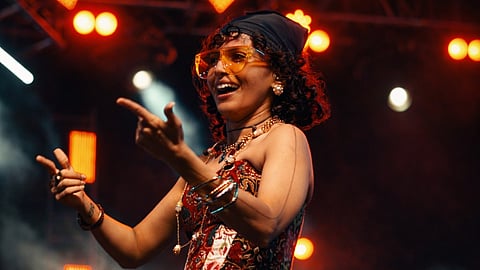
For as long as Maalavika Sundar can remember, music has been both her discipline and her escape. A Carnatic singer who began learning music at two-and-a-half, she spent years training under her guru before stepping into the wider world of performance. She first came into the public eye through Super Singer 3, and Indian Idol, before making her playback singing debut with Dang Dang in Manam Kothi Paravai, a song that earned her the nickname Dang Dang Maalavika. Since then, she has moved between playback singing, Carnatic performance, independent music, and acting, making her film debut with Velvet Nagaram in 2020.
Her latest release, Valli Kanavan, is a Kavadi Chindhu she first encountered as a child, now reimagined through a sound that feels like a reflection of where she is today. We chat with Maalavika about Valli Kanavan, finding liberation, embracing vulnerability, and letting herself fly. Excerpts:
You describe Valli Kanavan as a Kavadi Chindhu that has stayed with you since childhood. What is it about this particular melody that has remained so emotionally alive for you?
Valli Kanavan is a song I have heard since I was very young. I started learning music from my teacher, Srimati Padmavati Anantha Gopalan, when I was just two and a half. Every year, she would conduct examinations, followed by large music-and-dance productions, with the entire story, music, and choreography conceptualised by Jayanthi Kumaresh, my teacher’s niece. We would all come together for these productions, and Valli Kanavan became one of those melodies that stayed with me.
When I was in 7th standard, I began living with my guru in a gurukulam and stayed with her until I was 23. It was an incredibly disciplined way of growing up. Looking back, I sometimes feel I didn’t have much of a conventional childhood—I didn’t get to explore or do many of the things children normally do. Perhaps that is also why Valli Kanavan continues to bring me such immense joy. It takes me back to a very specific part of my childhood, and that feeling has never really left me.
And somehow Valli Kanavan is like home to me. I think art is home to me and specifically a few songs, especially when you just go wild, you know, those are the tunes that have actually helped me. So I picture myself in those tunes and it makes me dance inside my head, having a very fear-free life and just flying.
So I think Valli Kanavan is that tune for me which has, yeah, helped me stay alive.
You’ve called the song a source of “joy, liberation and innocent exuberance”. What does liberation mean to you at this stage of your life, musically and personally?
I’ve had a very caged life. I’m not complaining, it was something I chose, and I’m happy for whatever I put myself through because it has brought me here musically. But there are days when I feel like maybe I could have had a much simpler, normal life.
Liberation to me now is having a very cage-free life. As I’ve grown older, I’ve found my own way to stay grounded, humble, kind, compassionate and empathetic, while still saying what I feel I should and not constantly doing things for others. Most of my life, I felt like I was moulded into other people’s sketches—you have to be this way, you have to be that way. Finally, I feel like I’m embracing myself. I have flaws and I’m not perfect, but I want to embrace them and speak my mind when I feel I have to, in a kind and polite manner.
Musically, I don’t feel contained by Carnatic music, cinema music or independent music. I’m letting myself free and surrendering to the art, whether I’m performing, writing, singing for another composer or practising. Earlier, even during practice, I felt I had to be perfect, to hit every note right. Now I’m like, it’s okay, we are humans. I just want to enjoy the art and go with the flow. I want to surrender myself to the art, and that is liberation for me right now.
How did you and your musicians approach the arrangement of Valli Kanavan, and what instruments did you layer into it while retaining the essence of the original?
My musicians and I have been travelling and performing together for quite a long time, so the band already has its own sound — very Carnatic rock and Carnatic folk rock.
We didn’t think about any particular instrument or approach. We were like, this is a family, this is the song, so how do we approach it together? That’s how we built the arrangement.
We have Akshay on the guitar, Reshwin on bass, Ashwin Iyer on keys, Livingston on percussion, Kuberan on drums and Krishnaraj on violin. I also have to mention Toby, who mixed and mastered the track. So we were jamming and we decided we want to take the song this way. I mean, I’m not able to say what the song needed or something. It’s just the way we wanted to express ourselves.
My previous tracks have also been with them, but I’ve never heard Valli Kanavan arranged like this. Of course, many musicians and artistes have put the song out there, but we wanted to approach it in our own way.
You’ve moved through several versions of yourself: contestant, playback singer, classical performer, actor and independent artiste. What feels different about the Maalavika we’re meeting today?
I think the Maalavika we are meeting today is much more responsible for everything—the opportunities that have come her way, the ones that haven’t, and what life has offered and hasn’t offered.
I’m taking responsibility for everything. It’s very new to me because, as humans, we have a tendency to say, this is why I didn’t get that opportunity, this is why my life turned out this way, this is why this person did that to me. I’ve always tried to be a humble, kind person, but now I feel much more aware of everything in my life. I’m embracing and accepting everything that has happened.
Every day feels like a new chapter, and I’m trying to be as present as possible.
You’re constantly performing and travelling. How do you take care of your voice and maintain your stamina on the road?
Apart from manja podi paal or, you know, milagu, chitharathai, athimadhuram and all of that is there, warm water and steam inhalation, all that helps, but I think voice rest helps me the best.
I regularly hit the gym, and then just being with people with whom I can be myself, where I don’t have to perform or talk or do anything extra.
You’ve shared quite a bit about fitness on Instagram over the years. How has your relationship with fitness changed as your career has evolved?
Definitely, my relationship with fitness has changed. When I started working out, it was just about bringing my size and weight down. Now, it is like meditation to me. It is something I always go back to, and I feel like I stay sane because of my fitness.
When you try a new movement, fail, and keep trying again and again, you learn not to give up. That has helped me in my life, my music, everything. Even the way I move and put myself out there when I perform comes from the relationship I’ve built with fitness.
If you had a week with absolutely no professional commitments, where would you go and how would you spend it?
I would still be working. I have this problem where I cannot not work. I’d do something, even if it’s little, but of course, the location would change.
It would be somewhere in the mountains, where I could sit in front of them and sing, think about all the things I haven’t done, and slowly pick each one. I’d eat nice food, play with a lot of doggos, meet new people and observe them. I love observing people and getting to know them.
When I’m in the city, I feel like somebody is always watching me. In the mountains, that doesn’t happen. It’s the trees, plants, flowers, mountains and rivers that hear me. They don’t judge me, and I don’t judge them for their sound.
You have already spent years exploring what a Carnatic-trained singer can do across genres. Is there still a musical boundary you want to break?
Technically, I don’t know, but I would like the whole world to listen to my story. I want to be more real and tell them what my story is. So, it is more of an emotional breakthrough that I want to do.
If Valli Kanavan were a colour, what colour would it be?
Valli Kanavan to me is white. I want whoever listens to it to feel like their life is being coloured too. When they listen to my Valli Kanavan, I want it to be a clean slate, white, so they can paint whatever they feel like.
What are you currently curious about outside of music?
I want to know how to climb Mount Everest, how to ride a proper sports bike, and how a sportsperson lives. I want to know what it feels like to be a bird and fly because, somehow, so many of my songs are about flying. I want to be a bird, I want to be a fish, I want to do a scuba diving instructor course, I want to go bungee jumping. I’m curious about all these things, and I want to experience them all.
What’s next for you?
I just want to live life, not fearing anybody, not fearing anything. Just want to live and do the things that I really want to do, travel a lot, just sing my heart out, just tell my story out, meet a lot of lovely people. I just want to live, live with a lot of life in it.
Coffee or chai?
Neither.
One song you wish you had sung?
Nila Kaaigiradhu, Ennavale, Sanda Kozhi and Dillu Baru Jaane.
Most overplayed song on your playlist right now?
Arunagiri Perumale by Pradeep Kumar. I’ve played that a lot. Then there’s doomsday by Lizzy McAlpine, and a lot of Bruno Mars’ songs. Sukoon by Arijit Singh, Salim-Sulaiman and Shraddha Pandit is also on repeat.
Your comfort food?
My comfort food is Vatha kuzhambu with potato curry, or Chilli garlic rasam with potato fry and an omelette. Pulao is another favourite. I also love Arachuvitta vengaya sambar with any vegetable, or Arachuvitta keerai. Basically, simple, comforting food.
One person you’d happily swap lives with for a day?
I would not want to swap lives with anybody. I’m not sure, I’m very scared of the uncertainty. But maybe Zendaya.
Valli Kanavan is out on all major streaming platforms.
For more updates, join/follow our WhatsApp, Telegram and YouTube channels.