
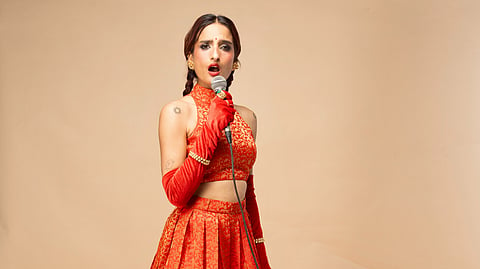
Rashmeet Kaur redefines love and identity through her genre-blending album Parinda

After a decade of moving between independent music, Bollywood playback and live performances, Rashmeet Kaur is entering a new chapter with Parinda. The eight-track album brings together Punjabi folk and sufi influences with R&B, jazz, rock and electronic sounds, while exploring different phases of love — from new beginnings and companionship to heartbreak, acceptance and finding yourself again. In a conversation with Indulge, Rashmeet talks about finding herself through the album, bringing Punjabi folk into contemporary music and learning to trust her own voice.
You describe Parinda as an album about love but also about finding yourself. How did your own experiences shape the album?
Parinda is very much a reflection of where I’ve been emotionally and personally. Love is definitely at the heart of the album, but for me, love has also been a journey of understanding myself — my choices, my boundaries, my vulnerabilities and ultimately my own worth. Over the years, I’ve experienced different kinds of love, loss, uncertainty and growth and all of those experiences naturally found their way into the music. I think, the album is about that moment when you realise that finding yourself can be just as profound as finding or losing someone else.
The album blends Punjabi folk with R&B, jazz, rock and electronica sounds. What draws you to bringing traditional sounds into contemporary music?
I’ve always felt that Punjabi folk has an incredible emotional depth and timelessness to it. I grew up listening to these melodies and voices, so they are instinctively a part of how I understand music. At the same time, I’m an artiste of my generation and I’m naturally influenced by contemporary sounds such as R&B, jazz, rock and electronica. For me, bringing the two worlds together isn’t about trying to make folk sound ‘modern.’ It’s about allowing these beautiful traditional sounds to exist in a new context. I love discovering how a folk melody, a particular vocal texture or an old lyrical thought can take on a completely different life when placed against a contemporary production.
The title Parinda means bird and represents freedom and self-exploration. What did freedom mean to you while making this album?
Freedom, for me, meant giving myself permission to be completely honest. To not make music based on what I thought I was supposed to sound like or what people might expect from me. There was a lot of unlearning involved — letting go of the need for validation and trusting my own instincts. Parinda became a space where I could explore different sounds, emotions and versions of myself without having to fit into one particular box. In that sense, the bird became a very natural metaphor: being able to fly, explore and find your own personal direction.
You’ve spent the last decade moving between independent music, Bollywood playback and live performance. How has that journey shaped the artiste you are today?
Every part of that journey has taught me something different. Independent music taught me ownership and the importance of having a voice of my own. Playback taught me adaptability and how to interpret someone else’s musical and emotional vision. Performing live has taught me the importance of connection because when you’re on stage, there’s nowhere to hide. Moving between these worlds has also made me more comfortable with not being defined by one category. Today, I feel much more interested in being an artiste who can evolve, experiment and tell stories in different ways rather than fitting neatly into one space.
As a female independent artiste, what have been some of the biggest challenges you’ve faced while building your career in the music industry?
One of the biggest challenges has been learning to take myself seriously in an industry where you’re constantly being evaluated and compared. As an independent female artiste, you often have to wear many hats — you’re the performer, the creative director, the decision-maker and sometimes even the person figuring out the business side of things. There have also been moments where I’ve had to work harder to make sure my artistic choices were respected and heard. But those challenges have also made me stronger. I’ve learned to be patient, to know what I bring to the table and, most importantly, to not compromise on my identity just to fit into someone else’s idea of what an artiste should be.
You’ve spoken about self-assurance and knowing your worth. Has becoming more confident in yourself changed the way you approach your music?
Absolutely. I think confidence has changed my relationship with music more than anything else. Earlier, there was a tendency to question whether something was ‘good enough’ or whether people would accept it. Today, I’m much more willing to trust my instinct. Knowing your worth doesn’t mean you stop listening or learning. It means you stop allowing outside opinions to define your sense of self. That has given me the freedom to make music that feels honest to me, even when it may not fit neatly into an existing category.
Your music draws from artistes such as Surinder Kaur, Noor Jehan, Reshma and Nusrat Fateh Ali Khan. How have these voices influenced the way you understand Punjabi music and your own identity as an artiste?
These artistes taught me that the voice carries far more than melody. There is history, emotion, pain, longing and cultural memory in the way they sang. Surinder Kaur, Noor Jehan, Reshma and Nusrat Fateh Ali Khan each had such distinct identities, yet they could communicate something deeply human. Listening to them made me understand that Punjabi music doesn’t have to be confined to one sound or one era. It can be raw, spiritual, romantic, powerful and deeply contemporary in its emotional relevance. They’ve given me a sense of where I come from while also inspiring me to find my own voice within that tradition.
You recently performed on Colors and became the first artiste to perform in both Hindi and Punjabi on the platform. What did that moment mean to you?
It was a very special moment because it felt like a recognition of both sides of my artistic identity. Hindi and Punjabi are both deeply connected to who I am as a musician and being able to represent both on a platform like Colors felt incredibly meaningful. I’ve always wanted my music to cross linguistic and cultural boundaries without losing its roots. So that performance felt like a beautiful reminder that you don’t necessarily have to choose one identity — you can embrace all the different influences that make you who you are.
You’ve performed across India, North America, Australia and Europe. How have international audiences changed the way you see your own music?
Performing internationally has made me realise just how universal emotion is. You can be thousands of kilometres away from home, performing for people from very different backgrounds and a Punjabi song can still make someone sing along, dance or feel something deeply. It has also made me appreciate my roots more. When you’re away from home, you sometimes see your own culture through a different lens. I’ve realised that the things I once considered very familiar or ordinary can actually be incredibly special and distinctive to someone experiencing them from the outside. That has made me even more proud of bringing Punjabi music and my own interpretation of it to different audiences.
What’s next for you?
I think Parinda is the beginning of a new chapter rather than an endpoint. I want to continue exploring the space between my roots and contemporary music and keep pushing myself creatively. There’s definitely more music coming and I’m excited about collaborating, performing and experimenting with sounds that I haven’t explored before. More than anything, I want to keep growing without losing the honesty that brought me to Parinda in the first place. I’m really looking forward to seeing where this next chapter takes me.
Parinda is streaming on all audio platforms.
For more updates, join/follow our WhatsApp, Telegram and YouTube channels.