
- LIFESTYLE
- FASHION
- FOOD
- ENTERTAINMENT
- EVENTS
- CULTURE
- VIDEOS
- WEB STORIES
- SPORTS
- GADGETS
- CAR & BIKE
- TRAVEL
- SOCIETY
- GALLERIES
- NORTH EAST
- INDULGE CONNECT
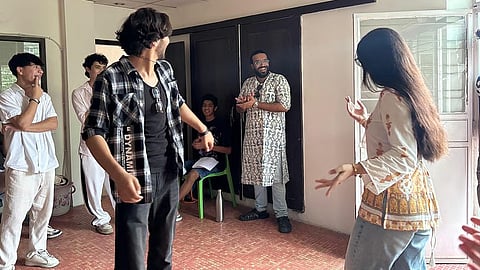
Twenty-one-year-old Hamed left Afghanistan for Delhi in 2018. On Friday, he returned home—if only for 40 minutes. At Alliance Française de Delhi, the first-time actor stepped into the role of Jaan, the hero of the Afghan folktale Tales of Mullah Mohammad Jaan, as part of The Night They Chose, a World Refugee Day production that brings together young forcibly displaced artists from Afghanistan, Myanmar, Somalia and Sudan. Through folklore, music and dance, the play celebrates cultures often reduced to headlines of conflict.
Directed by Ritvik Mohan Bhagat, the production was presented in association with the Migration and Asylum Project (MAP), a legal aid centre that works on migration, gender and displacement, with a focus on making justice more accessible, particularly for women and girls from marginalised communities. The play draws on four traditional folktales—'Tales of Mullah Mohammad Jaan' from Afghanistan, 'The Father's Last Advice' from Myanmar, 'Coldiid and the Peaceful Warrior' from Somalia, and 'Fatana and the Ghoul' from Sudan.
"It gives you a sense of belonging—and those little instances where you get those flashbacks of life back at home," says Hamed. "When you've heard these stories since childhood and then you perform them yourself, it feels like meeting your superhero."
For Roshni Shanker, founder and executive director of MAP, the production is also an attempt to tell refugee stories through art rather than statistics. "This World Refugee Day, we are using the power of theatre and storytelling to spotlight the human cost of forced displacement," says Shanker. "Our aim is to move beyond the numbers and help audiences understand how conflict and displacement devastate lives, families and communities."
Choosing stories over suffering
The production almost began with a very different script. Bhagat says Alkazi initially suggested adapting The Beekeeper of Aleppo, a novel that explores the refugee experience and the hardships of rebuilding life in a new country. But after speaking with the young performers, he realised that wasn't the story they wanted to tell.
"They didn't want to do something very hard-hitting," he says. "They wanted something light-hearted and fun."
Instead, Bhagat researched traditional stories from the four countries represented by the cast, weaving three tales around the Afghan story of Mullah Mohammad Jaan and Aisha. "That's how we decided to call it The Night They Chose," he says.
The Afghan folktale is a star-crossed love story reminiscent of Heer-Ranjha or Romeo and Juliet. While the original ends in tragedy, this production rewrites the ending, allowing the lovers to live. "There is already so much darkness and sadness in the world around us. We decided to let the lovers live... so people can feel that they can write their own destiny," Bhagat says.
The English-language production incorporates traditional songs, costumes, dance and poetry in Persian, Somali, Arabic and Burmese.

Four countries, one stage
The four stories retain their own cultural identities while contributing different ideas to the production. The Somali tale introduces themes of non-violence, the Burmese story explores interpretation and choice, while both the Afghan and Sudanese stories centre on women who refuse to surrender their agency.
"The story reflects the restrictions women face in Afghanistan," says Athena, who moved to India a decade ago and co-directed the production. She has worked with MAP and refugee communities for the past two years. “But those restrictions also resonate with women from Myanmar, Sudan and Somalia. The girls performing this play all connect with that."
"If they're playing a character who has agency, they start believing that they themselves have agency. There is always light at the end of the tunnel," says Bhagat.
For Athena the rehearsals became more of a home than preparation for a performance. "Sometimes putting your emotions into words is difficult. This story and this play gave them an opportunity to express themselves," she says.
For Hamed, performing an Afghan story also became a way of reconnecting with his identity after years away from home. "There are a lot of Afghans here in Delhi. I don't feel strange. The people are friendly and respectful, and our cultures are not too different. It's also safe—you can go wherever you want at any time and you don't feel like you're in an unsafe environment."
Athena, who arrived in India in 2016, says the story transports her back to Navroz celebrations in Mazar-e-Sharif—to the memories she thought she had left behind. "This story takes me back to those memories," she says.
Beyond headlines
For both Athena and Hamed, the production is also an opportunity to present Afghanistan beyond the images that dominate international headlines. "When people hear Afghanistan, they think of war, terrorists and restrictions," Athena says. "I've tried to change that picture through our culture, our music and our stories."
Hamed agrees that changing the ending of the Afghan tale was symbolic. "Our people have seen enough sadness and misery," he says. "When we do a play like this, it takes a little bit away from that feeling of powerlessness. Even if it's only a 40-minute play, we can give people a different taste of our culture.”
This article is written by Adithi Reena Ajith