
- LIFESTYLE
- FASHION
- FOOD
- ENTERTAINMENT
- EVENTS
- CULTURE
- VIDEOS
- WEB STORIES
- SPORTS
- GADGETS
- CAR & BIKE
- TRAVEL
- SOCIETY
- GALLERIES
- NORTH EAST
- INDULGE CONNECT

History is filled with men who fought wars, led armies and became legends. But how often do we celebrate women who defended their kingdoms with equal courage? While names such as Rani Lakshmibai, Razia Sultana and Velu Nachiyar are familiar to many, Rani Abbakka deserves a place in that conversation too. The 16th-century queen of Ullal, in coastal Karnataka, resisted Portuguese expansion and fought to protect her kingdom’s sovereignty and maritime trade.
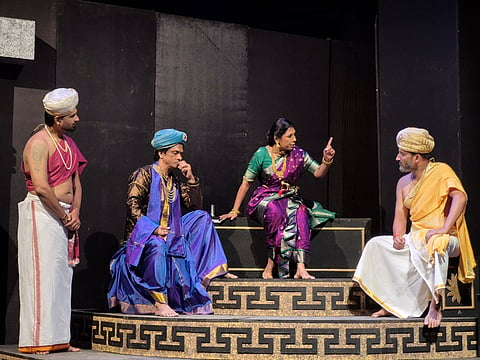
As ANK theatre group marks 50 years of Hindi theatre, its golden jubilee production, Veera Rani Abbakka – The Queen of the Seas, The Fearless Flame of Ullala, brings Abbakka’s story to Mumbai. Founded by the late actor and theatre-maker Dinesh Thakur in 1976, ANK presents the play, written, designed and directed by Preeta Mathur Thakur, who also performs in it.
In an exclusive conversation with Indulge Express, Preeta discusses bringing Abbakka’s story to Hindi theatre and the importance of taking women’s histories beyond their home regions.
Why is Rani Abbakka still relatively unknown while male warriors are celebrated?
I think documentation is one of the key reasons. India has a rich tradition of oral histories and folklore, but many stories have not been widely documented or popularised. Abbakka is celebrated in coastal Karnataka, but her story remains relatively unfamiliar beyond the region, particularly in Hindi popular culture. That is why I chose to stage the play in Hindi, so her remarkable story can reach a wider audience.
We cannot ignore the male gaze through which history has often been written. Abbakka’s story has largely survived through the Yakshagana tradition. Through this production, I want to bring the story of a queen who defended her coastal kingdom in the 16th century to audiences in Mumbai and beyond.
Why did you choose Abbakka’s story for ANK’s 50th anniversary, and how did you approach portraying her?
While Abbakka’s achievements were recorded, there was limited information about her as an individual and a woman. I cross-checked details against at least two additional sources before incorporating them into the script.
Yakshagana is integral to her story, so I incorporated its elements into the choreography and designed the set to preserve the cultural authenticity of Tulunadu. As an actor, I felt I could bring a female gaze to a story that may not have been told from that perspective before.
As ANK turns 50, what changes would you like to see in theatre?
Corporate houses, too, should support Hindi theatre, just as they fund musical shows and other large-scale productions.
Working with Gen Z actors, technicians and set designers has also been an experience. To carry forward ANK’s 50-year legacy, we must work with the younger generation, although it requires a different approach.
October 18, 6.30 pm. At Tata Experimental Theatre, NCPA, Mumbai.
For more updates, join/follow our WhatsApp, Telegram and YouTube channels.