
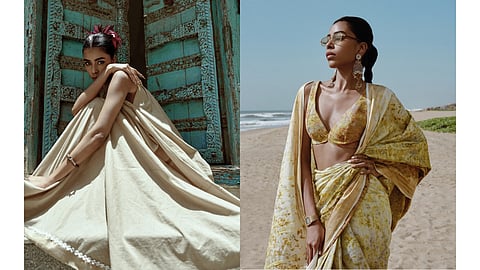
Suresh Menon’s eco-printed collection redefines sustainable fashion in Chennai

With nearly a decade in fashion, Chennai-based designer Suresh Menon has built a practice that moves between creative experimentation and everyday dressing. Having started designing at 18, he has worked across customised occasionwear, editorial looks and made-to-order pieces for actors, models and private clients. His latest collection takes the traditional art of eco-printing and gives it a contemporary, wearable edge, using flowers and other natural materials to create distinctive prints. The collection combines handloom and natural fibres with a more sustainable approach to fashion, while simple silhouettes keep the focus on comfort and ease.
Suresh Menon on His Journey in Fashion
As he prepares to open a new space in the city, Suresh Menon talks to Indulge about finding his design language, staying open to experimentation and balancing creative expression with what his customers want.
You’ve been designing for almost a decade. How has the journey been so far?
It’s been about eight years of doing it properly, in terms of having a major brand, but almost 10 years since I started getting into designing, having a store and everything. I started around 2015-16. I’ve had three stores so far, although they have been in different locations. I currently have a store in Palavakkam, and I’m also opening a small store in KNK, Nungambakkam.
Your new collection marks a shift towards sustainability. What prompted this?
I’ve been gravitating towards sustainability for the longest time. I’ve always been a designer who worked with the fabrics I had. Even when I was in school, I would take my mother’s cotton saris or old chiffon saris and ask her to lend them to me so I could cut them and make something. It has always been about using what was available at home. My experimental work has often been with things people already have. It could be old saris, leftover silk or fabrics that I could source at a lower price. I’ve always believed that one person’s trash can be another person’s treasure.
For the longest time, I was also in survival mode. In Chennai, there is a strong demand for bridal wear, blouses and occasionwear, so I spent six or seven years serving that market. But now I feel I have a little more space to breathe and explore what I want to do creatively.
Tell us about the eco-printing process behind the collection.
I had collected sustainable materials from different places and had also been researching eco-friendly printing. One day, I decided to bring everything home and experiment with it in my garden with my partner. We went to a market and found flowers that were about to be thrown away. They still had a few days of life left in them, so I bought them. That night, we started experimenting with eco-printing at around 10 pm and continued until the next morning. We created around eight different samples. We used natural fibres and natural flowers to create the colours, without chemicals. Alum was used as a mordant to help the fabric hold the colour.
We used old cotton and mulmul and created a whole set of samples that night. What I found interesting was that I was getting my hands dirty. Normally, when I design clothes, I touch the fabric, help with cutting and draping, but this was different. I was actually involved in the making process from the beginning. The pieces coming out of this collection are literally made by my hands and my team. That makes it very close to my heart.
What was the biggest challenge in working with this technique?
There was a lot of physical work involved. There is a lot of tying, rolling and arranging. You have to clean the flowers, dismantle them and arrange them on the fabric. Doing it yourself is hard work because there was nobody around who had experience with the technique. But more than the physical challenge, the difficult part was making it wearable. I wanted to take this traditional technique and translate it into modern clothing that people can relate to. There are flared pants, slightly corseted pieces, shirts, trousers, short dresses and long maxis. The challenge is making the technique wearable through modern cuts.
What do you enjoy most about working with handloom?
The feel of handloom is something very historical and very much like home. It reminds me of the cotton clothes we wore as children. There is a certain comfort in the fabric. My first motivation is always to make people feel comfortable while wearing my clothes, but I still want to bring in a little colour and style. When I think about this collection, I think of comfort with a little bit of style — being modern while still having that Indian touch.
How should people care for these garments?
The care is quite simple. You just shouldn’t use harsh chemical washes. You can hand-wash them with a very small amount of mild detergent. You don’t necessarily have to dry-clean them. Since the fabrics are natural fibres, I wouldn’t recommend putting them through a washing machine with a long spin cycle. You can soak them for a little while, rinse them and dry them naturally. We tested some of the samples with hand washing, and the colour held well.
How would you describe your design language?
I don’t have a professional education in design. I’ve done workshops, including one where I learnt eco-printing, and I’ve taken basic courses, but I don’t have a formal degree in fashion. For me, design has always been about what I am in that particular period of my life. Whatever I’m feeling or gravitating towards becomes the collection. A lot of designers have a very specific language. But I don’t want to put myself in a box. I like the unpredictability of not knowing what my next collection will look like. I’ve made peace with the fact that not everyone is going to like everything I do. But I believe there will be something or the other that people can connect with across different collections or different parts of my creative journey.
How has your approach to fashion changed over the years?
When I was in school, I already knew I wanted to be a designer. By 11th and 12th, I was preparing for the entrance exams because I wanted to study fashion. I came from a family with no fashion background, so I didn’t really know how to bridge the gap between having this dream and actually making a career out of it. Over the years, I have gone through a huge transformation from simply wanting to create what I wanted to becoming someone who also understands what people need. I make bridal blouses and all kinds of customised pieces because I’m not in a position to tell a customer, ‘This is my collection and you have to buy from this.’ I have to survive and I have to deliver what someone who lives down the street and comes to me with a specific requirement wants. We make normal clothes as well. We customise. I’ve even done uniforms for hotel staff and other requirements. So, anything and everything we do. My approach to design has become much more customer-friendly. I don’t shame or dismiss any specific requirement when it comes to clothing.
How do you balance your creative side with what your customers actually want?
There are two very different worlds for me. Something like my black-and-gold collection is an extreme expression of my creativity. If I make 30 or 40 pieces, perhaps only half of them may be commercially wearable. They might be blouses, dresses or corsets—more editorial pieces. But with this collection, I know every piece can be sold and every piece is something somebody can wear in their everyday life. I want that stretch between two worlds: something people enjoy watching, perhaps a musician or an artiste, and something that a person working in an office can actually connect with and wear every day.
You also have a background in makeup. Is that still a part of your creative practice?
I’m still involved in makeup. Even recently, I did the makeup for a music video. I have toned it down a little because I need to be present at my store and focus on design. I never really stopped loving makeup; I just don’t put as much time into it now. For me, makeup is almost like painting. I’ve always been an artist and I draw well, so I love the craft of makeup. I think I will get back to it more seriously at some point, but it will happen in its own time.
What are you working towards next?
I’m moving to KNK, Nungambakkam, and will be opening a branch there in November. It will be a small store, almost like a tiny, cute space. There isn’t much parking, so I don’t think I can invite a huge crowd. It will probably be a soft launch. The idea is that people who have to travel all the way to Palavakkam will now have a more accessible space in the city where they can meet me, shop from the collection and also discuss customised pieces. The new sustainable collection will be available there.
—manuvipin@newindianexpress.com
@ManuVipin
For more updates, join/follow our WhatsApp, Telegram and YouTube channels.