
- LIFESTYLE
- FASHION
- FOOD
- ENTERTAINMENT
- EVENTS
- CULTURE
- VIDEOS
- WEB STORIES
- SPORTS
- GADGETS
- CAR & BIKE
- TRAVEL
- SOCIETY
- GALLERIES
- NORTH EAST
- INDULGE CONNECT

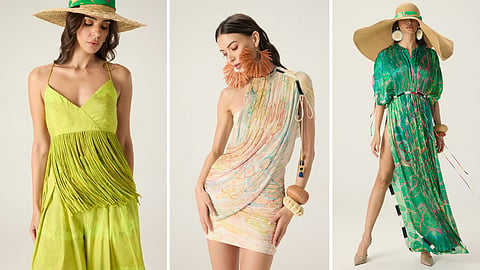
Appliqué is more than just a decorative technique—it is a tradition of resilience, beauty and resourcefulness that has travelled across cultures and centuries. With Reverie, Saaksha & Kinni gives appliqué a contemporary spin.
Appliqué transforms printed surfaces into dimensional compositions, with each motif individually cut, positioned and meticulously stitched by skilled artisans. Many of these elements are created using repurposed production offcuts, giving new life to leftover fabric while reinforcing the label’s mindful approach to design.
The collection also draws from the rhythmic patterns of Gujarati bandhani and the fluid movement of Rajasthani leheriya, reinterpreting these age-old textile traditions through bold, contemporary narratives.
Saaksha Bhat, co-founder of Saaksha & Kinni, takes us through the intricacies of the collection.“Reverie started with the idea of daydreaming, that beautiful space between reality and imagination where you allow yourself to be completely free,” says Saaksha, who wanted the collection to feel like that: colourful, fluid and a little unexpected. They were particularly drawn to the idea of taking familiar Indian textile traditions and looking at them through a contemporary lens. “Bandhani and leheriya became starting points, but rather than reproducing them literally, we wanted to break them apart, reinterpret their rhythm and translate them into something that felt like what the brand is known for,” she adds.
The duo has treated the garments like a canvas for appliqué, where they could build, layer and cut into the surface rather than simply placing a print onto a fabric. “It also felt like a very natural way to bring our love for craft and colour together. The technique allowed us to create something that felt handmade and tactile, but at the same time, graphic, modern and quite bold,” shares Saaksha.
What drew them to appliqué was its dimensionality. “There is something very special about seeing individual pieces come together to create an entirely new visual. It also has an element of spontaneity. You can keep moving things around, layering different colours and shapes, and the final result has a sense of imperfection that makes it feel truly handcrafted,” admits Saaksha.
When it comes to print, it simply sits flat on the surface. Appliqué, however, becomes part of the construction of the piece. “The layers create texture, shadows and depth, so the design changes as the garment moves. From a distance, it reads as a bold graphic, but when you come closer, you discover all these little details and textures,” she says.
Using production offcuts became an exciting part of the creative process. Rather than looking at leftover fabric as waste, they started looking at it as another resource for the collection. “The colours, shapes and quantities available influenced how some of the appliqué was developed. It made the process more spontaneous and encouraged us to work with what we already had, giving the pieces another layer of individuality while also being more conscious about how we use our materials,” says Saaksha, giving us another reason to love the garments.
It is the sense of rhythm that attracted the designers to bandhani and leheriya.
Bandhani is characterised by the repetition of dots, and the idea of creating an image through hundreds of small interventions. Leheriya, meanwhile, is more about the movement and fluidity of lines. “We abstracted those elements rather than interpreting them traditionally. You can see their influence in the movement of the appliqué, the lines, the pleating and the way patterns travel across the garments,” she explains.
The colours are joyful and optimistic. The palette of deep blue, emerald, fiery red, lime and orange was inspired by the intensity of Indian landscapes and the energy of celebration. “There is also a sense of contrast in the palette, colours that you might not traditionally put together but which somehow become very harmonious when placed next to each other,” she says.
The micro-pleating is inspired by the traditional Gujarati technique of crushing. Here, the designers have taken a technique rooted in a traditional textile vocabulary and translated it into a more sculptural, contemporary form. “Because it is done by hand, every piece has a slightly different character. It gives the garments beautiful movement and texture while keeping them light and fluid,” says Saaksha, who adds that craft has an incredible place in contemporary fashion, but the way we approach it has to evolve.
So, is there another craft technique she would like to experiment with next? “There are so many,” she says, adding, “We are always researching Indian crafts and thinking about how we can reinterpret them. I would particularly love to explore more three-dimensional textile techniques and surface manipulation—techniques where the craft actually becomes part of the architecture of the garment.”
Rs 15,000 onwards. Available online.
—manuvipin@newindianexpress.com
@ManuVipin
For more updates, join/follow our
https://www.whatsapp.com/channel/0029Vb677uz60eBXiDYheb0n