
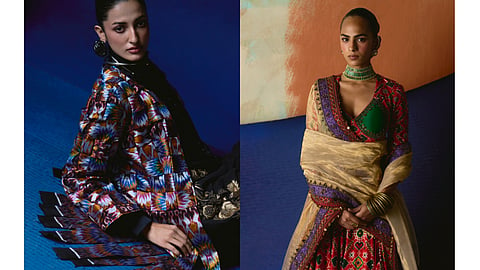
Swadesh collaborates with Mayyur Girotra to celebrate India's rich textile traditions

India’s Textile Heritage has never been short of character. The challenge is finding new ways to wear it without losing what makes it distinctive. That is the idea behind the collaboration between Swadesh and designer Mayyur Girotra, which brings together the richness of regional crafts and a contemporary design vocabulary. Kanjeevaram, patan patola, banarasi, ikat, bandhani, kalamkari and pochampally take centre stage in the collection, each bringing its own history, technique and regional identity. Rather than simply revisiting these traditions, the collaboration explores how they can find a place in today’s wardrobe while retaining their individuality.
The beauty of regional textiles
For Mayyur, this is an extension of a journey that has long informed his work. His travels across India, interactions with artisan communities and interest in lesser-seen textile techniques have shaped a design language that draws on both heritage and experimentation. Through The Collectables by Mayyur Girotra, this exploration has also taken an archival turn, with vintage textiles, handlooms and traditional techniques being restored, reworked and given a new lease of life.
We speak to Mayyur Girotra about the collaboration, the craft traditions that shaped the collection and the importance of keeping India’s textile heritage relevant.
What inspired the collaboration between House of Mayyur Girotra and Swadesh?
The collaboration came from a very natural alignment in the way both Swadesh and I look at Indian craft. There is a shared respect for the textiles, the people who create them, and the generations of knowledge behind them. I have always believed that our crafts do not need to be reinvented; they need to be discovered, understood, celebrated and given new contexts. With Swadesh, there was an opportunity to explore that through the House of Mayyur Girotra’s design language.
How did you select the Indian textiles and craft traditions for the collection?
We wanted the collection to reflect the incredible diversity of Indian textiles. Each textile comes from a different region, carries a distinct technique, and brings its own visual language. Together, they tell a much broader story of Indian craft.
What attracted you to kanjeevaram, patan patola, banarasi, ikat, bandhani, kalamkari and pochampally?
It was really their differences that attracted me. Kanjeevaram and banarasi have this incredible richness, patan patola is about precision, ikat has a beautiful movement, bandhani is incredibly intricate, kalamkari carries stories; and Pochampally has such a strong geometric identity. The excitement was in seeing how these different languages could enter the world of House of Mayyur Girotra without losing their individual character.
How have you reinterpreted these traditional textiles through your embroidery and customisation?
The textile was always the starting point. We worked with colour, scale, placement, silhouette and embroidery to build around its existing character rather than overpower it. You see that in our signature MG jackets worked around ikat, and in an exclusive kalamkari piece where we have explored the story of Krishna Leela.
Was there a particular textile or craft technique that was especially interesting to work with?
I found ikat particularly interesting because of its slight movement and softness of the edges. Working that fluidity into the structure of our signature MG jackets created a very interesting dialogue between the textile and the House.
What were some of the challenges of bringing these traditional textiles into a contemporary design language?
The challenge was knowing when to intervene and when to let the textile speak for itself. These crafts already have such strong identities, so it was important that our design language added another dimension without taking away what makes them special.
Do you see collaborations like this playing a role in keeping traditional crafts relevant for a new generation?
Absolutely. But relevance has to go beyond simply making heritage fashionable for a season. A craft remains alive when there is appreciation for it, demand for it and a reason for the next generation of artisans to continue practising that knowledge. Collaborations can give these traditions new contexts and introduce them to audiences who may not otherwise engage with them.
What do you hope people take away from this collection about India’s textile heritage?
I hope people come away understanding just how extraordinary and diverse India’s textile heritage is. I would love for the collection to make people more curious about where these textiles come from, who makes them and the stories they carry.
Price on request. Available online.
—manuvipin@newindianexpress.com
@ManuVipin
For more updates, join/follow our WhatsApp, Telegram and YouTube channels.