
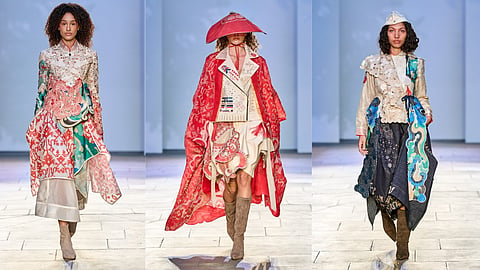
Jajaabor's latest collection bridges Bengal and Japan through love, revolution, and craftsmanship

A freedom fighter, a love story and a bowl of curry—Jajaabor’s latest collection has an unusual story to tell. Inspired by revolutionary Rash Behari Bose’s journey from Bengal to Japan, The Other Bose—A Taste of Love and Revolution explores the meeting of two cultures through fashion. Presented in London with Oxford Fashion Studio, the collection brings together Japanese minimalism and Bengali craftsmanship, pairing kimono-inspired silhouettes with jamdani, kantha and sashiko.
Jajaabor’s The Other Bose: The Story Behind the Collection
At its heart is the story of Indo Karii, an Indian curry that travelled to Japan and became a symbol of love, migration and cultural exchange. Founded by Kanika Sachdev and Neelanjan Ghosh, Jajaabor—meaning “nomad” in Assamese—was born from a desire to discover stories, cultures, crafts and places and weave them into a contemporary expression of fashion. Neelanjan tells us how history, food and craftsmanship came together in this collection.
What first drew you to the story of Rash Behari Bose? Why did you choose to explore his journey through fashion?
Our fascination with Japan began almost a decade ago, even before Jajaabor existed. We were mesmerised by how its centuries-old traditions and craftsmanship coexisted with a contemporary world. Even then, we remember thinking that if we ever had a brand of our own, we would create a collection inspired by Japan. When we returned last year, we already knew we wanted to explore Japan through our next collection. But while walking through Shinjuku, we stumbled upon Nakamuraya and discovered the story of Indo Karii and Rash Behari Bose. Suddenly, the collection had found its narrative.
His extraordinary life of exile and belonging, love and rebellion, and cultural exchange fascinated us. His journey became our bridge between Bengal and Japan, allowing us to tell his story through textiles, silhouettes and craftsmanship.
What does “love and revolution” mean to you in the context of this collection?
Looking at Rash Behari Bose’s life, two forces remained constant: revolution and love. His love for India, Toshiko, Japan and even food. He was an important figure in India’s freedom struggle, and even after escaping to Japan, he continued working towards Indian Independence. He later played a significant role in the Indian Independence movement in Southeast Asia, eventually handing over its leadership to Subhas Chandra Bose.
Yet his life was equally defined by love. He married Toshiko Soma, embraced Japanese culture, and built a family there. For us, love and revolution weren’t opposing forces. They existed alongside each other, shaping his life and legacy. We wanted to tell his story not merely as a revolutionary, but as a man whose life brought together love, rebellion, food, culture and belonging.
How did his connection with Japan influence the collection?
Rash Behari Bose’s journey allowed us to take our exploration of jamdani from our previous collection, Calcutta–Kolkata, further. While our previous collection explored Bengal’s rich visual language, The Other Bose allowed us to take that exploration beyond Bengal and into Japan. His story inspired us to create a visual and textile bridge between the two cultures, bringing together their craftsmanship, influences and shared history.
How did you bring Bengali and Japanese influences together without making them feel literal?
Rather than simply placing recognisable elements from both cultures alongside each other, we looked for similarities in their craftsmanship and visual languages. We were fascinated by the similarities between kantha and sashiko, particularly their hand-stitching, repetition and considered craftsmanship. We also drew from Japanese architecture, traditional motifs, lanterns, flags, and everyday visual references encountered during our travels, interpreting these alongside Bengali textiles. The idea was to create a conversation between the two cultures rather than simply juxtapose them.
Tell us about the kimono-inspired silhouettes and how they work with Bengali drapes.
We were interested in how these two distinct approaches to dressing could exist within the same garment. The kimono-inspired forms brought a Japanese influence to the silhouettes, while the Bengali drapes introduced another layer of movement and textile expression. Rather than recreating traditional garments, we wanted to borrow from their design languages and reinterpret them in a contemporary way.
How did crafts such as jamdani, kantha and sashiko shape the collection?
We continued our exploration of jamdani while bringing kantha and sashiko into the conversation. One of our most fascinating discoveries was how kantha and sashiko, despite belonging to two distinct cultures, share an inherent simplicity. Both celebrate hand-stitching, repetition and the beauty of creating something meaningful through humble, considered craftsmanship. Alongside jamdani, these techniques helped us create a textile language that didn’t belong exclusively to either culture but celebrated the dialogue between them.
The curry bowl is an unexpected symbol in a fashion collection. What does it represent for you?
For us, the bowl of curry represents migration, cultural exchange, love and revolution. It tells the story of Rash Behari Bose finding a home in Japan and bringing a taste of India to a foreign land. We wanted to transform the humble bowl of Indo Karii into a visual language that could travel from Nakamuraya in Shinjuku to a runway in London. A bowl of curry became our canvas, a revolutionary became our muse, and a century-old Bengal—Japan connection became our story to tell the world.
What did presenting this collection in London mean for Jajaabor?
After nine years of building Jajaabor and showcasing our collections in India, including at Lakmé Fashion Week, presenting The Other Bose in London was an important milestone for us. It marked our first international runway presentation and the beginning of our journey in Europe. More than anything, it was an opportunity to introduce our designs and torytelling to an entirely new audience, understand how our work resonates outside India and build relationships within the European fashion community. For a label that has always been inspired by travel and discovering new cultures, taking our own story to London felt particularly meaningful.
Rs 27,000 onwards. Available online.
—manuvipin@newindianexpress.com
@ManuVipin
For more updates, join/follow our WhatsApp, Telegram and YouTube channels.