
- LIFESTYLE
- FASHION
- FOOD
- ENTERTAINMENT
- EVENTS
- CULTURE
- VIDEOS
- WEB STORIES
- SPORTS
- GADGETS
- CAR & BIKE
- TRAVEL
- SOCIETY
- GALLERIES
- NORTH EAST
- INDULGE CONNECT

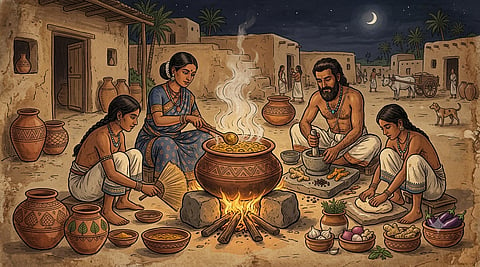
Many centuries before the microwave oven became available, the Harappans cooked a recipe that wouldn't seem very strange to us today. Archaeologists have discovered an ancient curry in Farmana, Ghaggar Valley, near present-day Delhi, made with aubergine, ginger, turmeric, and salt.
The identification involved the use of starch testing, which is a scientific method used by scientists to detect plant residues through the microscope. The world's oldest curry reportedly came from a small piece of a round cooking pot referred to as a handi.
The three ingredients, which made up the base of the said proto-curry, included aubergine, ginger and turmeric, in addition to salt. In further study, the presence of fruits such as mangoes, bananas, dates, and gourds was detected. Plant microfossils were studied, and the effect of heat, salt and sugar was analysed.
The world's oldest curry requires six to seven baby eggplants, an inch-sized piece of ginger, fresh or half a teaspoon of powdered turmeric, salt, one tablespoon of raw mango cubes, two to three tablespoons of sesame oil, and half a teaspoon of cumin. Dried sugarcane juice is used to taste, and sweet basil leaves are optional.
For the preparation, ginger, turmeric, and cumin should be ground using water. Sesame oil is heated and mixed with the paste and allowed to cook for a few minutes. The aubergines and salt are added and stirred well; covered and cooked until half-cooked. Water can be added if required. Mango and sugarcane juice are added to the mixture and left to simmer until the mango is cooked.
Scientists obtained starch molecules from 50 different surfaces, which included pottery, stones, human dental enamel, as well as the dental enamel of domestic cattle. Cattle were used in the experiments because they were mostly fed food scraps. Through this process, scientists discovered traces of plant matter in ancient diets.
or more updates, join/follow our WhatsApp, Telegram and YouTube channels.