
- LIFESTYLE
- FASHION
- FOOD
- ENTERTAINMENT
- EVENTS
- CULTURE
- VIDEOS
- WEB STORIES
- SPORTS
- GADGETS
- CAR & BIKE
- TRAVEL
- SOCIETY
- GALLERIES
- NORTH EAST
- INDULGE CONNECT

Homes are our safe zones. We are all familiar with that feeling of comfort we experience at home. We tend to see hotels as safe spaces, too, with predictable surroundings. But sometimes, you step into a hotel corridor that stretches farther than your eyes can see, your heart starts beating faster, and you don’t know why.
YouTubers cash in on this fear by checking into so-called haunted spaces and walking us through every nook and cranny. They may be playing on our fears, but science suggests that our brains can misread their surroundings. Studies show that architecture can deceive our senses, turning familiar places into something eerily unfamiliar.
How our brains survey a space
When you step into a building you’ve never visited before, such as a new house, your body pauses as the air shifts and the light changes. Our brain almost immediately starts building an internal ‘map’ of the space, says Lisa Giocomo, professor of neurobiology at Stanford University School of Medicine, in an interview with National Geographic.
There may also be a range of inaudible or barely audible noises, including infrasound, generated by sources such as old pipes, ventilation systems and air conditioning. These sounds may contribute to an uneasy state of mind and trigger a stress response, even when we are not consciously aware of them. This could help explain why some old houses feel spooky, leading people to believe they are haunted.
Some studies suggest that infrasound may cause adverse reactions, such as sleep disturbances, anxiety and discomfort, while others have found little evidence of such effects.
Why decay stirs unease
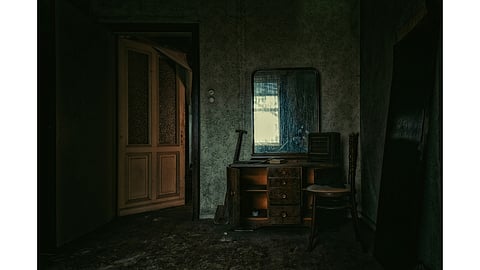
When we see an old house with noticeable signs of decay, abandoned halls, large or unusually small rooms, or the smell of rot and dust, our brains may interpret these cues as signs of neglect or potential danger. Research into environmental psychology suggests that certain surroundings can influence our sense of safety and comfort.
The same applies to new houses and unfamiliar buildings, where the brain is still processing sensory information and spatial cues. Even in a hotel, an unfamiliar space can make us feel uneasy. The echo of footsteps along a long, empty corridor, for instance, can heighten our sense of isolation.
Disorientation tricks the mind
Our brains rely on landmarks to navigate spaces, while many so-called haunted places lack clear visual cues. When we are unsure of our surroundings, the brain may struggle to establish where we are, leading to mild disorientation and a sense that something might be unsafe.
Studies suggest that changes in spatial complexity and lighting can influence physiological arousal, making people more alert as they move through certain kinds of rooms. In fact, architects have long used such principles, intentionally or otherwise. We see this in the disorienting symmetry of the Hall of Mirrors at Versailles, as well as in Brutalist buildings with their echoing voids.
Perhaps what makes a place feel haunted is not a ghost from its past, but the way its architecture, sounds and shadows affect our brains. Sometimes, the most unsettling presence in an unfamiliar space is the mind trying to make sense of what it cannot quite understand.
—manuvipin@newindianexpress.com
@ManuVipin
For more updates, join/follow our WhatsApp, Telegram and YouTube channels.