
- LIFESTYLE
- FASHION
- FOOD
- ENTERTAINMENT
- EVENTS
- CULTURE
- VIDEOS
- WEB STORIES
- SPORTS
- GADGETS
- CAR & BIKE
- TRAVEL
- SOCIETY
- GALLERIES
- NORTH EAST
- INDULGE CONNECT

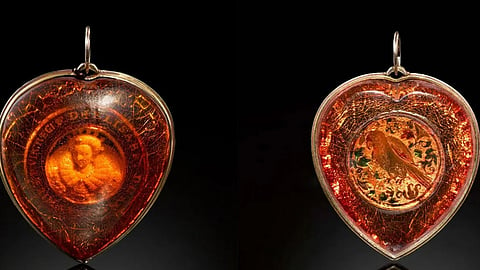
A small heart-shaped amber pendant, bought for a modest sum at an Edinburgh auction house last November, is heading back to the block at Sotheby’s London today carrying an estimate roughly 20 times higher than what its current owner paid for it.
When the pendant crossed the auction floor in Edinburgh last autumn, it changed hands for just £5,588 (about $7,350). At the time, it was catalogued as a 19th-century ‘Elizabethan-style’ trinket. Nobody in the room appears to have suspected they were looking at anything older. The buyer thought otherwise. After acquiring the piece, the anonymous consignor brought it to Sotheby’s, where specialists in sculpture and works of art took a much closer look and the story changed dramatically.
Using microscopy and x-ray fluorescence analysis, Sotheby’s experts, working with a former Victoria and Albert Museum jewellery conservator, concluded that the pendant was not a 19th-century imitation at all, but an authentic artefact dating to around 1600, the final years of Elizabeth I’s reign.
At the centre of the piece is a tiny carved portrait of the queen, sealed inside a curved dome of amber that magnifies the image beneath it. Art historians say that technique predates the invention of the magnifying glass by nearly a century.
Experts have tentatively attributed the work to Hans Klingenberg or Georg Schreiber, two amber carvers associated with the ducal court in Königsberg. The reverse of the pendant bears a separate carved image of a parrot, a symbol Renaissance artists sometimes linked to purity and the Virgin Mary.
An inscription encircling the portrait identifies the sitter in Latin as Elizabeth, by the grace of God, queen of England, France, Ireland, and Virginia.
The pendant now goes under the hammer as part of Sotheby’s ‘Master Sculpture from Four Millennia’ sale in London, carrying a pre-sale estimate of £100,000 to £150,000 — as much as 27 times its price just seven months ago. It ranks as one of the top lots of the sale, trailing only a previously unrecorded 17th-century carved nautilus shell estimated at up to £400,000.
Whatever the final hammer price, the pendant’s journey stands as a reminder that even in a field as heavily studied as Tudor royal portraiture, discoveries are still waiting to be made, sometimes in plain sight.
For more updates, join/follow our WhatsApp, Telegram and YouTube channels.