
- LIFESTYLE
- FASHION
- FOOD
- ENTERTAINMENT
- EVENTS
- CULTURE
- VIDEOS
- WEB STORIES
- SPORTS
- GADGETS
- CAR & BIKE
- TRAVEL
- SOCIETY
- GALLERIES
- NORTH EAST
- INDULGE CONNECT

For many, sindoor is synonymous with a deep shade of red. Applied along the parting of a married woman's hair or worn as a mark on the forehead, it is one of the most recognisable symbols of marriage in Hindu traditions. However, a closer look at regional customs reveals that sindoor does not always appear in the same shade. In some communities, it takes on a distinctly orange or saffron hue, raising an interesting question — when and why does a symbol so closely associated with red sometimes lean towards orange?
Traditionally, sindoor and kumkum have been prepared using different ingredients, and their colours can vary depending on the method of preparation.
The word sindoor is derived from the Sanskrit word sindūra, and traditional recipes for the powder often relied on simple ingredients. Turmeric, a golden-yellow rhizome, changes colour when mixed with an alkaline substance such as slaked lime.
The shade depends on proportion, so a little lime gives a warm orange hue and more lime pushes the preparation towards red. Different households, villages and regions settled on their own formulas, and their own shades.
Historically, some forms of sindoor also contained cinnabar or mercuric sulphide, a naturally occurring mineral pigment that produces a vivid red colour. Red lead, used as a cheaper substitute, leant a distinct orange hue.
Both mercury-based cinnabar and lead-based pigments are toxic and this has revived interest in herbal, turmeric-based versions.
Chemistry explains how sindoor can turn orange, but cultural symbolism helps explain why the colour holds significance.
In Indian religious traditions, saffron and orange are considered auspicious and spiritually significant. They evoke Agni, the sacred fire that carries offerings to the gods, as well as the rising sun and its life-giving energy. Orange is also associated with renunciation and spiritual discipline, traditionally worn by monks and ascetics who have relinquished worldly attachments.
Orange sindoor therefore sits between two ideas — the auspiciousness of marriage and the purity of the divine.
Hanuman offers a well-known example of the religious significance. In a popular legend, he saw Sita apply sindoor and asked why. She explained that it prolonged her husband Rama’s life. Hanuman, devoted to Rama, smeared his entire body with the powder. Devotees still offer orange-vermilion sindoor mixed with oil to Hanuman images, which is why so many shrines are coated in it.
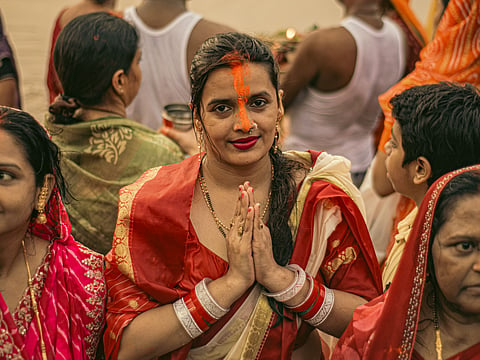
One of the most striking examples of orange sindoor can be seen during Chhath Puja, particularly in the traditions observed in Bihar and parts of eastern Uttar Pradesh. During the festival, married women observing the fast, known as vratins, often apply a long streak of bright orange sindoor extending from the bridge of the nose towards the hairline and along the parting of their hair.
This distinctive application is referred to as Bhakra or Bhakhra in descriptions of Chhath traditions. Its orange hue is associated with Surya, the Sun God, whose worship lies at the heart of the four-day festival.
The colour evokes the sun's radiance, energy and life-giving power. The ritual is also associated with prayers for the well-being and longevity of the family.
The difference between red and orange sindoor is not merely a matter of personal preference or changing beauty trends. It reflects the diversity of India's religious and cultural practices.
In Bihar and neighbouring regions, the long, orange streak worn during Chhath is a distinctive expression of devotion. In Bengal, by contrast, bright red sindoor is closely associated with Goddess Durga and the festival of Sindoor Khela. On Vijaya Dashami, married women smear one another with vermilion as they bid farewell to the Goddess, celebrating marital auspiciousness, womanhood and the triumph of good over evil.
In Hindu traditions, red is closely associated with Shakti, the creative and protective energy of the Goddess. It is linked to Durga, Parvati and Lakshmi, as well as to blood, fertility, vitality and the life force. Wearing red sindoor is therefore traditionally understood as invoking auspiciousness and divine protection for a woman's marriage and household.
Orange, yellow and saffron, meanwhile, carry their own layers of religious meaning. Turmeric has long featured in Hindu weddings and ceremonies, associated with prosperity, fertility and good fortune. Saffron represents sacrifice, renunciation and spiritual discipline, while orange evokes fire and the sun. These associations explain why orange-toned powders and markings find a place in certain rituals alongside the more familiar red vermilion.
The placement of sindoor is significant, too. The parting of the hair, known as the maang or simanta, has traditionally been associated with marital auspiciousness. In some religious and cultural interpretations, the line is regarded as a symbolic opening through which blessings and positive energy enter.
For more updates, join/follow our WhatsApp, Telegram and YouTube channels.