
- LIFESTYLE
- FASHION
- FOOD
- ENTERTAINMENT
- EVENTS
- CULTURE
- VIDEOS
- WEB STORIES
- SPORTS
- GADGETS
- CAR & BIKE
- TRAVEL
- SOCIETY
- GALLERIES
- NORTH EAST
- INDULGE CONNECT

In order to become India’s Silicon valley, Bengaluru first had to step out of the dark, and its story began in the year 1905. For years, cities across India traversed through low lit lanes as the dusk approached and the sun set. To fight that, an army of lamplighters would make their way through the lanes and light up the streets with tiny sparks of fire. One took charge of clearing the black soot from glass lanterns. Another filled them with kerosene. A third struck a match to bring a dim, yellow glow to the dark. But it all changed in 1905 when Bengaluru’s street lit up with electricity for the very first time, thanks to the mighty waters of a waterfall hundreds of kilometres away.
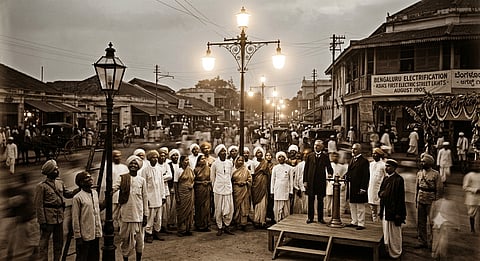
On the evening of August 1905, pedestrians gathered across the streets of KR market in Bengaluru and found something interesting taking shape. They still didn’t know that they were witnessing a beautiful historic moment. As per early reports, at exactly 7 pm, with a flick of a switch, electricity flowed through the streets for the very first time, and Bengaluru quite literally lit up! It became the first city in Asia to have electric street lights.
Now, a little backstory on this groundbreaking moment, it kind of started off like a charity case. Back then, a gold mine, the Kolar Gold Fields, hundreds of kilometres away from the town, was at its peak, producing lots of gold. Miners dug deeper each day and the kingdom was getting richer than ever. But at night working in the dark came as a problem. So, the engineers decided to generate electricity for the mines from the mighty Shivanasamundra falls. Following its successful construction, each day the waterfall would help generate electricity to the mine which was about 150 km away. Now, in 1905, there came a time when the falls would generate 2,000 horsepower in surplus amount.
As the transmission lines passed through Bengaluru, the then engineers came up with a proposal: Why not use the surplus power to light up the streets of Bengaluru? The Chief Engineer, William McHutchin wrote to the Maharaja of Mysore, Nalwadi Krishnaraja Wadiyar, for an approval, and soon the project got a go-ahead. In just nine months, engineers laid 57 kilometers of transmission lines from Kankanhalli, modern-day Kanakapura, straight into the heart of the city.
In August of 1905, Sir John Hewett, a member of the Viceroy’s Council got onto the streets and flipped a switch and thereon, Bengaluru received its first ever street lights. Initially electricity was a luxury with a handful of people experiencing it at their private homes. But gradually it reached hundreds of households, government buildings and commercial establishments.
As per reports, the entire electrification project cost around INR 6 lakh, with an annual maintenance cost of INR 50,000 back then. By June 1906, the city reportedly had 861 streetlights and 1,639 domestic connections. The government also started a scheme of INR 1 bulb per month which turned out to be immensely profitable over the years.
And that’s how a waterfall hundreds of miles away, with its thunderous force lit up a whole city!
For more updates, join/follow our WhatsApp, Telegram and YouTube channels.