
- LIFESTYLE
- FASHION
- FOOD
- ENTERTAINMENT
- EVENTS
- CULTURE
- VIDEOS
- WEB STORIES
- SPORTS
- GADGETS
- CAR & BIKE
- TRAVEL
- SOCIETY
- GALLERIES
- NORTH EAST
- INDULGE CONNECT

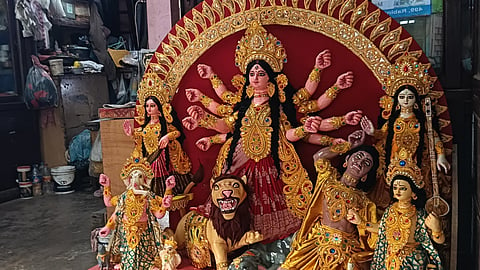
Every year when the rhythms of the dhaak fill the air and the shiuli starts to bloom, one knows that it's time for the Goddess’ arrival. With the khunti puja, modern pandals start their journey, and the traditional practices and rituals kick off in the bonedi bari’s of North Calcutta.
It is in these bylanes that one proverb escalated: Maa eshe goyna poren Jorashankhor Shib Krishna Daw barite, bhog khaye Kumartulir Abhay Charan Mitra barite and raat jege nrittyo dekhen Sovabazar Rajbarite (translation: The Goddess wears her jewellery in Jorashanko’s Shib Krishna Daw house, eats her fill at Kumartuli’s Abhay Charan Mitra’s house and watches performances throughout the night at Sovabazar Rajbari).
While there are many such sayings and beliefs, this one is still prominent after its revival in the 2018 adventure film starring Anirban Bhattacharya and Parno Mitra, Alinagarer Golokdhadha. Moreover, with the rise of digital content and a newfound love for bonedi bari’s, people set off to document and archive such trivia before they fade away. We set out wandering through the lanes of North Calcutta to discover the truth behind the saying.
Jorasankho Shib Krishna Daw
Post a 3- minute walk from the Girish Park Metro station, our first stop was the Jorashankho Shibkrishna Daw Bari. Located inside the Shib Krishna Daw lane, the Puja celebrates its 187th year in 2026. Established by Gokul Chandra Daw in 1840, it rose to prominence due to the genius of his descendant Shibkrishna Daw, whose innovation brought the already grand Puja to further limelight.
Priyobrata Daw, a family member, shed light on the saying, “The idiom is true, but in today’s digital era the meaning has slightly changed. Today people associate ‘jewellery’ with the imagery of kilograms of gold or diamonds, but that is not so. In those days, idol decorations were generally made of white shola called Dhaker Shaaj because the Shola used to come from Dhaka. But the traditional belief is that Shib Krishna Daw used to bring thin brass foils from Germany, made to appear like the Goddess’ jewellery.
They were coloured in gold, and these colours have not faded till now. The jewellery comprised the mukut, kaanpasha, choudani, etc. That is why the Goddess used to look different in appearance as opposed to the regular Dhaker Shaaj. From then on, the saying became famous that when the Goddess descends to Earth, she comes here to dress up first.”
Sovabazar Rajbari
Perhaps one of the prominent names that come to mind when describing North Calcutta to visitors or laymen is the Sovabazar Rajbari. The grand white palatial structure hosted the earliest Durga Puja that started in1757 under the guidance of Maharaja Nabakrishna Deb. Coming back to the popular saying, Nandini Mitra from the family sheds light on it.
According to her, “While we cannot pinpoint a particular date, it is said that the belief has been popular since the Durga Puja started in 1757. For quite a few years now, cultural performances have not happened here anymore. But the members of the family try their best to perform the Puja itself, adhering to all traditional beliefs and practices."
"Architecturally, the Naachghor was situated right opposite the Thakur Dalan. Several performances used to take place there. So, if one were to stand there, they could have seen the Goddess directly. The reason why this proverb keeps coming back even in 2026 is because of the grandeur of the location and the performances by popular performers of the time, including those who travelled from Benaras. This was considered very unique in those days.”
Kumartuli’s Abhay Charan Mitra Bari
It is said that the Goddess relishes the bhog/feast at Abhay Charan Mitra’s house. The house was said to have been situated in the bylanes of Kumartuli, where Gobindaram Mitra, the second Indian Deputy Collector, started the Puja in 1697.
It was later carried forward by his descendants. However, it was only when Abhay Charan Mitra took charge that the Durga Puja’s fame grew exponentially. It is said that the elaborate array of bhog included giant jalebis, nimki, radhaballavi, and more. Such were the taste and preparations that even the Goddess was said to favour him. Locals say that today the Durga Puja has shifted elsewhere and his descendants could not be reached either. But through local whispers, it is evident that the saying did have some hold back in the day.
For more updates, join/follow our WhatsApp, Telegram and YouTube channels.