
- LIFESTYLE
- FASHION
- FOOD
- ENTERTAINMENT
- EVENTS
- CULTURE
- VIDEOS
- WEB STORIES
- SPORTS
- GADGETS
- CAR & BIKE
- TRAVEL
- SOCIETY
- GALLERIES
- NORTH EAST
- INDULGE CONNECT

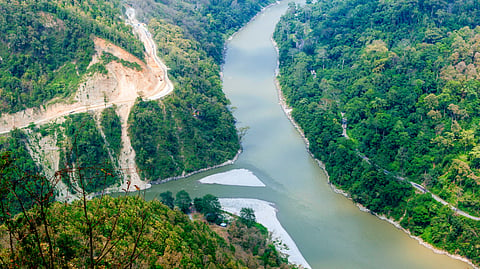
The Lepchas, indigenous people of the eastern Himalayas whose ancestral homeland encompasses Sikkim and the Darjeeling hills, have long understood the landscape around them through stories in which mountains possess divinity, rivers harbour desire and the fate of the living world is inseparable from the caprices of its natural forces. Their traditional homeland, Mayel Lyang, is often described as a hidden paradise, a place held in collective memory through oral histories, spiritual beliefs and generations of storytelling. Among these folklores is a love story whose protagonists are the Teesta and Rangit rivers, and whose emotional tumult carries wounded pride, catastrophic fury and the arduous grace of reconciliation.
According to one version of the legend, Rongnyu and Rangit were creations of Itbu-moo, the Mother Goddess, whose blessings could not protect their romance from the vicissitudes of fate. Having fallen in love, the pair prayed to Kongchen Kongchlo, associated with Mount Khangchendzonga, before leaving their homeland of Mayel Lyang for the distant plains, agreeing to meet at Peshok after racing along separate routes. Rongnyu entrusted herself to Parilbu, a serpent whose steady constancy proved more dependable than Tutfo, the mountain bird chosen by Rangit, whose flight was repeatedly diverted by fruit-laden trees, flowers and insects.
By the time Rangit arrived at their rendezvous, Rongnyu was already waiting, and his astonished exclamation, “Thi-sa-tha?”, meaning “When did you arrive?” in the telling of the legend, is said to have given rise to the name Teesta. Humiliation curdled into fury, and Rangit retreated towards the Himalayas with such destructive force that the waters rose to engulf Mayel Lyang, driving the Lepchas, along with the creatures that shared their homeland, towards the heights of Tendong Hlo, the mountain that rose above the deluge to offer refuge.
Desperate prayers followed, until Kahomfo, the partridge, offered millet to the mountain deity and pleaded for mercy on behalf of the imperilled living world. The Mother Goddess relented, the waters receded and the survivors were spared. Only then could the lovers reconcile, with Rongnyu soothing Rangit's fury and the pair resuming their journey together towards the plains, their waters meeting in a confluence that continues to hold significance in Lepcha cultural memory.
Email: anoushkakundu@newindianexpress.com
For more updates, join/follow our WhatsApp, Telegram and YouTube channels.