
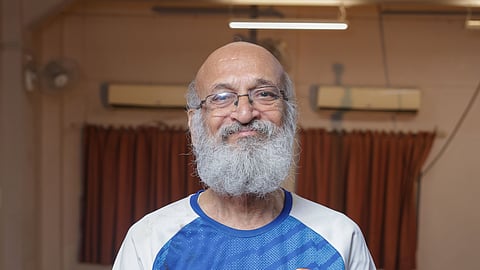
Padmashri Uday Deshpande on reviving Mallakhamb

Padmashri Uday Vishwanath Deshpande is a pivotal force in reviving the ancient sport mallakhamb in modern times. Founder of Vishwa Mallakhamb Federation, Uday has made the sport gender and age inclusive. He has also trained notable celebrity dancers like Daksha Seth and Isha Sharvani, among others. On the sidelines of his mentorship at the Movement Bootcamp organised by Sapphire Creations Dance Company, we catch up with him on mallakhamb, his contributions, and where the sport stands today.
How did mallakhamb originate?
Mallakhamb is an ancient Indian traditional physical culture. It’s a simple wooden pole about 8.5 ft tall, smooth, polished, and tapered at the top. Another form is rope mallakhamb, a 16 ft-high cotton-canvas rope for acrobatic exercises and yogic postures.
A complementary exercise for wrestling, it started during the time of the second Bajirao Peshwa of Maharashtra about 250 years ago. Two wrestlers from Hyderabad had challenged wrestlers in Pune. A 17- 18-year-old boy, Balambhatt Dada Deodhar, prayed to Goddess Saptashrungi, representing the seven hills. The Goddess was pleased by his penance and said Hanuman would show him some wrestling tricks in dreams. So, Bajrangbali gave him the insight of wrestling on a wooden plank. He came back and defeated the Hyderabadi wrestlers. That is why it’s known as mallakhamb – malla meaning wrestler and khamb meaning pole.
When the British defeated the Peshwa, he travelled on foot to places like Surat, Ujjain, Varanasi, Kanpur and Balambhatt, setting up akhadas en route. Today, though these akhadas continue to exist, the trainers are dwindling.
What physical parameters are needed to practise mallakhamb?
There is no prerequisite. Anyone can learn mallakhamb at any age. It is a complete exercise. It enhances strength, stamina, speed, endurance, flexibility, neuromuscular coordination, balance, confidence, and courage. It tones the biceps and triceps and the respiratory, digestive, and circulatory systems. It improves your disease resistance. I know someone who started learning mallakhamb at 82 and gave a live demonstration at 89 during the first World Championship in 2019.
How do you handle apprehensive students?
Courage is not the absence of fear, but willingness to perform despite it. Initially, they are afraid to climb the pole or sit and stand. But after a lot of practice, they gain confidence and improve a lot. An acquaintance has done a PhD on mallakhamb and its mental benefits. It has been scientifically proven that practitioners are apt at quick decision-making, overcoming fear, public speaking, etc.
It’s usually advised not to stand upside down for long, but in mallakhamb, certain postures keep one suspended upside down. What are its medical effects?
The brain and body need blood circulation throughout. When you stand or sit, the blood doesn’t reach the top of your head. There are many inverted positions in which, if we stay for a short while, the blood flow becomes smoother.
Traditionally, mallakhamb was practised by men, but you have made it inclusive for everyone. How challenging was it to break the glass ceiling?
Initially, only men practised it because women were restricted. People thought that it disturbed their cycles or hampered their pregnancy chances. I conduct classes for ladies between 15 and 55 years. When I teach the visually impaired, I give them simple voice instructions. They were initially hesitant, but now it has changed. I know Pranjal Patil, who practised mallakhamb and accompanied me to many places for demonstrations. Today she is the first visually impaired IAS officer in India.
Do you think physical education (PT) still does not get its due?
Absolutely. PT still means standing on the ground and doing some free-hand exercises. But teaching the basics of various sports is still not done. It’s important to emphasise sports because it develops overall personality.
What is preventing mallakhamb from reaching the mainstream?
More patronage is needed. We say mallakhamb should be introduced in schools, but we need trained teachers for that. We also need publicity.
Where should a person start if they want to learn mallakhamb?