
- LIFESTYLE
- FASHION
- FOOD
- ENTERTAINMENT
- EVENTS
- CULTURE
- VIDEOS
- WEB STORIES
- SPORTS
- GADGETS
- CAR & BIKE
- TRAVEL
- SOCIETY
- GALLERIES
- NORTH EAST
- INDULGE CONNECT

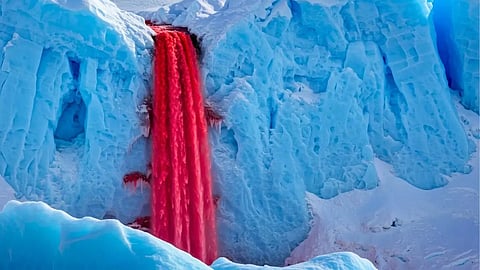
One of the natural wonders of Antarctica is Antarctica's blood fall. It is a dark red waterfall flowing out of the Taylor Glacier to Lake Bonney, located in the McMurdo Dry Valleys of Antarctica. Discovered in 1911 by Griffith Taylor, the rust-coloured waters had mystified the scientific community for over a century. While many speculated that the waterfall was connected to some sort of volcanic activity, researchers claim to have uncovered the secret behind the mysterious red waterfall.
Scientists have proven that this fall does not consist of blood. Rather, it is created by the flow of iron-containing brine found under Taylor Glacier. This water originates from a salty liquid found in an old reservoir located under the glacier for many years.
With the glacier constantly moving, there is an accumulation of pressure underneath the ice. The pressure pushes the brine through tunnels within the glacier, finally reaching the surface. With the water coming into contact with the atmosphere, is a chemical reaction between the iron and oxygen present. This results in the formation of iron oxide, which is the substance that causes rust.
The big discovery took place in 2017, when scientists from the University of Alaska Fairbanks employed the use of radar imaging to analyze the glacier. They identified a network of channels underneath the glacier that are under pressure and mapped out the course of brine movement within the glacier for about 300 meters until it reached the destination, which is Antarctica's blood fall.
Another reason for its liquid state is the extremely high amount of dissolved salts in the water. Salt decreases the freezing temperature to a level much lower than that of regular water. With the addition of heat, the solution manages to stay liquid under one of the world’s coldest glaciers.
It has also been discovered that there were ancient microorganisms existing in the brine water. These organisms could have been surviving beneath the glacier for many years without any light or air. There are also some other elements like Silicon, Calcium, Aluminium, and Sodium.
Moreover, the results can prove useful to researchers looking for life on other planets. This is because similar brine conditions may exist under the icy crust of both Mars and the moon of Jupiter, called Europa. That makes Antarctica's blood fall more than a geological curiosity.
For more updates, join/follow our WhatsApp, Telegram and YouTube channels.