
- LIFESTYLE
- FASHION
- FOOD
- ENTERTAINMENT
- EVENTS
- CULTURE
- VIDEOS
- WEB STORIES
- SPORTS
- GADGETS
- CAR & BIKE
- TRAVEL
- SOCIETY
- GALLERIES
- NORTH EAST
- INDULGE CONNECT

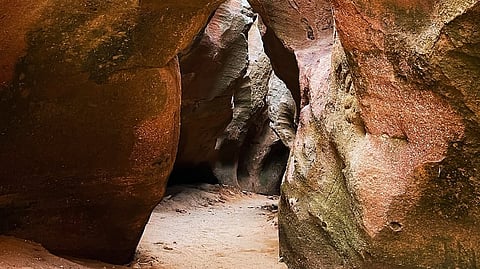
About 30 km from Puducherry, the landscape around Thiruvakkarai changes from the familiar coastal terrain to exposed sandstone, eroded gullies and fossilised tree trunks. The area forms part of the Cuddalore sandstone formation and its fossil wood dates to roughly 20 million years ago, placing it within the Mio-Pliocene geological period. The site is now recognised as a National Geo-heritage site and maintained by the Geological Survey of India.
The most unusual stop at this National Fossil Wood Park, is where sections of ancient tree trunks lie preserved in stone. The GSI explains that the wood was buried in sandstone deposits and that silica gradually replaced the organic material while retaining details such as annual rings and nodes. The park currently preserves around 181 fossil wood remains across nine enclosures, offering a rare opportunity to see evidence of an ancient landscape rather than simply read about it in a museum.
Walk through the park first before exploring the surrounding sandstone terrain. The exposed red and brown formations, uneven gullies and eroded surfaces give the area a distinctly different character from the greener landscapes around Puducherry.
Thiruvakkarai also has an archaeological layer. The wider area contains megalithic burial remains, adding evidence of human activity to a landscape whose geological history stretches back millions of years. The combination makes the destination particularly suited to travellers who are interested in geology, archaeology and less conventional heritage sites.
The nearby Vakrakali Amman Temple offers a contrasting stop after the fossil park. Thiruvakkarai works best as a slow exploration rather than a checklist of attractions. Begin with the GSI-managed fossil wood park, walk through the exposed sandstone landscape and then continue to the temple before returning towards Puducherry. It is a compact outing, but one that places geological history at the centre of the journey.
For more updates, join/follow our WhatsApp, Telegram and YouTube channels.