
- LIFESTYLE
- FASHION
- FOOD
- ENTERTAINMENT
- EVENTS
- CULTURE
- VIDEOS
- WEB STORIES
- SPORTS
- GADGETS
- CAR & BIKE
- TRAVEL
- SOCIETY
- GALLERIES
- NORTH EAST
- INDULGE CONNECT

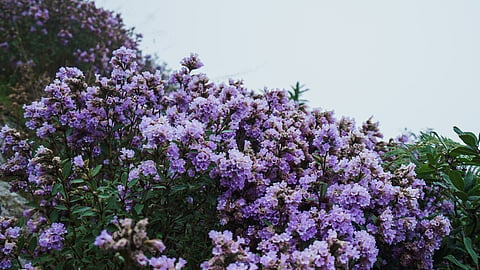
A neelakurinji flower takes twelve years to bloom, blooms exactly once, and then dies. Every twelve years or so, without forecast beyond botanical clockwork, the rolling grasslands of Munnar and its neighbouring hill ranges undergo a transformation. Slopes that have worn green for over a decade suddenly flush into a haze of violet-blue, as if the sky had slipped and settled onto the mountains.
The flower responsible is Strobilanthes kunthiana, a modest shrub that rarely grows taller than a person, found scattered across the shola-grassland ecosystems of Kerala, Tamil Nadu, and Karnataka. Munnar's Eravikulam National Park holds the country's densest concentration of it with thousands of hectares that spend most of their existence looking unremarkable, right up until the year they don't. It's not a coincidence that the Nilgiri hills owe their name to this very flower.
Each plant blooms exactly once in its life. It flowers, sets seed, and dies — full stop. There's no second act. The next generation has to germinate from that seed and spend the following decade-plus quietly growing toward its own single performance. The term for this one-and-done reproductive strategy is semelparity. This is a plant that spends 99% of its existence in preparation for a finale it will not survive.
But different populations, even within the same district, tick on their own independent cycles. The famous Eravikulam population in Munnar last painted the hills blue in 2018, with its next mass bloom not expected until 2030. But a separate population near Chokramudi and Mattupetty, which last flowered in 2014, has been blooming this year instead.
Kodagu in Karnataka saw its bloom in 2018, while Chikmagaluru's Mullayanagiri range lit up blue in 2022. Multiply that across the roughly 40-odd flowering varieties of Strobilanthes found in the region, several with entirely different cycles and the ‘once in 12 years flower’ turns out to be an ongoing, overlapping rotation across the Ghats.
Tourism surges overnight in bloom years, hillside homestays fill up, and photographers plan trips years in advance. But that popularity cuts both ways: the species was formally assessed by the IUCN for the first time only in 2024, and it landed on the Red List as Vulnerable — squeezed by plantation expansion, invasive species, and the very tourist footfall its beauty attracts.
If you're planning around the marquee 2030 Eravikulam bloom, mark the calendar now because by the time those hills turn blue again, you'll have had twelve years to get ready for it.
For more updates, join/follow our WhatsApp, Telegram and YouTube channels.