
- LIFESTYLE
- FASHION
- FOOD
- ENTERTAINMENT
- EVENTS
- CULTURE
- VIDEOS
- WEB STORIES
- SPORTS
- GADGETS
- CAR & BIKE
- TRAVEL
- SOCIETY
- GALLERIES
- NORTH EAST
- INDULGE CONNECT

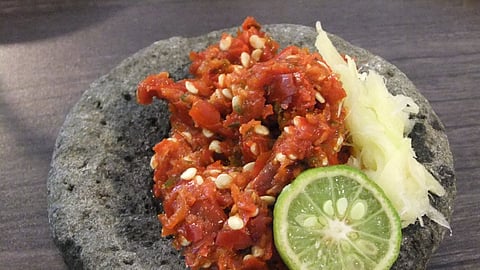
Sambal is less a single recipe than a habit. Across Indonesia, Malaysia and Singapore, a plate of rice, fish or vegetables can feel oddly unfinished without a spoonful of it on the side. The chilli is the constant. Almost everything else changes: the shallots, the garlic, the lime, the shrimp paste, the fruit, the oil, and whether the whole thing is cooked or simply crushed and served.
That makes sambal a surprisingly reliable way to read a map.
The chilli itself is a relative newcomer. It arrived from the Americas in the 16th century, carried along Portuguese and Spanish trade routes, and was taken up so quickly that it soon pushed long pepper out of most dishes. Before that, the region's sharp relishes leaned on ginger, galangal and pepper. The tools stayed the same. In many Indonesian homes, sambal is still ground in a cobek with an ulekan, often on the floor, where the work is simply easier.
Java is where the numbers become slightly absurd. Indonesia counts somewhere between 200 and 300 varieties of sambal, and a large share of them come from the island. Sambal terasi, made with chilli and fermented shrimp paste, is the everyday standard. As a rough rule, cooked sambals are more common in western Indonesia, while raw ones turn up more often in the east.
Bali offers the raw version at its most direct. Sambal matah is not pounded at all. Shallots, chilli and lemongrass are sliced finely, then dressed with lime and hot oil, so the result looks more like a salad than a paste.
Further east in Maluku, sambal colo-colo follows a similar logic. Chopped chilli, tomato and shallot are brightened with citrus and spooned over grilled fish, which is probably all the fish needs. In Sumatra and parts of Malaysia, by contrast, sambal tempoyak is built on fermented durian, a reminder that sambal can be as much about preserving a glut as about adding heat.
In Malaysia and Singapore, sambal belacan does much of the work. The shrimp paste is toasted before it is pounded with chilli, and lime juice goes in at the end. The sambal served with nasi lemak is a different thing again, cooked down slowly until it turns deep red, sweet and slightly sticky.
Sambal also travelled well beyond the region. In Sri Lanka, pol sambol combines grated coconut with chilli, onion, lime and Maldive fish. In the Netherlands, colonial history and a long-settled Indonesian community have made jars of sambal oelek a fixture of ordinary supermarket shelves. Javanese migrants carried their sambals to Suriname, while in South Africa the Cape Malay kitchen uses the word for grated relishes of fruit or vegetables sharpened with chilli.
There is a simple way to taste your way through it. Start with the chilli, then look for the second ingredient. Shrimp paste points to the coast. Fermented durian points to the forest. Coconut, lime and fish each tell their own story about what grew nearby and what needed to be kept.
A spoonful of sambal can carry quite a lot of geography. Follow it far enough and you end up at the market, the mortar and the people who decided what their chilli needed.
For more updates, join/follow our WhatsApp, Telegram and YouTube channels.