
- LIFESTYLE
- FASHION
- FOOD
- ENTERTAINMENT
- EVENTS
- CULTURE
- VIDEOS
- WEB STORIES
- SPORTS
- GADGETS
- CAR & BIKE
- TRAVEL
- SOCIETY
- GALLERIES
- NORTH EAST
- INDULGE CONNECT

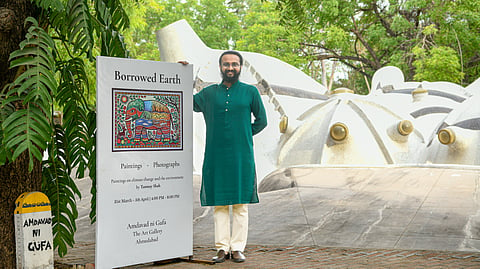
A clock melts beneath an iceberg, a water ATM stands in a parched landscape and a city skyline rises above layers of sleeping animals and marine life. In Borrowed Earth, Tanmay approaches climate change through objects we recognise, allowing the familiar to become a means of apprehending the environmental systems that govern our lives. Selected through UNESCO’s open call as one of six projects from the Asia-Pacific region, the series was presented at an online artist exchange in August of this year. We speak to Tanmay about finding a language for climate change through art, the filmmaking sensibilities that inform his paintings and where he hopes to take the project next.
“More than a decade of making films on social issues taught me to start with the relationship between a subject and the people encountering it. I’ve seen people engage most deeply when they recognise something of their own lives in an issue. With Borrowed Earth, I wanted to bring climate questions into that space of recognition,” Tanmay tells us.
“We encounter a great deal of climate imagery through catastrophe: floods, fires and devastated landscapes. What concerns me is the gap between seeing a consequence and understanding how it developed. An image can leave us alarmed while the connections with our own lives remain unclear. I wanted to begin with everyday experience and move towards those larger relationships,” he says.
The paintings operate through a series of deceptively simple metaphors. In Measure, a thermometer grows through a leafless tree, making rising temperatures legible through the image of a living system under stress. Melt Time places a clock beneath an iceberg, its face dissolving into rivulets of water, while Still Level sets a glass of water on a table in a room overtaken by rising water. The images suggest that ecological disruption often gathers momentum long before its consequences become undeniable.
“A clock, a paper boat, a fish, a turban or a water ATM gives the viewer something familiar to recognise. Colour draws attention from across the room. Up close, a detail changes the meaning: industrial forms appear inside a fish, a straw reaches into groundwater, or a clock becomes part of melting ice,” Tanmay reveals.
His background in filmmaking informs the deliberate choreography of the viewer’s gaze, with colour and familiar objects establishing the first encounter before smaller details alter the reading of the image.
Access turns water scarcity into a question of availability and affordability through a water ATM stranded in a cracked landscape. Aquifer follows a striped pipe through layers of brick towards groundwater, giving extraction an almost corporeal dimension, while Underneath places a modern skyline above animals and marine life, exposing the ecosystems obscured by urban expansion.
“Film gives you duration: you can establish, build, and reveal across shots. In these paintings, I bring that movement into a single frame, deliberately planning the viewer’s path. Documentary practice shapes the thinking beneath the composition. Before I make an image, I ask how the issue enters someone’s work, routine, or choices,” he says.
The series also considers ecological memory and the interdependence of living beings. Seasons Within, inspired by Tanmay’s encounters with elephants in Sri Lanka, places different ecological conditions within the animal’s body, exploring how changing seasons affect the relationship between a creature and its landscape. The work was subsequently featured by UNESCO, extending the project’s reach beyond the exhibition space.
“Borrowing carries a responsibility that ownership can make us forget,” he says of the title. Making the paintings has sharpened his awareness of how everyday conveniences affect other forms of life, from birds drawn towards artificial light to creatures inhabiting polluted water. For Tanmay, personal responsibility must exist alongside institutional, commercial and public accountability.
The exhibition at Amdavad ni Gufa in Ahmedabad drew 1,515 visitors, including more than 200 students, whose responses have helped shape the project’s next phase. Tanmay hopes to take Borrowed Earth to other cities while developing engagements with schools and colleges, using painting to encourage young people to observe their surroundings and investigate the environmental relationships embedded in everyday life.
“I believe art’s possibilities extend beyond self-expression into communication, learning and participation. For children and young people especially, a familiar image can become a starting point for observation and questioning,” he says.
Email: anoushkakundu@newindianexpress.com
For more updates, join/follow our WhatsApp, Telegram and YouTube channels.