
- LIFESTYLE
- FASHION
- FOOD
- ENTERTAINMENT
- EVENTS
- CULTURE
- VIDEOS
- WEB STORIES
- SPORTS
- GADGETS
- CAR & BIKE
- TRAVEL
- SOCIETY
- GALLERIES
- NORTH EAST
- INDULGE CONNECT

For a lot of young people today, the sari remains one of the most beautiful garments in an Indian wardrobe, and one of the most intimidating to actually put on by yourself. Draping is its own skill, refined enough that it has become a profession in its own right, with sought-after sari drapers commanding real fees and building careers around the craft. Most people learning on their own turn to a string of tutorials, or a patient relative. There are pleats to get right, a pallu to arrange and a drape to keep intact once you start moving. For younger people who did not grow up wearing saris every day, learning the technique can be daunting. It isn't surprising, then, that pre-draped and ready-to-wear saris, along with easier alternatives like lehengas and kurtis, have found such a steady market among people who'd rather skip the struggle altogether.
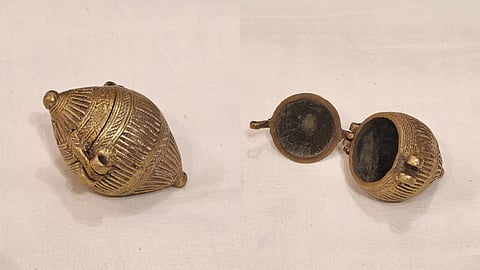
But there was once a tiny object designed to make one particular style of sari draping easier. The karataa is a small metal ball, about two inches in diameter, that was used to secure the first knot of a sari as it was wrapped around the body. In parts of eastern India, particularly rural West Bengal and Odisha, women once wore their saris without a blouse or petticoat underneath, and the karataa was what held the cloth secure at the waist, the loose end wrapped around it like a toffee twisted at its ends, then tucked into the fabric to form the drape's first knot.
What made the karataa remarkable was what it carried inside itself. The ball opened in half and screwed shut, doubling as a tiny, discreet locker for a few coins or puja threads, a way for women to always keep something of their own close at hand.
Today, the karataa survives mostly in memory. With petticoats and blouses now standard, its disappearance feels like the fading of an entirely different relationship with the sari. A relationship where the knowledge of how to wear one lived in the hands of the women who wore it, and where it could be held in place, tucked and tied, without a professional, a petticoat or a YouTube tutorial.
Email: anoushkakundu@newindianexpress.com
For more updates, join/follow our WhatsApp, Telegram and YouTube channels.