
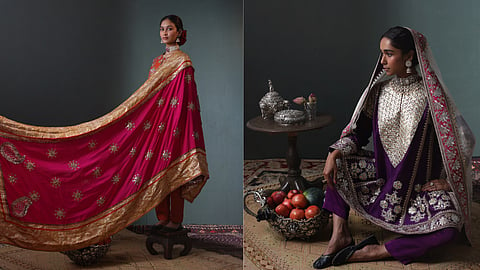
Divya Sheth revives forgotten gota patti craft with sacred motifs and slow, hand-folded detailing

Divya Sheth, a limited garment range, revisits and revives a nearly forgotten gota patti technique, which has been commercialised so much that artisans are now altering their techniques and raw materials to mass-produce pieces. Instead of appliquéing the gota, they now paste them onto the fabric using glue, and the metal wires in the gota have now been replaced by plastic strips. While the craft has flourished and adapted with time, it was heartbreaking for designer Divya Sheth to see the core changing so much. Unlike the more commonly seen surface-applied or pasted gota work, this range brings back an older method where the gota is hand-folded and sewn down using an almost invisible single-thread technique.
Preserving the soul of traditional gota patti
The pieces draw from sacred visual traditions, incorporating motifs such as the Kalash, Ashtamangal, and Tree of Life symbols historically seen in ceremonial torans, which carry meanings of protection, continuity, and abundance.
This direction aligns with Divya’s larger practice, one that focuses on craft preservation and a slower, more intentional approach to design.
She talks to Indulge about revisiting the gota patti technique in her latest collection and why its charm never fades.
What inspired you to revisit this older gota patti technique?
The inspiration was actually very personal for me. My mother belonged to Jaipur, and she owned some incredibly beautiful old gota garments made with real silver and gold gota work, which I eventually inherited. When I later wanted to create something myself in gota, I realised that the quality available today had changed drastically. It filled me with a lot of grief because the sensitivity and craftsmanship of the older process were disappearing. Historically, gota had softness, intricacy and fluidity, whereas today, much of it has become surface-driven and mechanically applied. I wanted to revisit that older way of working and revive the emotional and handcrafted quality the technique once carried.
How does this method differ from the gota work we commonly see today?
Most gota available today comes in pre-cut shapes, usually diamonds or teardrops, and is often glued onto the fabric before being finished with dori work. The result can feel quite rigid and decorative. In this collection, we moved away from that entirely. By reviving the older process, we were able to shape and fold the gota by hand, allowing much more flexibility with motifs and forms. This meant we could create everything from architectural layouts to softer symbolic forms like the anaar, torans, and sacred motifs. The finish also feels far more integrated into the textile, softer and more fluid, rather than something simply stuck onto the surface.
Why was it important for you to approach the collection with restraint?
For me, restraint is deeply connected to beauty and spirituality. I did not want the garments to feel loud or excessive. The idea was to allow the craftsmanship, symbolism, and textiles to coexist quietly. My larger design philosophy is deeply influenced by temple cultures, sacred spaces, and Jain principles of simplicity and inwardness, so the garments naturally carry that sense of stillness and restraint. I feel that when craft is approached gently, it carries much more emotional depth and longevity.
Can you tell us about the hand-folding and single-thread technique?
The process is extremely intricate and slow. Instead of using pre-cut gota pieces, every strip is individually folded and shaped by hand according to the motif being created. These are then attached using an almost invisible single-thread technique, which allows the embroidery to blend seamlessly into the fabric. It requires immense precision because the craftsmanship has to remain delicate while still retaining structure. The beauty of the technique is that it gives the gota movement and softness, making it feel like part of the textile itself.
What kind of fabrics work best with this style of embroidery?
We mostly work with softer natural fabrics that allow the embroidery to settle organically into the textile. Handwoven silks, finer cotton silks, chanderis and softer weaves work beautifully because they support the fluidity of the gota rather than make it feel heavy or stiff. The idea is always for the textile and embroidery to move together harmoniously.
How long does it take to create one piece using this method?
The process is extremely time-intensive because everything is done by hand, from shaping the gota to attaching each element individually. Depending on the scale and complexity of the motifs, one garment can take anywhere from several days to a few weeks to complete.
What drew you to motifs like the Kalash, Ashtamangal, and Tree of Life?
I come from a family that builds temples, so textiles and sacred symbolism have always been deeply present in my life. Growing up, I saw textiles being used in every ritual and offering. These textiles always carried auspicious symbols meant to hold certain energies and meanings. Motifs like the Kalash, Tree of Life, pomegranate, and Ashtamangal represent fertility, abundance, continuity, protection, and spirituality. I wanted to continue that ancient wisdom through the garments and reinterpret these symbols in a way that still feels relevant and emotional today.
Prices start at Rs 28,000. Available online.
—manuvipin@newindianexpress.com
@ManuVipin
For more updates, join/follow our
https://www.whatsapp.com/channel/0029Vb677uz60eBXiDYheb0n