
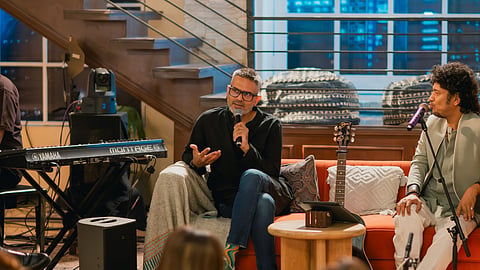
Vaibhav Modi on Teri Adaa and reimagining the modern ghazal

Some creative partnerships begin in studios, while others begin somewhere far less expected. For lyricist, writer and producer Vaibhav Modi, his association with singer Papon began with a chance conversation in an elevator in 2012 and eventually led to songs like Khumaar and Tauba. More than a decade later, the two are back with Teri Adaa, the first release from Sar-e-Shaam, a new ghazal EP that finds playfulness, wit and romance in a genre often associated with heartbreak. The new release also marks another chapter in a creative partnership that has grown over a decade, with two more songs set to follow. Vaibhav chats with us about the making of Teri Adaa, collaborating with Papon, and bringing the ghazal closer to a new generation.
What makes Teri Adaa different from the ghazals we are used to hearing?
Teri Adaa is a ghazal that smiles. Most of us grew up associating the ghazal with heartbreak, longing and lament, and that landscape is beautiful, but it is not the only one the form can hold. With Teri Adaa, Papon and I wanted to capture the mischief between two people instead. The teasing, the little battles of wit, the affectionate acceptance of how unpredictable love and lovers can be.
What keeps this partnership creatively exciting?
Some partnerships are made in studios; ours was made in an elevator. We met in 2012 while recording a song I had written for a friend’s telefilm, and a conversation on the way out turned into exchanged numbers, then jam sessions, and then Khumaar and Tauba for his Coke Studio episode in 2013. What has kept it exciting is very simple. We share a frequency. Papon is not just a collaborator for me; he has been one of my important influences.
How did Teri Adaa come together?
Organically, like everything in this partnership. It began during the lockdown, in the middle of the long jamming sessions Papon and I have kept up for years. Three or four ghazals were born and matured parallel to each other. Teri Adaa was released last month as the first ghazal from Sar-e-Shaam.
Why was accessibility important while retaining the essence of the ghazal?
They may not always know the grammar of the ghazal, the radif and the qaafiya, but they instantly recognise genuine emotion and craft. Our attempt with Sar-e-Shaam is to keep the soul of the form intact, the classical Urdu poetry, and the mehfil setting, while making the emotion immediate enough that you do not need a dictionary to feel it.
What can listeners expect next?
There is a lot of music ahead. Two more ghazals from Sar-e-Shaam are set to release in the months to come, so Teri Adaa is only the opening of the mehfil.