
- LIFESTYLE
- FASHION
- FOOD
- ENTERTAINMENT
- EVENTS
- CULTURE
- VIDEOS
- WEB STORIES
- SPORTS
- GADGETS
- CAR & BIKE
- TRAVEL
- SOCIETY
- GALLERIES
- NORTH EAST
- INDULGE CONNECT

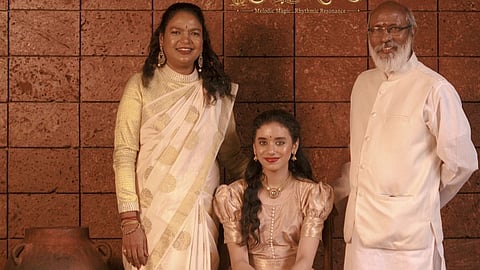
It is not often that one encounters a musical rendition built entirely around chittaswarams. So when mridangam exponent DA Srinivas, veena virtuoso Punya Srinivas, and young keyboardist Navya Umesh came together for Potful of Swaraas, it was obvious that it would have everyone sit up and take notice. The project brings together five iconic Carnatic compositions: Shobhillu Saptaswara, Mahadeva Sutam, Vaanchatonu, Samagana Priyakaram, and Raghuvamsha Sudhaambudhi. We chat with the musicians to know more about the same.
The making of Potful of Swaraas: A tribute to iconic Carnatic chittaswarams
The inception of Potful of Swaraas
How did the idea for Potful of Swaraas come about? “I have been playing the mridangam for more than 35 years,” begins Srinivas. “One thing I have always noticed is how audiences come alive during the chittaswarams in a concert. For those unfamiliar with the term, chittaswarams are passages of swaras within a composition, usually appearing after the anupallavi or charanam. Mridangam players instinctively know when these sections are approaching and understand precisely where to punctuate, where to create silence, and how to heighten the excitement.”
He adds, “I first played these five chittaswarams for Balamuralikrishna sir and gradually fell in love with them. When my wife, Punya, and I launched our band Paanchajanyam in 2005, we composed nine original pieces, one of which was Potful of Swaraas. The response was extraordinary and ever since then we have wanted to create a video around the composition. One day, we simply decided it was time to make it happen.”
The project took an interesting turn when Navya’s mother mentioned that her daughter performed konnakol, the art of vocalising percussion syllables. “It is very rare to see a young girl performing konnakol, and we were deeply impressed by her rendition,” recalls Srinivas. “By the time we eventually began work on the video, more than a year had passed, and we decided to include her keyboard skills as well. Delip Horner, who has worked closely with Punya, created four different arrangements that bridged the chittaswarams with contemporary musical textures, and we selected the version that best suited the composition.”
Discovering a young prodigy
Punya Srinivas explains why Navya was the perfect fit for the project. “This composition has been very special to us for nearly twenty years. We first performed it around the time our band was launched, and it immediately became one of my favourites. We always wanted to keep presenting it, but over the years concert programming increasingly shifted towards commercial and contemporary formats. This composition, with its intricate rhythmic structures and mathematical patterns, is not necessarily the most accessible piece for every audience. As performers, we also adapted, presenting more audience-friendly repertoire, including popular Tamil songs and lighter concert selections. As a result, we set this piece aside, waiting for the right opportunity to bring it back.
She adds, “Recently, I began exploring more collaborations. The first was with Pratik Srivastava, an outstanding sarod player from Mumbai who is doing remarkable work. Following that project, we collaborated with Navya. Navya is an exceptionally talented young artiste and a true prodigy. Beyond her musical abilities, she is remarkably mature, composed and grounded for her age. We were deeply impressed not only by her talent but also by her personality. When I was around her age, opportunities from senior artistes played a significant role in my own journey. Someone has to extend a hand and create a platform for young talent. We felt fortunate to do the same for Navya through this project. Since this composition is so close to our hearts, having her as part of it made the experience even more meaningful.”
Months of rehearsals and learning
Navya reflects on the months of preparation that went into the project. “We've been working on this project for about five to seven months. During that time, I visited Punya ma’am and Dr Srinivas’ home many times for rehearsals—probably ten to fifteen times, though I’ve honestly lost count. The entire project was carefully conceptualised by both of them, and it has been a wonderful experience.”
The project also involved frequent travel from MRC Nagar to Koyambedu. “There was quite a bit of travelling. It was physically tiring at times, but I really enjoyed spending time with them. I learned so much from both of them. Apart from working on the project itself, they taught me many valuable things that went beyond music. It was definitely challenging because it required a lot of time. Travelling there, spending long hours rehearsing and then returning home meant that I had to miss a few days of school. But I managed to catch up with my studies and balance everything somehow.”
On blending different instruments and musical traditions
Punya Srinivas, who has collaborated with artistes such as Ravi Shankar, Zakir Hussain, John McLaughlin, and Ilaiyaraaja, says, “Both Srinivas and I have extensive experience in recording studios, in addition to live performances. I've worked on numerous recordings with various composers, while Srinivas began his career working with legends such as MS Viswanathan and later contributed to many of AR Rahman’s projects. That exposure taught us how to adapt the veena across different genres—whether Hindustani music, folk traditions, or contemporary arrangements.”
She adds, “When performing alongside instruments such as the guitar, sitar, sarod, or violin, I don’t approach the veena strictly from a traditional Carnatic perspective. Instead, I adapt my playing to complement the character and sound of the accompanying instrument. Only then can a collaboration feel natural and cohesive.This experience helped us shape the sound of this project, allowing each instrument to retain its unique identity while blending seamlessly into the overall composition.”
On presenting Carnatic music in new ways
Punya says, “I believe this format offers an exciting way of presenting Carnatic compositions to contemporary audiences. Importantly, we are not compromising the grammar or integrity of the music. Rather, we are enriching it through thoughtful arrangements and broader sonic textures. We are very conscious of preserving the essence of Carnatic music and avoiding unnecessary adulteration. The flexibility comes primarily through the presentation and background arrangements, which can help audiences connect with the music more easily. In that sense, we are offering another avenue through which people can approach, experience, and appreciate Carnatic music.”
On future experiments and collaborations
“Experimentation has always been central to our musical journey. Whether through projects such as Veena to Veena, Sound of Swan, Aridam, or other collaborations, we have consistently sought to explore new ideas while remaining rooted in musical authenticity.
Going forward, I want to continue pushing creative boundaries, collaborating with exceptional musicians, and finding fresh ways to present our music. Ultimately, the goal is simple: to create meaningful music that resonates with people, brings them joy, and is shared wholeheartedly.”
For more updates, join/follow our
https://www.whatsapp.com/channel/0029Vb677uz60eBXiDYheb0n