
- LIFESTYLE
- FASHION
- FOOD
- ENTERTAINMENT
- EVENTS
- CULTURE
- VIDEOS
- WEB STORIES
- SPORTS
- GADGETS
- CAR & BIKE
- TRAVEL
- SOCIETY
- GALLERIES
- NORTH EAST
- INDULGE CONNECT

Misho began with a simple realisation: Suhani Parekh’s sculptures belonged on the body. After studying fine arts and sculpture at Goldsmiths, University of London, Suhani realised that her creations seemed more compelling when worn than when displayed on an art pedestal. That instinct became Misho, which made its debut in 2016 with architectural sterling silver jewellery at Mumbai’s Bungalow 8.
Ten years on, that first idea has travelled considerably and grown into a wider Misho universe spanning high jewellery, with the Jaipur collection, couture and metalwear, alongside the sculptural jewellery that remains at its core. Her pieces have also found their way into the wardrobes of names including Kendall Jenner, Priyanka Chopra Jonas, Deepika Padukone, Dua Lipa and Zendaya — bringing Suhani’s art-meets-adornment vocabulary to an increasingly global audience.
“It's special to reach the 10-year milestone with Misho. My goals for the brand keep evolving as we do, so yes, it's exceeded my expectations from 10 years ago, but I keep setting new visions for the brand. Some of the most special moments were seeing our pieces on celebrities like Beyonce and Zendaya, the success of our Pods and lately guiding Misho into the couture and ready-to-wear spaces and really expanding our design language. As we continue to expand our offerings across jewellery, ready-to-wear and couture, we’ll also be launching fine jewellery soon, which I’m really excited for everyone to see. And there are a few more categories in the pipeline that I can’t reveal just yet,” Suhani teases.
That question took on a new form in 2024, when Misho entered ready-to-wear with Volume One. It was a natural extension of the designer’s approach, translating the architectural language of her jewellery into a capsule of well-structured wardrobe staples. The collection was pared back to black and white, a deliberate choice that placed the emphasis on form, cut, proportion and silhouette — and one that also reflected the founder’s own monochromatic style.
Volume Two, the Spring/Summer ’26 edit, built on that vocabulary rather than simply repeating it. The everyday wardrobe remained at its centre, but the visual language expanded through new references and a more developed relationship between clothing and jewellery. Across both volumes, the ensembles carried the precision of the design house’s jewellery without requiring an occasion to wear them.
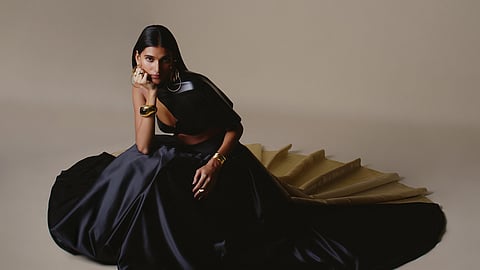
Volume Three marks the point where that conversation changes direction. With the festive season in full swing, Misho now turns its attention to occasion dressing, bringing its ready-to-wear story into a setting where Indian silhouettes draw from the language of classic Greek sculpture.
“What caught my interest was that, although the references come from very different histories, they share a strong relationship with the body. Indian silhouettes have this incredible intelligence in the way fabric is wrapped, pleated and gathered, while classic Greek sculpture captures drapery in a way that feels almost alive despite being carved in stone — the sweep of fabric over a shoulder, folds gathering at the waist, the contour of a torso. When I started sketching Volume Three, I knew I wanted to create looks for occasion dressing and somehow these were the two visual histories that kept staying with me. The collection grew from finding the common ground between them and translating that through our own sculptural vocabulary,” she reveals.
Offering nine looks, the third chapter asks what that same language can do when the occasion calls for something more, with offerings such as the label’s first sari, bandi-inspired tailoring, bodypieces, trousers with ant accents and embellished corsets.
“Globally, when people think of Indian clothing, the conversation often begins with embroidery, embellishment and craft — all of which are, of course, incredibly rich parts of our design heritage. But I sometimes feel that the strength of traditional Indian silhouettes themselves can get overlooked. The bandi was a really interesting starting point for us. It is an age-old, traditionally masculine form with such a strong silhouette. We reinterpreted it as a modern vest shaped specifically around the female body, so the original reference is still visible, but the proportion and attitude feel completely different. Interestingly, the Cut-Out Vest has become one of our most popular pieces since the collection launched. The sari was particularly important, because this is our first one and I was drawn to its architecture — the pleats, the way the fabric travels around the body and the pallu as a gesture. That language appears elsewhere too. A corset, for example, is finished with a pleated shoulder drape referencing the pallu,” the founder shares.
There is a lovely push and pull throughout the new edit as we spot masculine codes meeting feminine ones and tailoring giving way to drape, while structure is softened by movement.
“I’ve always liked the tension that happens when masculine and feminine codes are placed together rather than treated as opposites. It also comes quite naturally from my own personal style — I’ve always loved wearing and styling menswear on myself because I like the edge and contrast it brings. For me, occasion dressing today doesn’t have to sit within one specific idea of femininity. It can be a structured vest with a fluid skirt or a corset paired with something more architectural,” she explains.
One can also witness the tension between the permanence and weight we associate with marble sculpture and the movement of fabric in this collection. And Suhani tells us that this contradiction was one of the most exciting parts of developing the collection.
“In Greek sculpture, fabric is completely static, but the way it is carved gives it this extraordinary sense of movement. With clothing, we were almost trying to do the reverse — create something with a very defined, sculptural form that could still move naturally on the body. A lot of that came through draping and controlling where the fabric gathers and falls. The draped skirts, for instance, reference the folds wrapped around figures in Greek statuary, while still feeling fluid when worn. For the bodypieces, we worked with a specialised polymer to make those sculptural gestures more perma - nent. The Asymmetric Shoulder Drape captures the sweep of fabric over the shoulder, while the Torso Belt is a more literal translation of sculpture, tracing the contours of the waist and navel,” the designer tells us.
The jewellery, too, takes the conversation somewhere new. This time, the label’s sculptural gold-plated brooches that adorn the bodypieces are inspired by palace architecture, wildlife and scenes observed on safari in Rajasthan. Think a monkey guiding its newborn, a flock of birds, local flora, large geckos and wild rabbits just hopping about. The bijouterie ranges from sculptural torque necklaces to statement onyx earrings and, in some cases, the jewellery even becomes functional — the Panther Brooch, for example, secures the pleated shoulder drape on a corset. They bring another layer to the clothes, turning embellishment into storytelling while keeping Misho’s fascination with the natural and built worlds intact.
“The brooches came quite directly from my travels through Rajasthan, particularly from scenes I observed on safari. There is something incredibly cinematic about seeing animals moving through the landscape, especially against the scale and detail of Rajasthan’s palace architecture. A peacock is sitting within an ornate archway, a panther chasing a deer, a leopard at rest and elephants moving through the landscape. Then we let that world become a little more playful and surreal. One brooch has an elephant carrying a tree on its back with monkeys sitting amongst the branches. It obviously isn’t something you literally encounter on safari, but it grew from the same visual world. I liked the idea that the brooches could sit somewhere between observation and imagination. From a distance, you see the composition of gold across the bodice; up close, you begin to discover that each brooch has its own little scene or character, so together they create another layer of storytelling,” the designer signs off.
₹3,003 onwards. Available online
For more updates, join/follow our WhatsApp, Telegram and YouTube channels.