
- LIFESTYLE
- FASHION
- FOOD
- ENTERTAINMENT
- EVENTS
- CULTURE
- VIDEOS
- WEB STORIES
- SPORTS
- GADGETS
- CAR & BIKE
- TRAVEL
- SOCIETY
- GALLERIES
- NORTH EAST
- INDULGE CONNECT

Smoke was never meant to be a flavour. For most of history it was a side effect of keeping food. Hanging meat or fish near a fire dried it out, kept insects away and slowed the spoiling. The taste simply came along with the job. Somewhere along the way, people started to want it for its own sake.
Follow it around the world and every kitchen turns out to have its own fuel, and its own reasons.
In the hill kitchens of Nagaland in northeast India, meat is still often hung on racks above the hearth, where it dries slowly in the smoke from daily cooking. Smoked pork cooked with fermented bamboo shoot is one of the region's defining dishes. The smoke is not added as an extra step. It comes from living around a fire.
Japan took the idea somewhere far more precise. To make katsuobushi, fillets of skipjack tuna are simmered, then smoked over hardwood again and again for weeks until they are dry and almost as hard as timber. Shaved into fine flakes, they form the base of dashi, the stock behind a great deal of Japanese cooking. Most people taste the smoke without ever noticing it.
In the Wuyi mountains of Fujian, smoke ends up in a cup. Lapsang souchong tea leaves are dried over pinewood fires, which gives the tea its unmistakable campfire aroma. It is a useful reminder that smoke does not need meat or fish to cling to.
Spain applies it to a spice. In La Vera, in Extremadura, red peppers are dried slowly over smouldering oak in smokehouses for around two weeks before being ground into pimentón. The paprika is protected by name, and it gives chorizo and many Spanish stews their colour and their depth.
Mexico's chipotle is the same logic applied to a single chilli. It is simply a ripe jalapeño, smoke-dried until wrinkled and leathery. The name comes from Nahuatl and roughly means smoked chilli. Thick-fleshed chillies do not dry easily in the sun, so the fire did the work instead.
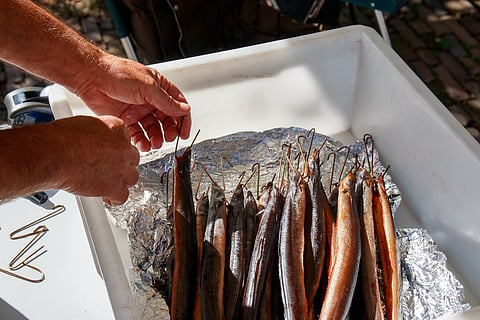
On Scotland's east coast, the Arbroath smokie keeps things wonderfully plain. Haddock is salted, tied in pairs by the tail and hot-smoked over hardwood in pits made from cut-down barrels. The name is protected, and a true smokie has to be made within a few miles of the town.
Iceland offers perhaps the most revealing example. Hangikjöt, the smoked lamb eaten at Christmas, was traditionally smoked over dried sheep dung, because the island had very few trees to spare. Birch is often used too. It is difficult to think of a better example of a cuisine making do with what the landscape offered.
And in central Texas, brisket is smoked for many hours over post oak, the local hardwood, until the outside darkens into a crust and the inside barely holds together. Here, smoke stopped being about preservation a long time ago. It is the point of the meal.
The most useful question to ask of any smoked dish is what was burned. Oak, pine, birch, beech or dung all leave a different mark, and each says something about what grew nearby and what people had to work with.
Smoke is one of the oldest flavours in cooking, and one of the least intentional. It just took a while for people to decide they liked it.
For more updates, join/follow our WhatsApp, Telegram and YouTube channels.