
- LIFESTYLE
- FASHION
- FOOD
- ENTERTAINMENT
- EVENTS
- CULTURE
- VIDEOS
- WEB STORIES
- SPORTS
- GADGETS
- CAR & BIKE
- TRAVEL
- SOCIETY
- GALLERIES
- NORTH EAST
- INDULGE CONNECT

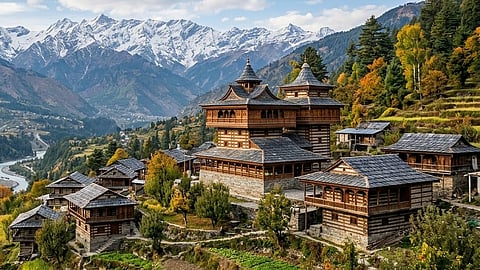
The houses in Himachal Pradesh’s mountain villages can be up to a millennium old. Without the use of cement, mortar, or any metal nails, the houses have successfully managed to survive in the face of earthquakes, heavy snow, and harsh climatic conditions. These Kath-Kuni homes are one of the most impressive architectural marvels of India.
The construction method is is widely used in the hill areas of Himachal Pradesh. The name Kath-Kuni comes from the Sanskrit words kashth (wood) and kona (corner), which refers to the wooden logs placed at the corner junctions of the stonewalls.
Only local materials are used for building Kath-Kuni homes. These include deodar wood, stone, and slate. Unlike other buildings where vertical columns are used as the foundation, in this construction process, a frame is built using horizontal timber beams along with cross-beamed woods. Stone masonry layers are alternated by wooden beams.
The stability of the walls depends on the weight of the stones and wooden peg joints, aka kadil joints. The house stands on an elevated stone base that keeps it above the ground level to protect it from dampness and melting of snow. The roofs made of slates provide waterproofing to the building.
One of the most important factors contributing to the high popularity of Kath-Kuni homes is its earthquake-resistant design. The Himalayan region is quite seismically active and has been hit by many earthquakes in the past, such as the Kangra earthquake of 1905, Uttarkashi earthquake of 1991, and Sikkim earthquake of 2011.
However, during the disastrous Kangra earthquake, a lot of buildings collapsed. However, some of the Kath-Kuni homes in Kullu Valley were still standing after the earthquake. The timber joints such as the kadil dowel joint and maanwi dovetail joint permit each layer to shift a little during an earthquake. Rather than oppose the shifting, the structure absorbs the energy. Wood and stone, when combined, create a flexible structure, whereas friction between the layers improves ductility of the construction.
These traditional Kath-Kuni homes are designed keeping the climatic conditions in mind. The bottom-most floor of these houses is generally used for housing cattle, which in turn generates warmth that rises and warms up the upper floors. This is followed by the storage floor or the granary floor where provisions are stored. The living area is constructed on the upper floors and tends to jut outwards in order to get maximum sunshine.
It results into a passive climate control system whereby the houses keep warm during winter and remain ventilated in summers. Neither any mechanical warming nor cooling is needed; hence, the design becomes very energy efficient and environment-friendly.
The concept of Kath-Kuni homes has been transmitted by generations. The skilled constructor who builds these architectures is called Tavu. They are well aware of their surrounding natural resources, geography, climatic condition, and construction methods.
Nevertheless, the population of experienced Tavus has reduced since the use of concrete structures became common in modern buildings. This type of knowledge is mainly transferred through oral apprenticeship and therefore can be lost easily.
For more updates, join/follow our WhatsApp, Telegram and YouTube channels.