
- LIFESTYLE
- FASHION
- FOOD
- ENTERTAINMENT
- EVENTS
- CULTURE
- VIDEOS
- WEB STORIES
- SPORTS
- GADGETS
- CAR & BIKE
- TRAVEL
- SOCIETY
- GALLERIES
- NORTH EAST
- INDULGE CONNECT
At sunrise, Dongri shakes off the shadows of its underworld stereotype. The air is thick with the scent of nihari and marigolds, and the streets hum with stories hidden in crumbling facades and pastel balconies. Indulge Express joined a grassroots photowalk to explore how residents are preserving—and proudly retelling—the layered history of their neighbourhood.
From Dons to Dreams
Karim Lala. Haji Mastan. Dawood Ibrahim. For decades, these names have defined the identity of Dongri, etched in our minds through films like Shootout at Wadala and Raees starring Shah Rukh Khan, and books like S. Hussain Zaidi’s Dongri to Dubai. But there’s a new lens through which this neighbourhood deserves to be seen.
Today, comedians like Munawar Faruqui and Sumaira Shaikh, rapper Jazzy Nanu, and other young voices are redefining Dongri’s image. When Indulge Express joined a photowalk with Dr. Sadiq Uttanwalla, a doctor, resident of Dongri and historian, and Shantanu Dey, walk leader and curator of special heritage walks with PhotoWalks Mumbai, it became clear how these lanes tell a story beyond the stereotypes.

A Morning of Lanes, Scents, and Stories
The walk began in the Charnul area, also featured in Shahid Kapoor’s film Deva. It was early morning—workers, hunched over carts, loaded goods into tempos as steam rose from roadside chai. The streets smelled of freshly fried kachori, jalebi, and halwa, while a giant pot of mutton nihari simmered steadily for the evening feast.
A vegetable seller arranged tomatoes neatly in front of him; a flower vendor’s basket overflowed with marigolds, their fragrance mixing with the sharpness of fresh coriander nearby. In a quiet lane, a man carefully displayed old coins and vintage currency notes on a small box, like relics of time waiting to be discovered through a camera lens.
Above the bustling streets, Art Deco balconies, weathered colonial facades, and hand-painted tiles gleamed in the slanting morning light. These are buildings that have stood for over a hundred years, witnesses to the city’s colonial past. Yet, the looming shadow of redevelopment threatens to erase their texture and soul.
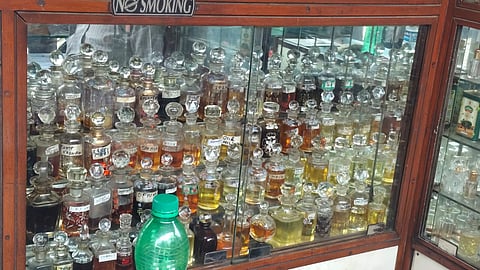
The neighbourhood also boasts century-old perfume and attar shops, their shelves lined with crystal bottles filled with oils sourced from Arabian countries—Dubai, Abu Dhabi, Oman. The warm, lingering aroma of attar feels like the very heartbeat of this area.
Faith, History, and the Next Chapter
In just a few lanes, faith coexists beautifully: a Shia mosque, a Jain temple, and a church stand side by side. The Moghal Masjid (Masjid-e-Iranian), built in 1860 by Iranian merchant Haji Mohammed Husain Shirazi, dazzles with its Persian Qajar tiles and stained glass. At the Khoja Jamaat complex, the Makrana-stone Baab-e-Shohada-e-Karbala Gate stands as India’s first memorial arch for Karbala’s martyrs, a striking frame against the morning sky.
History runs deeper at the old Umerkhadi (Dongri) Jail, built in 1804. Its walls once held freedom fighters like Tilak and Savarkar. Today, part of it serves as a juvenile detention center, a place of second chances, while nearby stands Asha Sadan, where children abandoned by their families now find new beginnings. It’s surreal to think that this building once witnessed executions. A place where lives ended now cradles life—a profound dichotomy that sums up Dongri’s journey from fear to hope.
As Dr. Uttanwalla reflected near the end of the walk, “I’ve seen Dongri change before my eyes. The Khoja community, traders from Kutch, Gujarat, once built these lanes with pride. We celebrated Navratri, Diwali, and Muharram side by side. With time, many Gujaratis and Jains moved to Borivali and Kandivali, and the cultural fabric here has thinned. What worries me most is how redevelopment threatens not just old buildings but the stories and bonds they hold. Yet I have hope—the next generation will bring back that lost glory.”
This photowalk reminded us that Dongri’s legacy is not just about its infamous dons—it’s about layers of history, textures of faith, scents of tradition, and voices of resilience. This is the Dongri you need to see—before its soul fades behind glass towers.
(By Arundhuti Banerjee)
For more updates, join/follow our WhatsApp, Telegram and YouTube channels.