
How artist Jagmohan Bangani reimagines the Agnihotra Mantra as a contemporary visual hymn

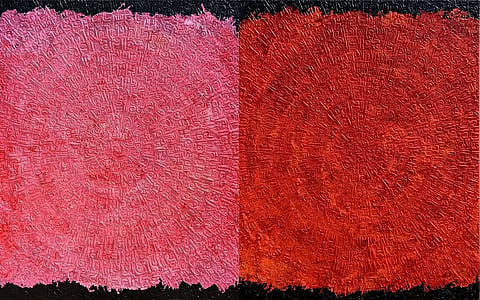
A standout voice at the ongoing Study UK Creative Connections exhibition, Jagmohan Bangani brings a deeply spiritual and contemporary edge to the showcase. Trained at the Winchester School of Art, his featured work, The Hymn (2022), blends the sacred Agnihotra Mantra with radiant tones, symbolising transformation, energy, and inner balance. With six solo shows and over 60 group exhibitions globally, Jagmohan is a force in Indian contemporary art. Through his Bangani Art Foundation, he mentors young talent from the Himalayas, furthering his commitment to cultural storytelling. His vision powerfully bridges Indian heritage and modern global aesthetics.
Excerpts from our conversation with the artist.
Can a painting chant? Artist Jagmohan Bangani thinks so...
The Hymn weaves the Agnihotra Mantra into a visual rhythm—what inspired you to bring this sacred chant into a contemporary diptych format?
Agnihotra is a Vedic fire ritual performed daily at sunrise and sunset. This sacred practice is especially aimed at purifying the environment, attaining mental peace, and promoting spiritual growth. In Agnihotra, offerings are made into the fire while chanting specific mantras. A few years ago, a close friend of mine living in Sydney commissioned an artwork based on the Agnihotra mantra. That was the first time I truly engaged with this ancient Vedic practice. What struck me most was that, even in a modern, urban setting halfway across the world, people were still performing this sacred ritual daily. It made me reflect on how deeply some individuals seek simplicity, grounding, and spiritual rhythm amidst the overwhelming noise of the digital age. This inspired me to bring the Agnihotra mantra into a contemporary diptych format, where each panel reflects the dual rhythms of the day—sunrise and sunset.
How do you see colour functioning as a spiritual language in this piece?
In this work, colour becomes a spiritual language that reflects the cyclical energy of the Agnihotra ritual. The diptych format mirrors the dual moments of the ritual—sunrise and sunset—with each panel carrying a distinct spiritual vibration through its colour palette. The left panel, created with radiant pink tones, conveys the gentle awakening of dawn. The circular composition, inscribed repeatedly with the Agnihotra mantra in Devanagari script, mimics the rising sun and radiates a sense of purity, new beginnings, and sacred calm. The right panel, infused with deep red tones, captures the warmth and intensity of dusk. Here too, the mantra spirals outward like the setting sun, expressing transformation, surrender, and closure. Across both panels, the circular arrangement of text and symbols not only mirrors the sun’s daily journey but also embodies the mantra’s vibrational rhythm. In Vedic thought, black can represent the unmanifest— the moment before light appears at dawn and the depth into which light recedes at dusk. In this way, black, in my work, connects to the meditative stillness and spiritual introspection at the heart of the ritual. Together, the colours and forms form a visual mantra, where repetition, rhythm, and symbolism turn the canvas into a sacred space.
How important is symmetry and rhythm in your visual storytelling?
Symmetry and rhythm have always been central to my visual art practice. These elements reflect not only aesthetic choices but also my personal nature. I am someone who values structure, discipline, cleanliness, and harmony in daily life. I like things to be in their place; time to be respected; and surroundings to feel calm and balanced. I believe this way of living naturally shapes the way I compose my artworks. The use of symmetry, repetition, and carefully arranged forms in my work creates a sense of visual order and meditative rhythm. Whether through circular text, layered geometry, or balanced compositions, I aim to evoke a space where viewers can slow down and connect inwardly.
In The Hymn, there’s a clear dialogue between the material and the divine. How do you personally experience or navigate that duality in your own creative process?
In The Hymn, the dialogue between the material and the divine is not just conceptual— it’s an intimate part of my creative process. I often begin with the material: the weight of the canvas, the thickness of the paint, the repetitive movement of the brush or tool as I inscribe text. This tactile engagement grounds me—it’s meditative, even ritualistic. But as the process deepens, something shifts. The repeated gestures, the layered mantra, and the circular form begin to transcend their material origins. The act of making becomes a form of prayer or offering. I no longer feel like I’m constructing an image—I feel like I’m channeling something, listening to a rhythm that’s larger than me. This duality—between the seen and the unseen, the earthly and the sacred—is not a conflict but a bridge.
How did your time studying in the UK influence your creative perspective, particularly in balancing traditional Indian themes with contemporary techniques?
Before going to the UK, my art practice was rooted in figurative work—focusing on village life and the emotional struggles of everyday human existence. However, it was during my time in the UK that my perspective began to shift. I was introduced to conceptual and text-based practices, and I began to see text itself as a powerful visual language. This opened up a new dimension in my work, allowing me to combine my strong freehand writing skills with a deeper exploration of Indian identity and spirituality. As my practice evolved, I felt a strong urge to reconnect with my cultural roots. I began to incorporate sacred and philosophical Indian texts—drawing from Vedic chants, Sanskrit language, and themes of devotion, meditation, and positive thinking. Through research, I found very few artists working with these elements in a text-based format, which motivated me to develop a unique visual language that blends the spiritual richness of Indian tradition with the experimental openness I experienced in the UK. The UK education gave me the tools and confidence to explore abstraction, layering, silence, and rhythm as formal elements—balancing traditional content with contemporary form.
Being featured in this British Council exhibition alongside other accomplished UK alumni, how do you see your work—especially The Hymn—contributing to the global conversation on identity, culture, and spiritual art?
Being featured in this British Council Study UK Creative Connections II exhibition among other accomplished UK alumni is both an honor and a moment of reflection. The Hymn contributes to the global conversation on identity, culture, and spiritual art by drawing deeply from ancient Indian traditions and reinterpreting them through a contemporary visual language. In a world that often leans toward fragmentation and distraction, this work reclaims the spiritual as a universal thread. The layered script, meditative geometry, and tonal rhythms act as a bridge between inner consciousness and outer cultural narratives. It speaks not only to my own identity as an artist rooted in Himalayan and Indian traditions, but also to a global longing for connection, ritual, and meaning. Through this artwork, I wish to invite people—especially those navigating the speed and stress of urban life—to reconnect with stillness, reflection, and a deeper spiritual rhythm. By presenting The Hymn in an international space, I aim to expand the dialogue around spiritual art—not as something bound by religion, but as a shared human need to pause, listen, and transcend.
Growing up in Uttarakhand—a region steeped in natural and spiritual heritage— how has the landscape and cultural atmosphere of the Himalayas shaped your visual philosophy?
Although I live in Delhi now, my soul has always remained in my village. I spent nearly 20 years growing up in the hills of Uttarakhand, and I still return to it frequently—it’s where I feel most grounded. The landscape, the silence, the rhythm of village life—all of it continues to live within me and shape how I see and create. Nature has been my greatest teacher. It taught me patience, observation, and a sense of balance—qualities that deeply influence my art. The spiritual atmosphere of my village, where deities like Chaar Mahasu are part of everyday life, was not something I studied; it was something I experienced as part of my being. This closeness to ritual, devotion, and simplicity became the unseen structure of my visual philosophy.
Through the Bangani Art Foundation, you’re mentoring emerging artists from the Himalayan belt. What are the most important values or skills you hope to pass on to the next generation?
Mentoring emerging artists is one of the most meaningful parts of my journey as an artist. Being born in the mountains and raised in the spiritual and cultural atmosphere of Uttarakhand, I understand both the richness of our region and the challenges faced by young artists here—limited exposure, lack of infrastructure, and few platforms for professional growth. The Bangani Art Foundation was created as a response to that gap—to support, guide, and uplift artists who carry deep potential but often lack opportunities. The most important value I try to pass on is authenticity—the courage to remain rooted in one’s cultural identity and lived experiences. In a time when trends often overpower substance, I encourage young artists to draw strength from where they come from—to reflect their surroundings, their people, and their inner worlds honestly.
Art does not grow in isolation. At the foundation, we foster a space where artists not only develop their own voice but also learn from one another. We engage in dialogues, collective workshops, critiques, and group exhibitions. I want them to understand that community matters—that sharing ideas, lifting others, and growing together is not only generous but essential. Through the Bangani Art Foundation, I don’t just want to build artists—I want to nurture sensitive, thoughtful, and conscious individuals who carry their practice with integrity, depth, and vision.