
- LIFESTYLE
- FASHION
- FOOD
- ENTERTAINMENT
- EVENTS
- CULTURE
- VIDEOS
- WEB STORIES
- SPORTS
- GADGETS
- CAR & BIKE
- TRAVEL
- SOCIETY
- GALLERIES
- NORTH EAST
- INDULGE CONNECT

Today, the ancient and the contemporary works walk hand in hand in Chennai—the kolam designs share space with immersive projections, and temple imagery engages in conversation with international contemporary practices. However, it was not an overnight transformation but rather a steady one—a movement that began with conviction and has since widened to embrace global influences, younger collectors, and new forms of practice. Speaking to a mix of curators and gallery representatives in Chennai reveals how much has changed and how much remains tied to deep cultural roots.
The foundations of Chennai’s modern art story can be traced to the intellectual ferment around the Government College of Arts and Crafts, led by KCS Paniker. Out of that milieu emerged the Madras Movement, which sought to give modern Indian art a distinctly southern identity, balancing Tamil culture, folk motifs, and philosophical ideas with the abstract languages of European modernism. “When we first became involved in the art world in the 1950s and ’60s, Madras had a very different landscape. There were no galleries in the commercial sense and, in fact, no real art market in the country,” recalls Anahita Daruwala Banerjee, the third-generation gallerist and owner of Artworld and Sarala’s Art International, one of the oldest modern art galleries in India. “Artists often struggled to find spaces to show their work. Madras, however, was intellectually alive. Out of this spirit arose what we now call the Madras Movement—a synthesis of indigenous tradition, Tamil culture, and abstraction that gave a unique identity to modern art from the South.” At that time, selling a canvas was rare, but the belief in shaping a new Indian modernism sustained the scene.
By the early 2000s, however, things looked very different. Chennai had a small but committed set of galleries, and among them was Ashvita’s, founded by Ashvin E Rajagopalan in 2002. “At that time, the art market was at the beginning of a very large bubble,” he says. “We had regular shows, people would come in and decide what to buy. It was a purely physical experience at the gallery, and one would have exhibition after exhibition and try to sell art, promote the artist, make their name, and that’s how we started.” Since then, he observes, disruptions—whether the 2008 financial crisis or COVID—have repeatedly forced galleries to rethink their models, moving more into online sales and digital advisories.
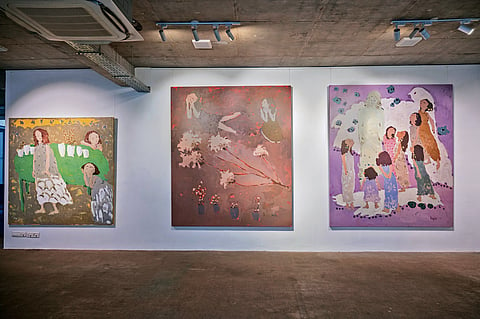
Over the last two decades one thing that has been constant is that the galleries, on one hand, have been celebrating senior and late-career artists with well-researched retrospectives, as well as showing a lot of emerging talent with contemporary visual languages. Artistic practices too have incorporated new mediums, and artworks are highly conceptual.
Varuna Arvind, who runs her eponymous contemporary gallery, shares how she has found the creative platforms changing over the years. “Artists are using more varied media. It’s not only “oil or water colour or sculpture”. Themes are broader too—identity, gender, environment, politics, urban issues, and climate change. We see shows that go beyond “pretty painting” to that are more socially relevant.”
The advent of digital platforms, has further changed the rules of the game. Instagram, WhatsApp, and catalogues, have become as important as the physical white cube.
As art curator and artist Jitha Karthikeyan puts it, “It cannot be denied that digital platforms and social media have hugely impacted the reach of art. An artist can now easily find a global audience, without any geographical limitations. However, experiencing art can happen only when one actually stands in front of an artwork. No online viewing can ever provide that experience.” The paradox of the digital turn is that it has made art more visible than ever, yet it hasn’t replaced the need for physical presence. Instead, the two now coexist: audiences discover art online before stepping into a show, and collectors negotiate sales as much on WhatsApp as across a gallery table.
For Anahata Sundarmurthy, founder of the new-age studio Art Kin Centre, this shift has also democratised access. “Social media and digital platforms have been instrumental in breaking glass ceilings, knocking down walls, and crashing gates when it comes to the art world, be it visual, performing, or crafts. It flattened the playing field to the majority degree,” she notes. This, she argues, has created new tiers of celebrity—creators and influencers—who can sustain careers entirely through online visibility and sales. It has also expanded what counts as art, with people now commissioning custom works from younger artists, or engaging with functional art and curated experiences that bring creative practice into daily life.
The audience itself has undergone a demographic change. As Jitha observes, “Earlier, one would find older collectors and the art literate at a gallery show. Today, with rising incomes, younger collectors have started investing in art. Households now want an original artwork on their walls. And thanks to many public art exhibitions like the Chennai Photo Biennale and the Kochi Biennale, the general public has also started visiting art shows.”
For Anahata, this reflects broader social changes. “Visual arts in Chennai are picking up, with more general public being exposed to different art forms becoming the norm. I will say this has a direct correlation to the increase in quality of living and current ratio of expendable money that people are earning per capita.”
But globalisation has also brought both opportunities and challenges. With the world opening up, thanks to the internet, opportunities for cross-cultural exchanges, art residencies, and art collaborations have increased significantly. This has allowed Chennai’s artists to blend foreign techniques with local sensibilities, creating hybrid visual languages.
Anahita shares: “Digital art, video, online shows, cross-cultural collaborations—all of this is part of the scene now. But what’s really special about South India is that the art here has always gone back to its own roots. Whether it’s temple traditions, folk arts, philosophy, or even just the visual rhythm of this landscape, artists here know how to take that depth and modernise it. They don’t just copy the West—they translate their heritage into something universal.” The balance between rootedness and relevance, between kolam patterns and conceptual installations, defines Chennai’s particular idiom.
That balance has also shifted over time. Ashvin argues that the regional schools of the 20th century—the Madras, Bengal, or Baroda movements—have given way to a more homogenised global art culture. “Today, the artists are global because access to information and images is pretty much global. Thanks to Instagram, that whole idea has kind of become homogenised. So everybody has access to every kind of imagery. Most artists are trying to reflect on the personal, on their own ego, their own thoughts, their own politics, and their own life.”
At the same time, institutional gaps persist. Jitha points out that “The art scene in Chennai is evolving at a slower pace than cities like Delhi and Mumbai. Exhibition spaces are limited. It would be wonderful if there are world class museums that showcase not just our history but also contemporary practices as well as international art.”
The need for stronger infrastructure is what most gallerists agree upon. This means more museums, state support, collectors’ circles, and platforms where experimentation can thrive without the pressure of immediate sales. Ashvin adds that the shortage of physical display spaces is a bottleneck; “Let’s say an average city has five galleries, each gallery can only do about eight exhibitions a year, and there are only so many walls. That’s very few in number compared to the number of artists who exist.” For a city with such a rich artistic lineage, the lack of large-scale institutions remains a glaring absence.
Even so, optimism abounds about the road ahead. Varuna observes that today, there is more public engagement and more versatility in the kinds of work being shown. Smaller galleries are holding their own, younger artists are breaking through, and buyers in the mid-price range are increasingly driving the market.
The future, then, may lie in making Chennai a more vibrant hub not just for art production but also for art consumption and critical discourse. Anahita shares a similar vision: “Looking ahead, I see the art scene becoming more dynamic, more international, and more connected. Chennai has always had strong roots in its own traditions, but in the coming years we’ll see even more cross-cultural collaborations, global residencies, and new media practices.” For Ashvin, the goal is to nurture collectors and build demand, because “when there is demand for art, the market grows. And that’s the best way to go about it.”