
- LIFESTYLE
- FASHION
- FOOD
- ENTERTAINMENT
- EVENTS
- CULTURE
- VIDEOS
- WEB STORIES
- SPORTS
- GADGETS
- CAR & BIKE
- TRAVEL
- SOCIETY
- GALLERIES
- NORTH EAST
- INDULGE CONNECT
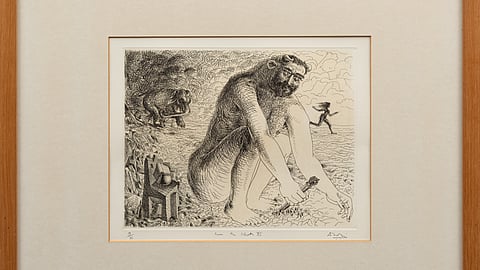
In the quiet of Akara’s Colaba gallery, forms rise and rest like fragments of an ancient dream. Bronze figures lean towards each other in measured stillness, their surfaces breathing with the memory of touch. Drawings and etchings trace gestures that feel both archaic and immediate. This is Nature Spirits, a gathering of Dhruva Mistry’s works made between 1983 and 1993, a period that shaped the trajectory of his career and established his place as one of India’s most original sculptors.
The exhibition, which runs until 4 November 2025, brings together sculptures, reliefs, and works on paper that mark Mistry’s early explorations into hybridity, divinity and form. The title evokes mythic beings that linger between the human and the elemental: nymphs, yakshis, fauns, guardians. They populate his sculptures with an air of guardianship and quiet power, suggesting the pulse of life that flows through stone and metal alike.
Born in Kanjari, Gujarat, in 1957, Mistry trained at the Faculty of Fine Arts, MS University of Baroda, before moving to London on a British Council Scholarship. His grounding in Indian sculptural tradition had given him a rigorous sense of structure and proportion. In Britain, long days at the British Museum opened new chapters of visual history. Encounters with Assyrian reliefs, Egyptian statuary and post-Renaissance European form expanded his understanding of the figure. Modernists such as Henry Moore, Constantin Brancusi and Picasso became part of his artistic conversation. The synthesis of these influences would become the foundation of his practice.

“My interest in Indian, Egyptian, Sumerian, Cycladic, Greek, Chinese, Mayan and other cultures arises from their exploration of figure as a form and evolution of life,” Mistry says. “As an artist of the sub-continent, I find unity in the diversity of ideas, practices and forms of life.”
The early years in London were marked by quiet study rather than production. When work did emerge, it came with a force of clarity. Pieces like Tree Spirit I (1988–90) and Moving Mountain I (1988–90) reveal a fascination with mythic hybridity and the interplay of mass and void. The Reguarding Guardians series, represented here by several works, stands at the centre of this inquiry. These figures, part-human and part-animal, seem at once protective and questioning, as if embodying the act of creation itself.
Akara’s curatorial approach allows this progression to unfold with care. “While nearly all of the works were created over a course of ten years during his time in the UK, there is also a small selection of newer works,” the gallery notes. “It marks his evolution over half a century and shows how developed his forms were even during his early years.” The final section of the exhibition presents more recent sculptures such as Hanuman (2025) and Seated-1 (2025), minimal steel constructions where geometry replaces flesh but the breath of being remains.
For Mistry, touch is the beginning of thought. “A sense of touch affects ideas of monumentality of forms in space,” he says. “Small scale variations remain handy for me to ascertain formal and structural aspects in the works being made larger than life.” His sensitivity to scale links his intimate studies to monumental commissions such as River in Birmingham’s Victoria Square, affectionately called The Floozie in the Jacuzzi. Whether cast in bronze or assembled from laser-cut steel, his sculptures carry a quiet sense of order that resists spectacle.
The works in Nature Spirits are not narrative in the traditional sense. They suggest story through proportion and rhythm rather than through illustration. “I aim for bare forms that pulsate their sculptural content,” Mistry explains. This restraint draws the viewer closer. Each curve and surface holds a stillness that feels alive, a meditation on how form itself can hold spirit.
The gallery space heightens this intimacy. Akara’s soft light and measured pace allow the viewer to experience the sculptures as living presences rather than historical artefacts. “Those who have seen Dhruva’s works before will connect with his newer pieces while also getting a glimpse into his early creations,” says the curatorial note. “Each work takes you on a journey through the array of influences he imbibes and employs within his vocabulary.”
Across four decades, Mistry has refined a sculptural language that is both rigorous and sensuous. His materials have changed, but his questions remain constant. What does it mean to give matter a pulse? How can form speak without words? “My work seeks air like primal breath in a newborn to face the world like ‘prana’ or visible semblance of being alive,” he reflects. That breath seems to move through Nature Spirits, connecting past to present, myth to modernity, and sculpture to something more essential — the will to be alive in form.
Exhibition: Nature Spirits by Dhruva Mistry
Dates: 9 October – 4 November 2025
(Story by Esha Aphale)
For more updates, join/follow our WhatsApp, Telegram and YouTubeolin channels.